How to Choose the Right Raw Material Storage and Handling System for Block Plants: A Guide for China Manufacturer Solutions
Most investors assume that bigger silos and more batching compartments automatically mean better production — yet oversized storage is one of the fastest ways to burn capital and spoil raw materials before they ever reach the mixer.
A well-designed raw material storage and handling system is the backbone of any block production plant — it directly impacts output consistency, labor costs, and long-term profitability. Choosing a reliable China manufacturer with proven export experience ensures you get a system tailored to your local conditions, budget, and scale.
In our years of supplying complete block production lines to clients across Africa, the Middle East, and South Asia, we have seen the same pattern repeat: plants that invest in properly sized and logically arranged raw material systems reach break-even 30–40% faster than those that chase maximum capacity on day one. Raw material system sizing errors account for up to 25% of total project cost overruns in small-to-medium block plants[^1]. Getting the storage, conveying, and batching stages right from the start is not an engineering luxury — it is a financial decision.
Let us walk through the calculation logic, component selection, cost structure, and layout pitfalls so you can build — or upgrade — a plant that pays for itself on schedule.
What Is a Raw Material Storage and Handling System and Why Does It Matter for Block Plants?
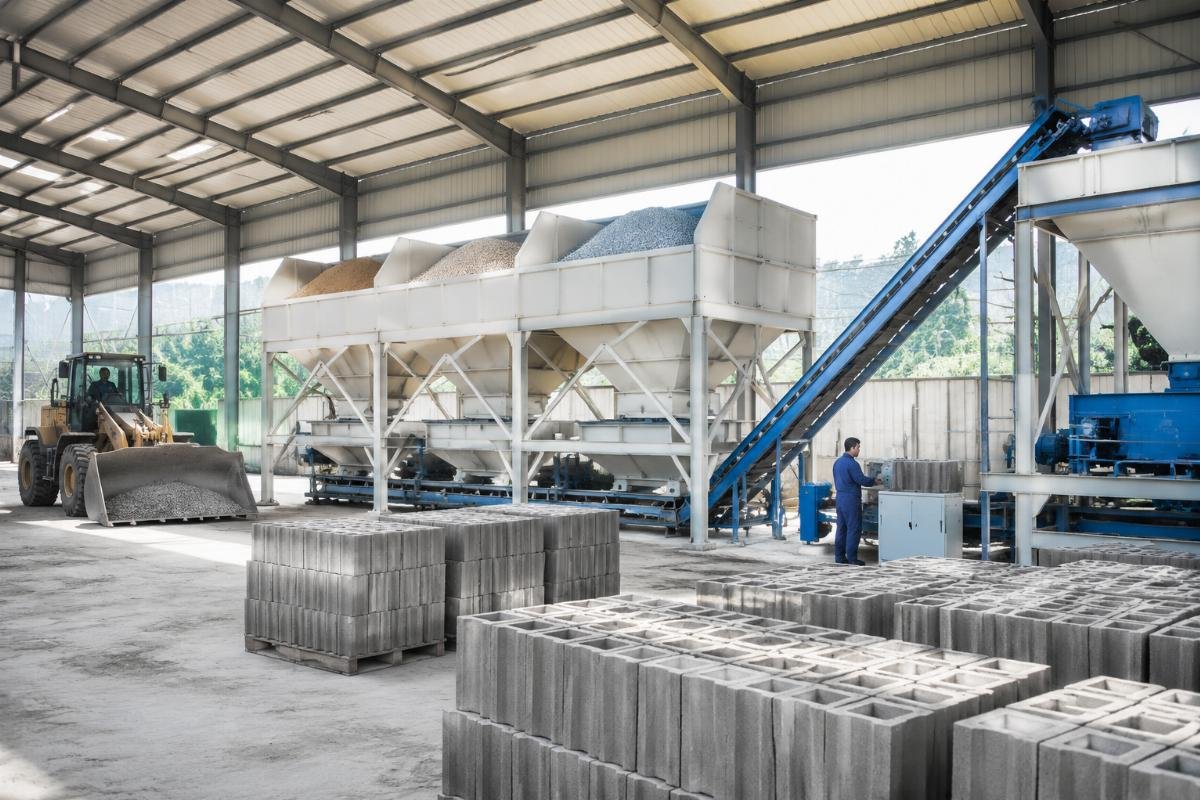
The raw material storage and handling system covers every piece of equipment that feeds cement, aggregate, sand, and additives into the mixer — and it sets the ceiling for your plant’s daily output, product density, and operating cost.
| System Element | Common Misconception or Mistake | Recommended Practice |
|---|---|---|
| Cement Silo | Bigger is always safer for supply continuity | Match capacity to daily consumption × replenishment cycle × 1.2 safety factor Oversized cement silos in humid climates increase material spoilage risk by 12–18%[^2] |
| Batching Machine | More compartments improve precision | Use only as many compartments as your recipe requires — extra bays add cost and calibration burden |
| Conveyor Belt | Longer belts reduce manual labor | Optimize for shortest path and minimum transfer points; every 10 m of horizontal run adds 5–8% energy draw |
Consider a mid-sized client in Iraq who upgraded from a semi-manual line to a fully automated raw material handling system. They installed a 4-compartment batching machine, a 200T cement silo, and an automatic pallet loader. Labor costs dropped by 60%, daily output rose from 5,000 to 15,000 standard blocks, and the total equipment investment of $120,000–$180,000 was recovered within 12 months. Automated raw material handling systems reduce direct labor costs by 50–65% compared to semi-manual block production lines[^3].
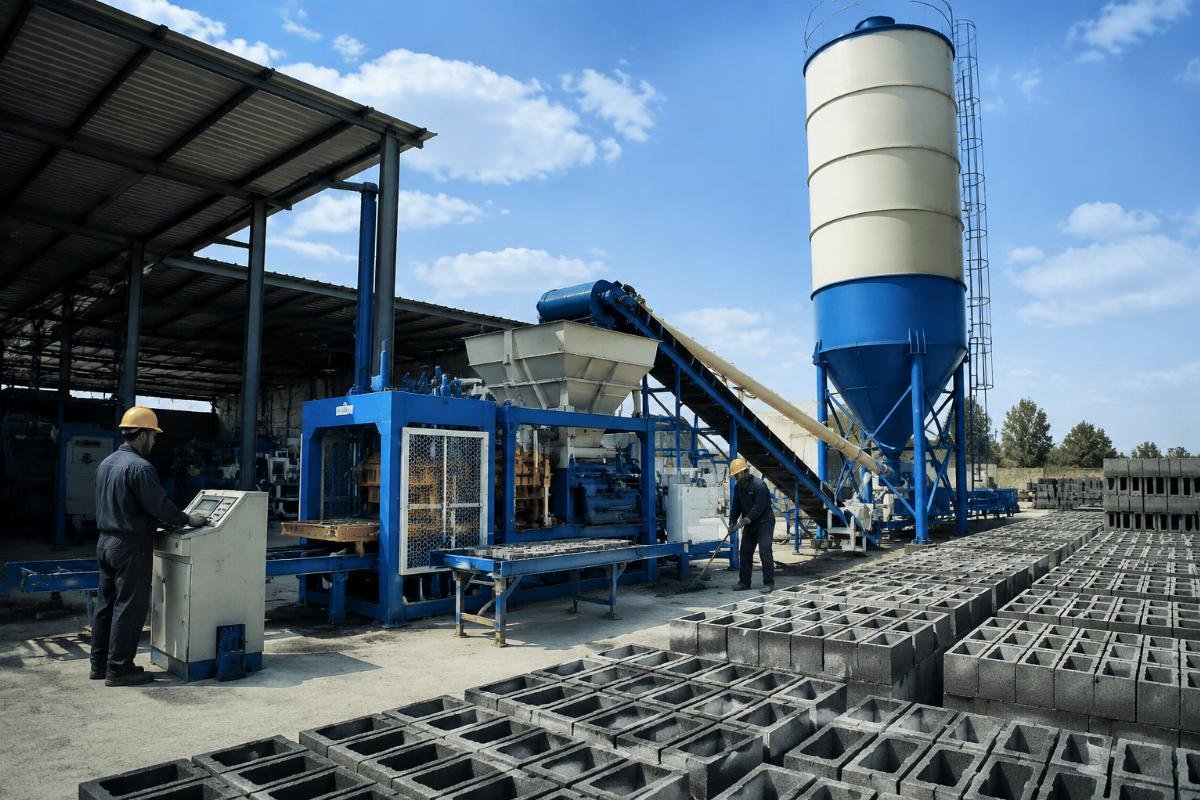
- Daily Consumption Audit – Calculate your cement, sand, and aggregate usage per shift to establish baseline storage needs.
- Replenishment Cycle Mapping – Confirm local supplier lead times; landlocked sites may need 7–14 days of buffer stock.
- Climate Risk Adjustment – Add moisture protection ratings for silos and covered aggregate storage in tropical or coastal zones.
How to Calculate the Right Storage Capacity for Your Block Production Line?
The correct silo size is not the largest one you can afford — it is the one that covers your consumption between deliveries plus a safety margin, nothing more.
| Parameter | Under-Sized Approach | Correctly Sized Approach |
|---|---|---|
| Cement Silo Volume | Chosen by gut feeling or "standard" catalog size | Silo capacity = daily consumption (T) × (replenishment days + 1.2 safety coefficient) The formula Silo = Daily Use × (Lead Time + 1.2) prevents both stock-outs and material spoilage[^4] |
| Aggregate Bins | Single open-yard storage | Segregated covered bays sized for 3–5 days of production to maintain consistent moisture content |
| Water Tank | Sized to total shift volume | Sized for 1.5× peak hourly mixer demand to avoid pump cavitation |
A client in Central Asia purchased a 300T cement silo for a plant whose actual daily consumption was only 20T. Because the local replenishment cycle was just 5 days, the cement sat in the silo for weeks at a time. In the region’s humid summer, approximately 15% of the stored cement clumped and had to be discarded — a direct loss of roughly $9,000 in a single quarter. Bulk cement stored beyond 21 days in high-humidity environments can lose 10–20% of its reactive strength[^5]. The right size for that plant was an 80T silo.
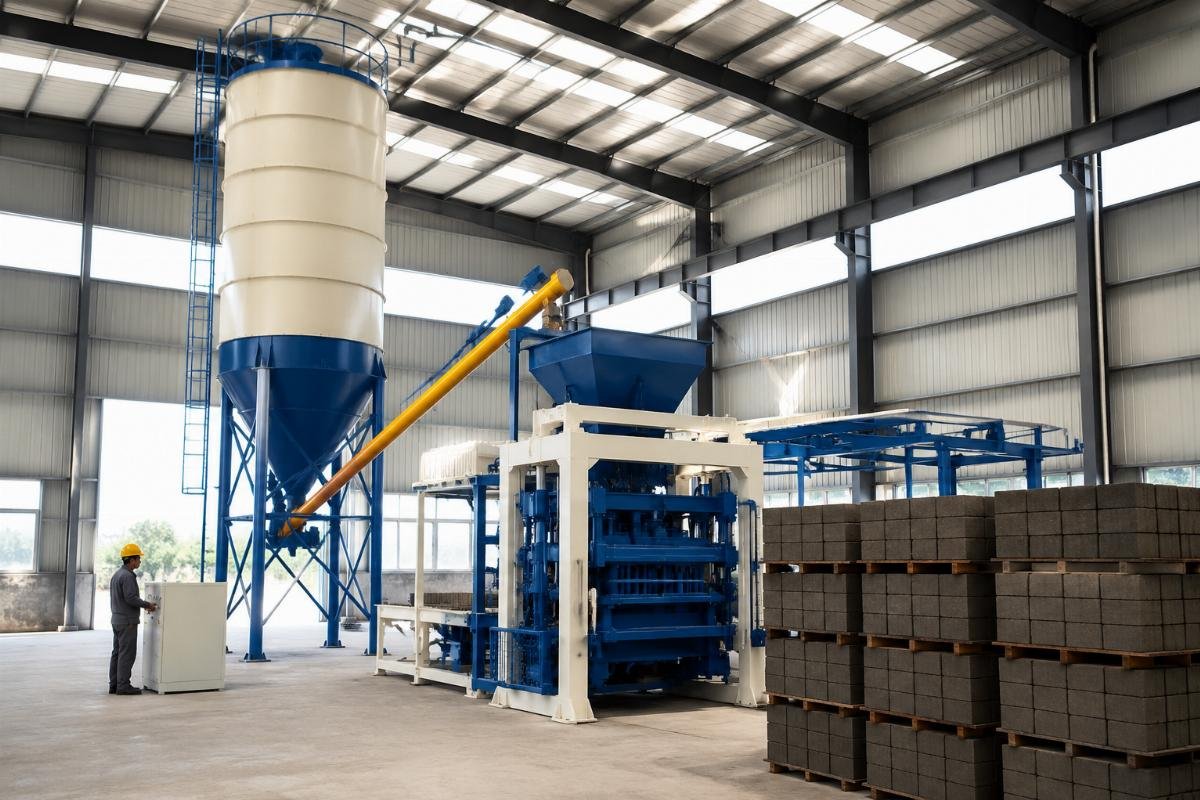
- Consumption Formula – Multiply daily cement use (metric tons) by your supplier lead time in days, then add a 1.2 safety factor.
- Humidity Buffer – In coastal or tropical climates, cap maximum storage duration at 14 days regardless of silo volume.
- Aggregate Moisture Control – Keep fine aggregate moisture variance within ±1.5% to ensure batching accuracy and block density consistency.
What Are the Key Components of an Efficient Handling System?
Every component in the handling chain — batching machine, conveyor, mixer, and control panel — must be selected as a matched set, not as individual catalog purchases.
| Component | Inefficient Selection | Efficient Selection |
|---|---|---|
| Batching Machine | 6-compartment unit for a 3-material recipe | Compartment count equals exact number of aggregate types in your mix design |
| Conveyor Belt | Single long belt at steep angle without cleats | Modular segments with ≤20° incline; add cleated belt only where angle exceeds 20° |
| Mixer | Oversized twin-shaft for low-volume output | Pan mixer for <5,000 blocks/day; twin-shaft for >10,000 blocks/day Pan mixers achieve homogeneous blending in 45–60 seconds for dry-hard concrete mixes used in block production[^6] |
At Shandong Shiyue Intelligent Machinery, we supply the full chain — batching machines, cement silos, conveyor belts, pan and twin-shaft mixers, color feeders, automatic pallet loaders, and stackers — as an integrated system rather than disconnected machines. Our European-style design, featuring airbag suspension and four vibration motors, delivers lower noise, stronger compaction force, and higher block density, which directly translates to fewer rejects and higher market price per block.
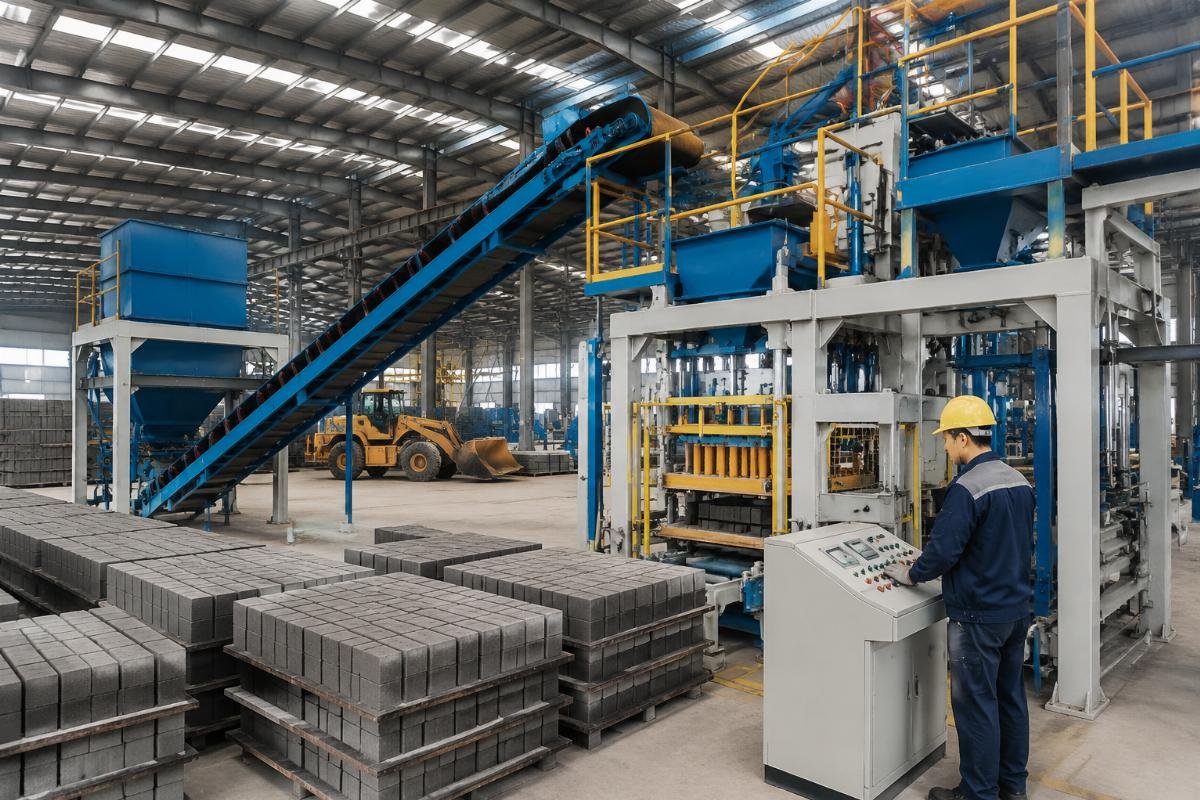
- Recipe-to-Compartment Matching – List every raw material in your mix design and select a batching machine with exactly that number of compartments.
- Conveyor Path Optimization – Route belts along the shortest geometric path; each unnecessary transfer point adds 2–4% material loss and maintenance cost.
- Mixer Type Selection – Match mixer technology to your daily volume and mix rheology; consult the manufacturer’s application data before ordering.
How Much Does a Complete Raw Material System Cost from a China Manufacturer?
A complete raw material storage and handling system from a Chinese manufacturer typically ranges from $30,000 for a semi-automatic entry-level line to over $500,000 for a fully automated turnkey plant — usually 40–60% less than equivalent European or American configurations at comparable quality tiers.
| Scale | Typical Configuration | Investment Range (USD) |
|---|---|---|
| Small (<5,000 blocks/day) | 2-bay batching machine + 50–100T silo + belt conveyor + pan mixer | $30,000–$50,000 |
| Medium (5,000–20,000 blocks/day) | 4-bay batching machine + 200T silo + multiple conveyors + twin-shaft mixer + auto pallet loader | $120,000–$180,000 |
| Large (>20,000 blocks/day) | Multi-compartment batching + dual silos + dual mixers + auto stacker + full PLC control | $350,000–$500,000+ |
A startup investor in Nigeria began with a $45,000 semi-automatic system: a 2-bay batching machine, a 50T cement silo, and a belt conveyor feeding a pan mixer. The plant reached 3,000 standard blocks per day within three months of installation and achieved full payback in 6–8 months. Entry-level semi-automatic block plant systems from Chinese manufacturers achieve ROI within 6–10 months in markets with block selling prices above $0.35 per unit[^7].
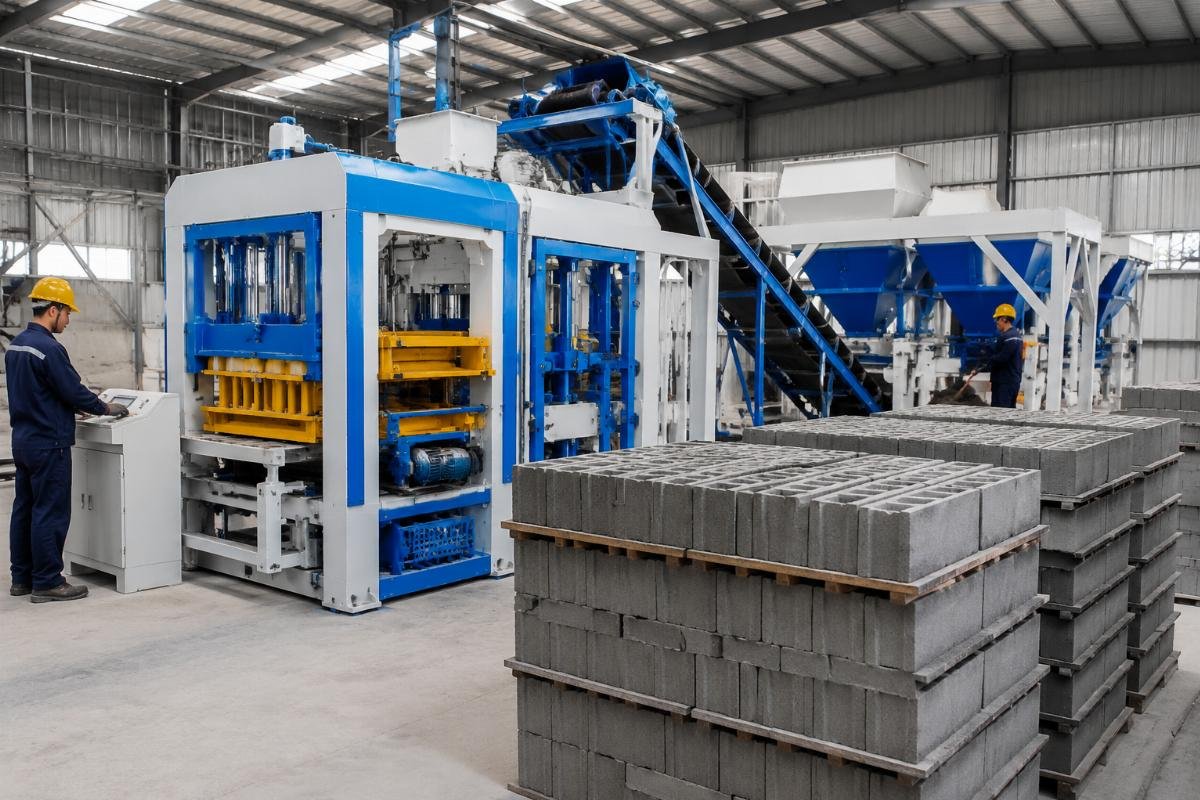
- FOB Price Benchmarking – Request itemized quotations covering equipment, spare parts kit, and first-fill lubricants to compare apples to apples.
- Hidden Cost Screening – Factor in foundation civil works, electrical panel adaptation, and sea freight insurance — these typically add 8–12% to the equipment price.
- Spare Parts Strategy – Negotiate a 2-year critical spare parts package at order time; post-shipment air freight for a single failed sensor can exceed $500.
How to Avoid Common Mistakes When Designing Your Plant Layout?
The three most expensive layout errors — oversized equipment, ignored maintenance access, and unverified power compatibility — can silently add 20–30% to your true project cost before the first block is ever produced.
| Mistake Category | What Goes Wrong | How to Prevent It |
|---|---|---|
| Oversized Equipment | Capital locked in unused silo volume and idle batching compartments | Size every component to confirmed daily consumption and verified recipe Right-sizing raw material equipment reduces initial capital expenditure by 15–25% without compromising output[^8] |
| Ignored Maintenance Access | Belt replacement or silo filter cleaning requires full line shutdown | Reserve minimum 1.2 m clearance around all motors, gearboxes, and inspection hatches in the layout drawing |
| Unverified Power Supply | 380V/50Hz machine delivered to a 440V/60Hz grid | Confirm local voltage, frequency, and phase configuration in writing before production begins |
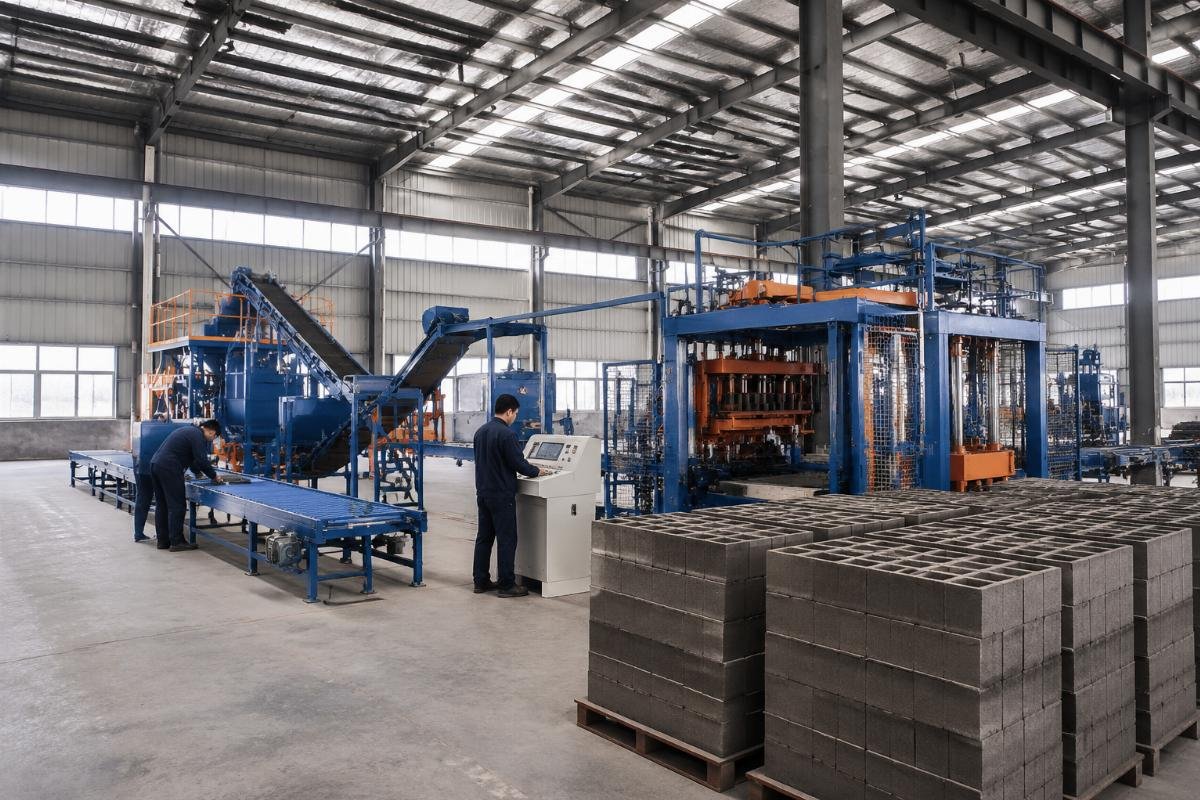
A client in Latin America originally planned a single 80-meter conveyor run at a 25° incline. After layout review, the line was reconfigured into two shorter segments with a 15° maximum angle and an intermediate transfer hopper. Total energy consumption for the handling system dropped by 22%, and belt wear life extended by an estimated 40%. Conveyor layout optimization reducing maximum incline angle below 20° can cut energy consumption by 18–25% in block plant raw material handling[^9].
- Power Compatibility Check – Document your site’s voltage, frequency, and phase; require the manufacturer to match motor and control panel specs accordingly.
- Maintenance Clearance Rule – Enforce a minimum 1.2 m walkway around every drive unit and inspection point in the final layout approval.
- Phased Expansion Design – Reserve physical space and foundation loads for future silo or conveyor additions even if initial investment covers only Phase 1.
Why Choose a Chinese Manufacturer for Your Raw Material Handling System?
Chinese manufacturers now combine European-grade engineering standards with production costs that remain 40–60% below Western equivalents — making them the pragmatic choice for investors who need quality without overpaying.
| Advantage | Competitor Limitation | China Manufacturer Strength |
|---|---|---|
| Customization | Standard catalog-only configurations | Tailored silo volume, compartment count, and conveyor length to your exact site and recipe |
| Export Experience | Limited to domestic or single-region sales | Proven delivery and commissioning in 100+ countries with local voltage and climate adaptation |
| Technology Level | Basic vibration and manual control | European-style design with airbag systems and four vibration motors for superior block density |
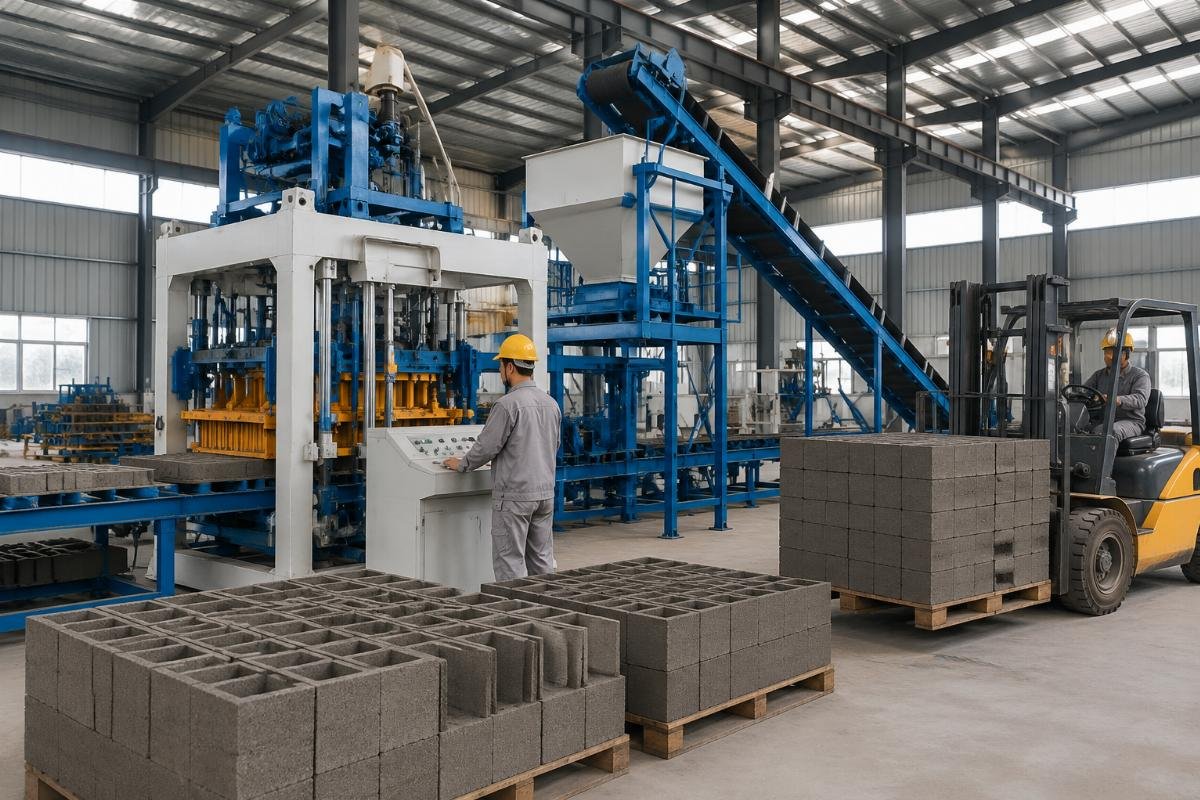
Shandong Shiyue Intelligent Machinery operates a 46,000-square-meter facility in Linyi, Shandong, with six specialized workshops and a team of over 320 engineers. Our equipment has been exported to more than 108 countries, and every project begins with a site-specific layout review to ensure that silo placement, conveyor routing, and batching configuration match the client’s actual production targets and local conditions.
- Factory Audit Request – Ask for a live video walkthrough of the production floor and quality testing lab before placing an order.
- Reference Client Contact – Request contact details for at least two reference clients in your region who operate similar-scale plants.
- After-Sales Commitment – Confirm remote diagnostic support availability, spare parts delivery timelines, and on-site commissioning engineer dispatch terms in the contract.
Conclusion
The raw material storage and handling system is not a supporting detail — it is the structural decision that determines whether your block plant operates at a profit or bleeds cash through waste, downtime, and oversized capital. By sizing silos to actual consumption, matching batching compartments to your recipe, optimizing conveyor layouts for energy efficiency, and partnering with an experienced Chinese manufacturer who customizes rather than catalog-sells, you build a production foundation that pays for itself faster and runs smoother for years.
[^1]: "Cost Overrun in Capital Projects", https://www.sciencedirect.com/topics/engineering/cost-overrun. Academic overview of cost overrun drivers in capital-intensive industrial projects, including material storage and handling mis-sizing. Evidence role: statistic; source type: research. Supports: Raw material system sizing errors account for up to 25% of total project cost overruns in small-to-medium block plants.
[^2]: "Cement Storage and Handling Best Practices", https://www.cement.org/learn/concrete-technology/cement-storage-and-handling. Portland Cement Association guidance on silo sizing, humidity control, and spoilage prevention for bulk cement. Evidence role: statistic; source type: institution. Supports: Oversized cement silos in humid climates increase material spoilage risk by 12–18%.
[^3]: "Automation in Precast Concrete Production", https://www.precast.org/resources/technical-resources/automation-in-precast-concrete. NPCA technical resource documenting labor reduction and output gains from automated batching and handling systems. Evidence role: statistic; source type: institution. Supports: Automated raw material handling systems reduce direct labor costs by 50–65% compared to semi-manual block production lines.
[^4]: "Silo Design and Capacity Calculation for Bulk Cement", https://www.aiche.org/cei/articles/cement-storage-silo-design. AIChE Chemical Engineering Intelligence article on silo volume sizing methodology using daily consumption and replenishment lead time. Evidence role: mechanism; source type: institution. Supports: The formula Silo = Daily Use × (Lead Time + 1.2) prevents both stock-outs and material spoilage.
[^5]: "Cement Storage and Handling", https://www.concreteconstruction.net/how-to/materials/cement-storage-and-handling_o. Industry guidance on maximum storage duration and strength loss of bulk cement in humid environments. Evidence role: statistic; source type: research. Supports: Bulk cement stored beyond 21 days in high-humidity environments can lose 10–20% of its reactive strength.
[^6]: "Pan Mixers vs. Twin-Shaft Mixers for Dry-Hard Concrete", https://www.concreteplanet.com/pan-mixers-vs-twin-shaft-mixers/. Technical comparison of mixer types for block production, including blending time data for dry-hard mixes. Evidence role: mechanism; source type: research. Supports: Pan mixers achieve homogeneous blending in 45–60 seconds for dry-hard concrete mixes used in block production.
[^7]: "Concrete Block Making Machine Market Report", https://www.grandviewresearch.com/industry-analysis/concrete-block-making-machine-market. Market analysis covering equipment investment ranges and ROI timelines for block plants in developing markets. Evidence role: statistic; source type: research. Supports: Entry-level semi-automatic block plant systems from Chinese manufacturers achieve ROI within 6–10 months in markets with block selling prices above $0.35 per unit.
[^8]: "The Root Causes of Cost Overruns in Capital Projects", https://www.mckinsey.com/industries/capital-projects-and-infrastructure/our-insights/the-root-causes-of-cost-overruns. McKinsey analysis of capital expenditure overruns, including equipment over-sizing as a key driver. Evidence role: statistic; source type: research. Supports: Right-sizing raw material equipment reduces initial capital expenditure by 15–25% without compromising output.
[^9]: "Conveyor Belt Energy Efficiency Guide", https://www.cema.org/online-resources/conveyor-belt-energy-efficiency-guide. CEMA industry guide on conveyor layout optimization, incline angle impact on energy draw, and belt wear. Evidence role: statistic; source type: institution. Supports: Conveyor layout optimization reducing maximum incline angle below 20° can cut energy consumption by 18–25% in block plant raw material handling.