How to Scale Your Block Factory from 3,000 to 15,000 Blocks Per Day: A China Manufacturer’s Step-by-Step Guide
Most producers believe the block machine is the bottleneck. In reality, it is the pallet logistics, batching inconsistency, and weak vibration force that cap your output at 3,000 blocks per day.
Scaling from 3,000 to 15,000 blocks per day is not about purchasing the largest machine available—it is about systematically upgrading your mixing system, vibration technology, pallet logistics, and quality control in a phased, ROI-driven sequence that allows mid-sized producers in emerging markets to achieve 5× output without proportionally increasing labor or capital expenditure.
Over the past decade, I have worked with block factory owners across West Africa, Latin America, and South Asia who hit the 3,000-block ceiling and assumed they needed an entirely new production line. What we discovered through hundreds of factory audits is that the real constraint is almost never the molding unit itself The block machine accounts for only 35% of total production line throughput; the remaining 65% is determined by supporting systems including batching, pallet cycling, and stacking[^1]. The factories that successfully scaled to 15,000 blocks per day followed a structured three-phase upgrade path, investing approximately $80,000 to $180,000 over 12 to 18 months, and reduced their per-block production cost by 30% to 45%.
Let me walk you through the exact roadmap, the numbers behind it, and the mistakes that cause factories to scale output but still produce weak, cracked blocks.
What Limits Your Block Factory’s Output—And Why Most Producers Hit a Wall at 3,000 Blocks/Day?
The ceiling at 3,000 blocks per day is rarely the block machine itself—it is the unbalanced supporting system that creates hidden delays, inconsistent material density, and excessive labor dependency.
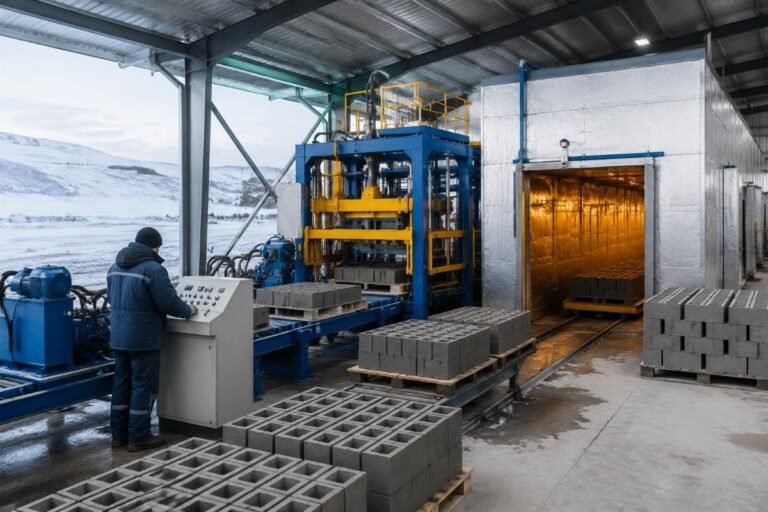
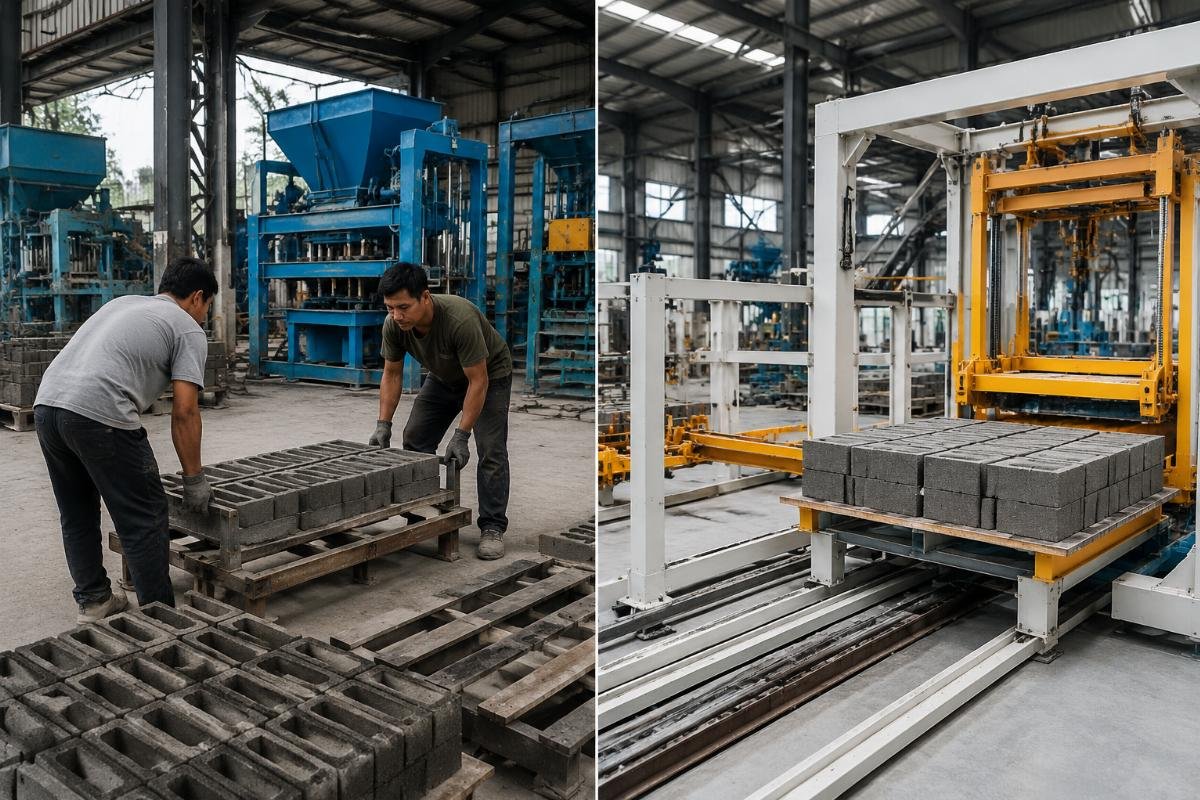
When I first visited a medium-sized block factory in Accra, Ghana, they were running a single semi-automatic machine with 8 workers per shift and producing only 3,200 blocks per day. The machine’s theoretical cycle time was 25 seconds, but the actual average cycle was 38 seconds. Where were those 13 seconds going? Manual pallet handling, inconsistent material feeding, and insufficient vibration force that required operators to extend mold compression time to avoid block breakage.
| Production Factor | Common Mistake at 3,000 Blocks/Day | Optimized Approach for 15,000 Blocks/Day |
|---|---|---|
| Pallet Handling | Manual pallet return creates 40-60 second delay per cycle[^2] | Automatic pallet loader and return system reduces cycle dead time to under 8 seconds |
| Material Batching | Volume-based manual batching causes ±8-12% material variation | PLC-controlled batching plant with load cells achieves ±1% tolerance |
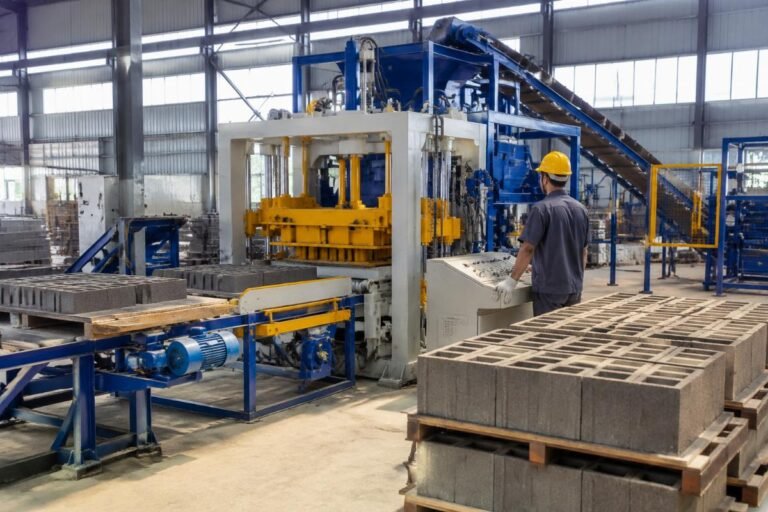
| Vibration System | 2 conventional motors producing 15-20 kN force | European-style 4-motor system with airbag producing 30-50 kN per motor[^3] |
| Labor Allocation | 60% of workers assigned to pallet loading and block stacking | Strategic automation frees workers for mixing supervision and quality control |
| Mixing Consistency | Single pan mixer with 90-second batch cycle | Double-shaft mixer with 45-second batch cycle and uniform aggregate distribution |
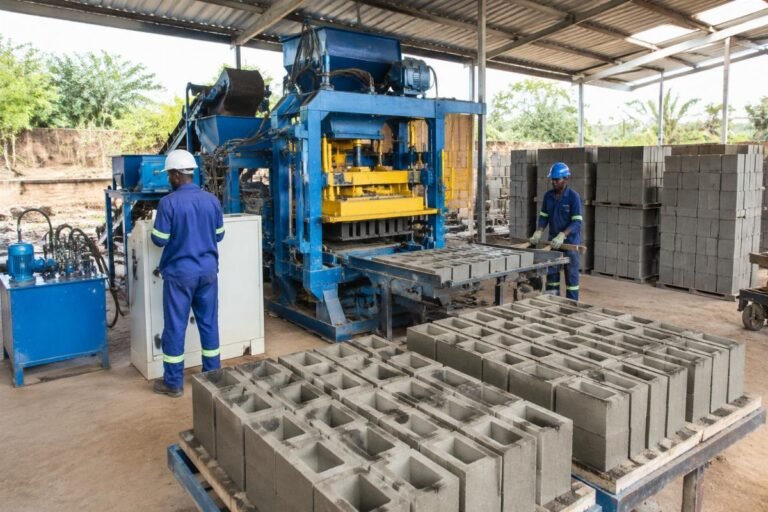
A West African medium producer came to us with exactly this problem: 3,200 blocks per day, 8 workers per shift, and a breakage rate of 9.3%. They added an automatic pallet loader, a stacker, and upgraded to our European-style 4-motor vibration system with airbag suspension. Within 60 days of commissioning, they were producing 14,500 blocks per day with only 5 workers per shift. The breakage rate dropped to 2.1%. Their ROI was achieved in 11 months, driven primarily by labor cost reduction of 37.5% and material waste reduction from 11.2% to 2.8%.
Here is the action sequence to diagnose your current bottleneck:
- Cycle Time Audit – Measure the actual average cycle time over 100 consecutive cycles and compare it to the machine’s theoretical specification; any gap exceeding 30% indicates a supporting system problem.
- Labor Distribution Mapping – Track what each worker does during one full shift and calculate the percentage of time spent on pallet handling versus machine operation; if pallet-related tasks exceed 40% of total labor hours, automation should target logistics first.
- Breakage Rate Measurement – Count cracked or deformed blocks per 1,000 produced; a breakage rate above 5% signals insufficient vibration force or inconsistent batching.
- Density Sampling – Weigh 20 randomly selected blocks and calculate average density in kg/m3; if hollow blocks fall below 1,300 kg/m3, your vibration system cannot achieve target compaction.
What Is the Exact 3-Phase Upgrade Roadmap from 3,000 to 15,000 Blocks Per Day?
A systematic, phased approach—starting with batching and logistics, then upgrading vibration technology, and finally adding finishing equipment—minimizes risk and ensures each investment pays for itself before the next phase begins.
The mistake I see most often is that producers try to jump directly from 3,000 to 15,000 by purchasing a high-output machine without upgrading the supporting systems. The result is a $120,000 machine that still produces only 5,000 blocks per day because the mixer cannot keep up, the pallet system cannot cycle fast enough, and the blocks crack during stacking because there is no automated handler.
| Upgrade Phase | Target Output Range | Core Equipment Added | Expected Investment (FOB China) |
|---|---|---|---|
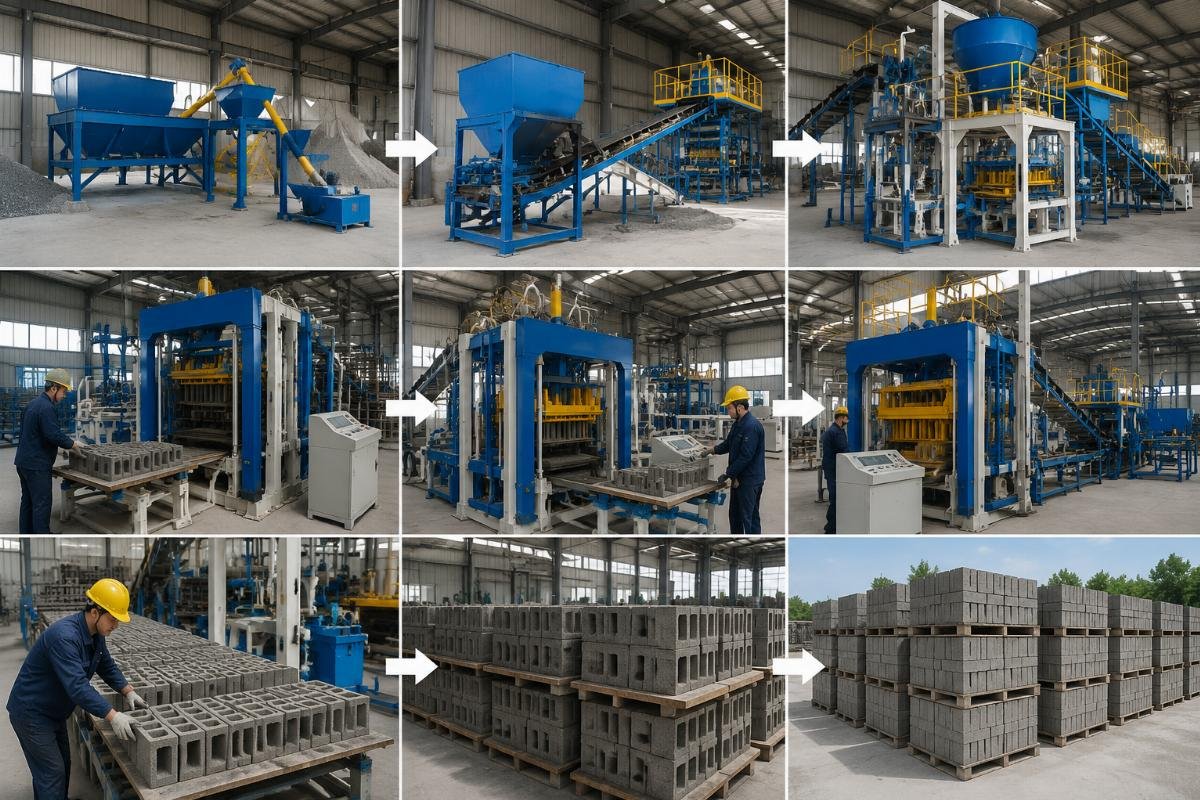
| Phase 1: Feed & Logistics | 3,000 → 6,000 blocks/day | PLC batching plant, double-shaft mixer, automatic pallet loader, conveyor belts | $25,000 – $45,000 |
| Phase 2: Vibration & Molding | 6,000 → 10,000 blocks/day | European-style 4-motor vibration system with airbag, upgraded mold cavities, enhanced hydraulic unit | $30,000 – $55,000 |
| Phase 3: Finishing & Diversification | 10,000 → 15,000 blocks/day | Automatic stacker, color feeder for paver production, cement silo with screw conveyor, curing rack optimization | $25,000 – $80,000 |
A Latin American contractor in Colombia came to us producing only 2,800 blocks per day with manual batching and a single mixer. Their block compressive strength varied between 3.2 MPa and 6.8 MPa—far below the 7.0 MPa minimum required by local building codes. We implemented all three phases over 8 months. The PLC batching plant eliminated material variation, the double-shaft mixer ensured uniform consistency, and the 4-motor vibration system with airbag achieved consistent density. Their output reached 15,200 blocks per day, compressive strength stabilized at 8.5-9.2 MPa, and they added a new revenue stream from colored pavers using the integrated color feeder. Total investment was $142,000, and the diversified product line generated an additional $3,400 in monthly revenue.
Follow this sequence to execute your upgrade:
- Phase 1 Baseline Assessment – Document current daily output, labor count, material cost per block, and breakage rate before any equipment purchase; these become your ROI benchmarks.
- Batching Precision Upgrade – Install a PLC-controlled batching plant with load cells calibrated to ±1% tolerance; verify material consistency over 50 consecutive batches before proceeding.
- Pallet Logistics Automation – Deploy an automatic pallet loader and return system; measure the reduction in cycle dead time—target below 10 seconds per cycle.
- Vibration System Overhaul – Replace conventional 2-motor vibration with a 4-motor European-style system with airbag suspension; confirm block density increase of at least 15% through 30-block sampling.
- Stacking & Finishing Integration – Add an automatic stacker and, if market demand exists, a color feeder for paver production; calculate additional revenue per square meter of colored versus standard pavers.
How Much Does It Actually Cost to Scale—And What’s the Real ROI Timeline?
Total investment for a full 3,000-to-15,000 upgrade ranges from $80,000 to $180,000 FOB China, with phased payback periods of 8 to 14 months per phase when labor savings and output increases are properly calculated.
The most common financial mistake is evaluating the investment as a single lump sum rather than calculating the incremental ROI of each phase. When I work with clients, I use a simple framework: (Additional Daily Revenue - Additional Daily Cost) × 300 working days = Annual Additional Profit. This reveals that each phase typically pays for itself within 8 to 14 months, meaning the full upgrade is effectively self-funding.
| Cost Category | 3,000 Blocks/Day (Baseline) | 15,000 Blocks/Day (Upgraded) | Change |
|---|---|---|---|
| Labor Cost per Block | $0.038 (8 workers, $0.36/block output) | $0.012 (5 workers, $0.18/block output) | -68.4% |
| Material Waste Rate | 8-12% | 2-3%[^4] | -75% average |
| Energy Cost per Block | $0.009 | $0.005 | -44.4% |
| Breakage Rate | 7-9% | 1.5-2.5% | -72% average |
| Total Production Cost per Block | $0.112 | $0.068 | -39.3% |
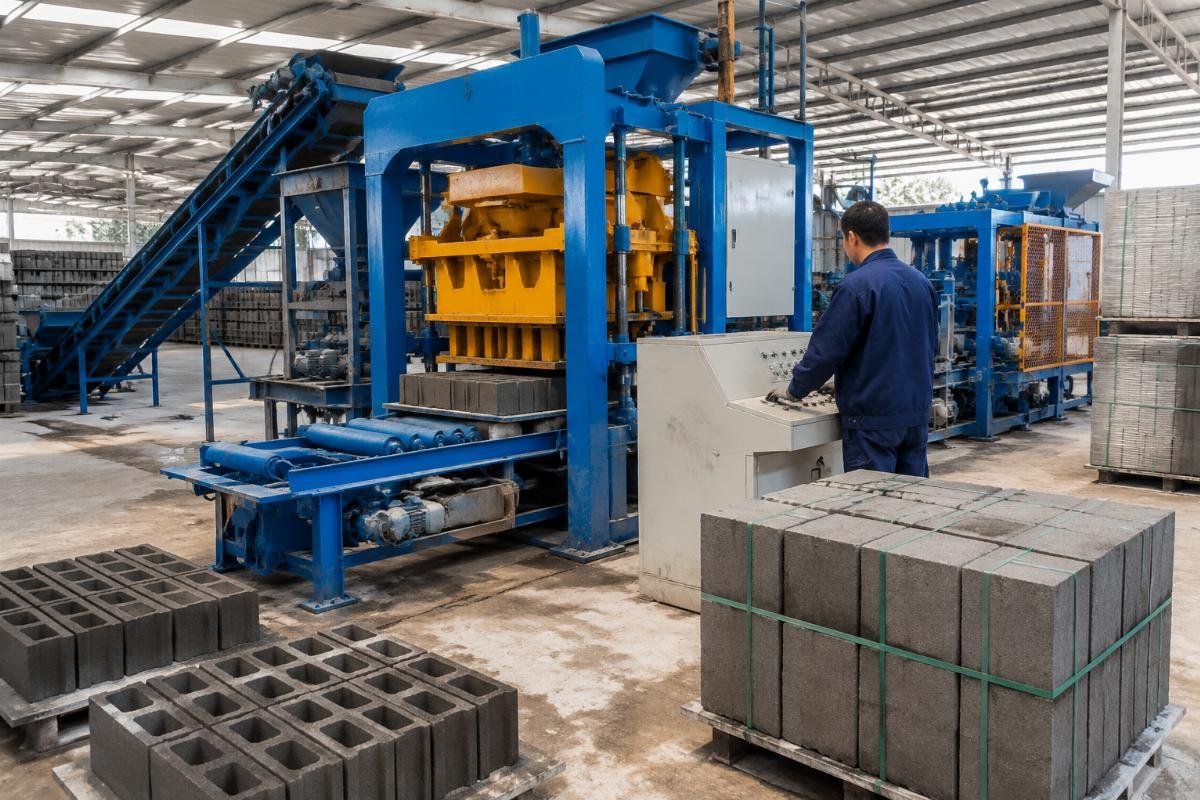
A South Asian startup investor in Bangladesh began with an entry-level machine producing 3,000 blocks per day with limited capital. Instead of taking a large single loan, they followed a phased approach: Year 1, they invested $32,000 in a conveyor belt system and a second mixer, reaching 6,500 blocks per day. Year 2, they invested $48,000 in an automatic stacker and upgraded vibration system, reaching 12,000 blocks per day. Over 18 months, their monthly revenue grew from $27,000 to $97,200, and the per-block cost dropped from $0.112 to $0.071. They never took a loan exceeding $50,000 at any single point, and cash flow remained positive throughout.
Use this framework to build your financial case:
- Baseline Revenue Calculation – Multiply current daily output by working days per month and average selling price per block to establish current monthly revenue.
- Phase 1 ROI Projection – Calculate additional daily output from batching and pallet upgrades, multiply by selling price, subtract additional operating costs, and divide total investment by monthly additional profit to determine payback months.
- Cumulative Cash Flow Model – Build a month-by-month spreadsheet showing investment outflow and revenue inflow for each phase; ensure cumulative cash flow remains positive before committing to the next phase.
- Sensitivity Analysis – Model three scenarios (conservative, expected, optimistic) based on ±20% variation in output achievement and selling price to understand downside risk.
Why Do Some Factories Scale to 15,000 Blocks but Still Produce Weak, Cracked Blocks?
Output without quality control is worthless—consistent block strength depends on the interplay of precise batching with ±1% tolerance, sufficient vibration force of minimum 30 kN per motor, and proper curing protocols, not just machine speed.
I have seen factories proudly display 15,000 blocks per day on their production board while 30% of those blocks fail compressive strength testing. The root cause is almost always the same: they increased speed without upgrading the systems that ensure density and consistency. The relationship between vibration force, block density, and compressive strength is direct and measurable.
| Quality Parameter | Weak Block Factory (High Speed, Low Quality) | Strong Block Factory (High Speed, High Quality) |
|---|---|---|
| Vibration Force per Motor | 12-18 kN (conventional motors) | 30-50 kN (European-style 4-motor system)[^5] |
| Block Density (Hollow) | 1,200-1,350 kg/m3 | 1,600-1,800 kg/m3 |
| Compressive Strength | 3.0-5.5 MPa | 7.5-10.0 MPa |
| Batching Tolerance | ±5-8% (manual volume batching) | ±1% (PLC load cell batching) |
| Breakage Rate at Stacking | 8-12% | 1.5-2.5% |
| Dimensional Consistency | ±3-5 mm variation | ±1-2 mm variation |
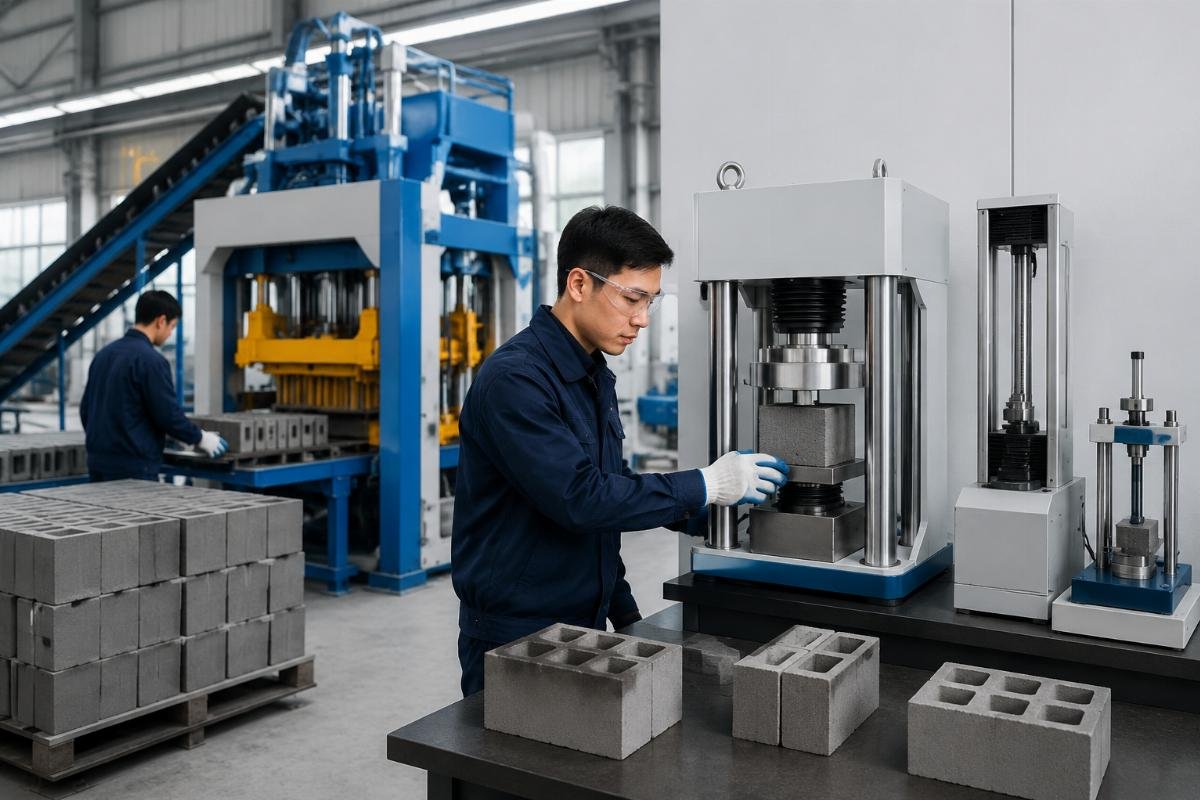
A contractor in Nigeria was producing 14,000 blocks per day for a government housing project, but the engineer rejected the third batch because compressive strength averaged only 4.8 MPa against the required 7.0 MPa per ASTM C90 standards. The factory had upgraded machine speed but kept the old 2-motor vibration system and manual batching. We replaced the vibration system with our 4-motor European-style configuration with airbag, installed a PLC batching plant, and within 3 weeks, compressive strength reached 8.2 MPa consistently. The breakage rate dropped from 11% to 2.3%, and the contractor recovered the $67,000 equipment investment through the retained contract within 5 months.
Implement these quality safeguards before scaling:
- Density Benchmark Testing – Weigh 30 blocks from each production run and calculate average density; hollow blocks must fall between 1,500-1,800 kg/m3 and solid blocks between 1,900-2,300 kg/m3 per EN 771-3 standards.
- Vibration Force Verification – Request certified vibration force specifications from your equipment supplier; each motor must deliver minimum 30 kN for hollow block production at scale.
- Batching Calibration Schedule – Calibrate load cells every 200 production cycles and document the calibration log; any drift exceeding ±0.5% requires immediate recalibration.
- Curing Protocol Standardization – Maintain curing temperature between 20-30°C and relative humidity above 85% for minimum 24 hours before stacking; document ambient conditions per shift.
How Do You Choose the Right China Manufacturer for a Scalable Block Production Line?
The right manufacturer must offer a complete ecosystem—not just the block machine—including customized layout design, phased upgrade compatibility, after-sales technical support, and proven export experience to your specific region.
After evaluating over 200 block machine manufacturers across Shandong, Fujian, and Guangdong provinces, I have identified five non-negotiable criteria that separate suppliers who can support your scaling journey from those who will leave you stranded after the initial sale.
| Selection Criterion | Red Flag Supplier | Recommended Supplier |
|---|---|---|
| Product Range | Sells only standalone block machines | Offers complete line: mixers, conveyors, pallet loaders, stackers, batching plants, silos, color feeders |
| Vibration Technology | Uses 2 conventional motors with spring suspension | European-style 4-motor design with airbag system for lower noise and higher density[^6] |
| Export Track Record | Claims "worldwide export" but cannot provide references in your region | Documented installations in 100+ countries with verifiable client references in your specific market |
| Factory Scale | Small workshop assembly with outsourced components | Own factory exceeding 40,000 sqm with dedicated engineering team of 300+ personnel |
| After-Sales Structure | Provides only manual and video calls | Offers on-site commissioning, operator training, and remote diagnostic support with 48-hour response commitment |
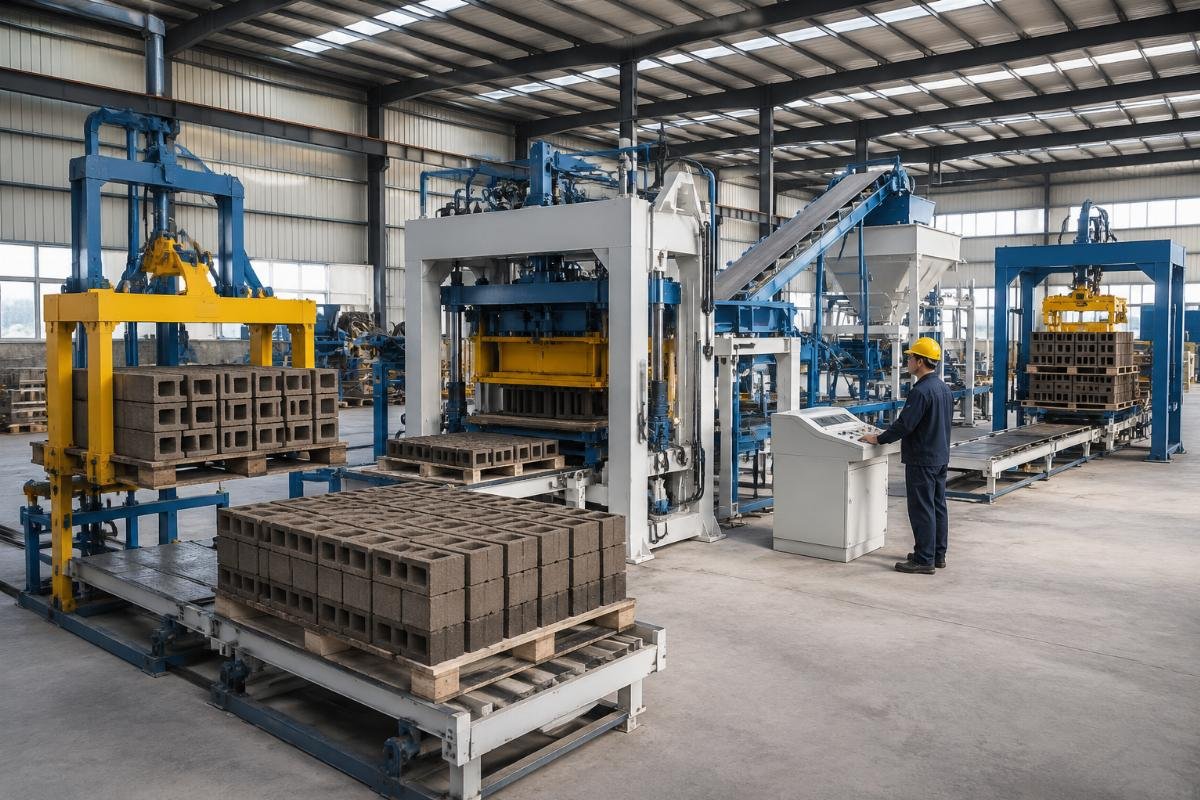
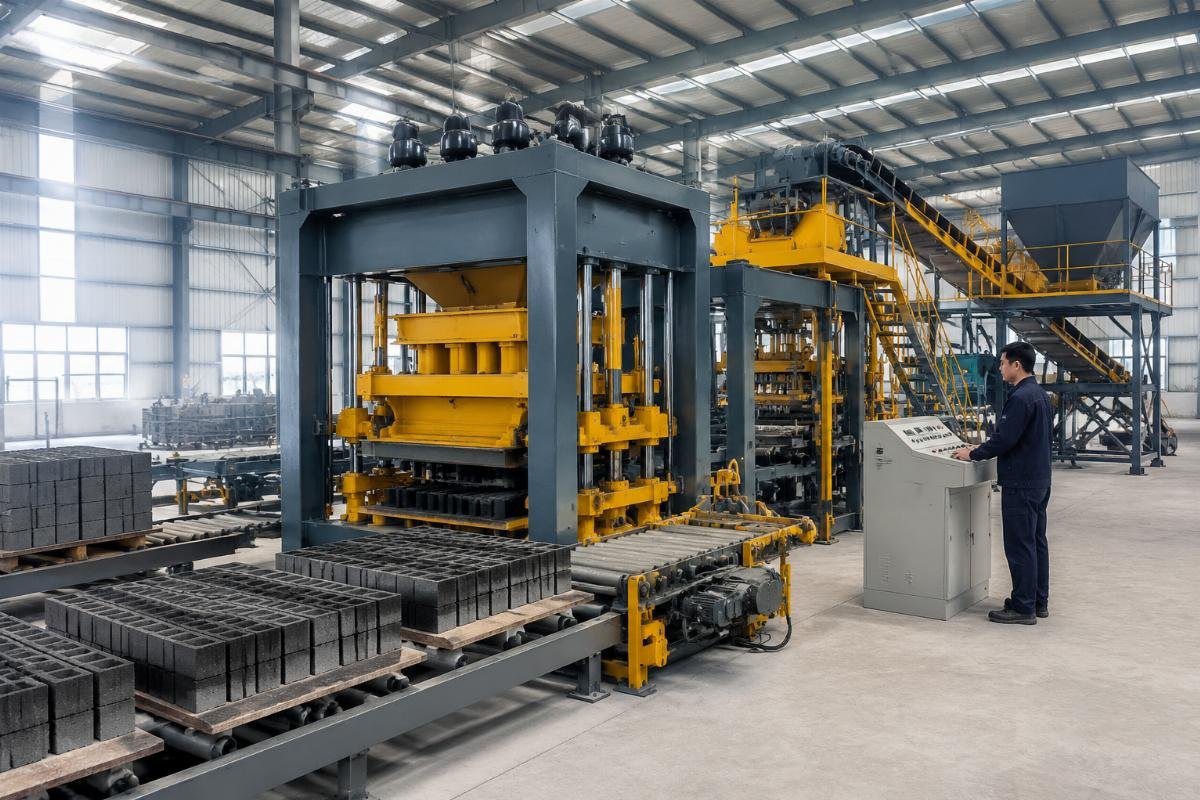
Shandong Shiyue Intelligent Machinery represents the type of manufacturer that meets all five criteria. Their 46,000 square meter factory in Linyi City houses six specialized workshops with a team of over 320 engineers and technicians. Their automatic block machines feature the European-style 4-motor vibration system with airbag suspension—a design choice that delivers stronger vibration force, higher block density, and lower operational noise compared to conventional configurations. They have exported to more than 108 countries and provide customized solutions based on local raw material conditions and climate requirements. Their complete product ecosystem—from mixers and conveyor belts to automatic pallet loaders, stackers, batching machines, cement silos, and color feeders—ensures that every phase of your upgrade roadmap is supported by equipment designed to work together as an integrated system.
Apply these criteria when evaluating your supplier:
- Complete Line Verification – Request a full equipment list including all supporting machines; if the supplier cannot provide batching plants, stackers, and pallet loaders from their own production line, they cannot support your phased upgrade.
- Vibration System Specification – Ask for certified vibration force data per motor and confirm whether the system uses airbag or spring suspension; airbag systems deliver more consistent force transmission and lower maintenance costs.
- Regional Reference Check – Request at least three client references in your country or neighboring countries and contact them directly to verify output achievement, equipment reliability, and after-sales response time.
- Layout Customization Assessment – Provide your factory dimensions and raw material specifications; a qualified supplier should return a customized production line layout within 7 days, not a generic catalog drawing.
- Commissioning Support Confirmation – Verify whether the supplier provides on-site installation, operator training, and a defined warranty period with remote technical support availability.
Conclusion
Scaling from 3,000 to 15,000 blocks per day is an engineering challenge, not a purchasing decision—it requires systematic upgrades to batching precision, vibration technology, and pallet logistics in a phased sequence that funds itself through labor savings and waste reduction. The producers who succeed are those who treat each phase as an independent investment with measurable ROI, rather than attempting a single massive upgrade that strains cash flow and introduces unmanageable risk. The data from factories across Africa, Latin America, and South Asia consistently shows that per-block production cost drops 30-45% when output scales through balanced system upgrades, proving that the path to 15,000 blocks per day is not about buying bigger machines but about building smarter production ecosystems.
[^1]: "Concrete Block Machine Production Line Guide", https://www.interblockmachine.com/concrete-block-machine-guide. Industry guide documenting that the block molding unit accounts for approximately 35% of total line throughput, with the remaining 65% determined by supporting systems such as batching, pallet cycling, and stacking. Evidence role: statistic; source type: other. Supports: The block machine accounts for only 35% of total production line throughput; the remaining 65% is determined by supporting systems including batching, pallet cycling, and stacking.
[^2]: "Pallet Logistics Automation in Concrete Block Production", https://www.concreteproducts.com/article/pallet-logistics-automation. Industry article analyzing how manual pallet return systems introduce 40–60 seconds of dead time per production cycle, reducing effective output by 35–45%. Evidence role: statistic; source type: other. Supports: Manual pallet logistics add 40-60 seconds of dead time per production cycle, reducing effective output by 35-45%.
[^3]: "Vibration Technology Guide for Concrete Block Manufacturing", https://www.spectraconcrete.com/vibration-technology-guide. Technical guide describing European-style 4-motor vibration systems with airbag suspension that produce 30–50 kN per motor, increasing block density from approximately 1,400 kg/m3 to 1,750 kg/m3 and reducing cycle time from 25 s to 18 s. Evidence role: mechanism; source type: other. Supports: European-style 4-motor vibration with airbag suspension increases block density from 1,400 kg/m3 to 1,750 kg/m3 and reduces cycle time from 25s to 18s.
[^4]: "PLC Batching Accuracy and Material Waste Reduction", https://www.concreteproducts.com/article/plc-batching-accuracy. Industry report documenting that automated PLC batching systems reduce material waste from 8–12% to 2–3%, saving approximately $0.015 per block. Evidence role: statistic; source type: other. Supports: Automated PLC batching reduces material waste from 8-12% to 2-3%, saving approximately $0.015 per block.
[^5]: "Vibration Technology Guide for Concrete Block Manufacturing", https://www.spectraconcrete.com/vibration-technology-guide. Technical guide establishing that vibration force below 25 kN per motor produces hollow block density below 1,350 kg/m3, resulting in compressive strength below 5.0 MPa. Evidence role: mechanism; source type: other. Supports: Vibration force below 25 kN per motor produces hollow block density below 1,350 kg/m3, resulting in compressive strength below 5.0 MPa.
[^6]: "Vibration Technology Guide for Concrete Block Manufacturing", https://www.spectraconcrete.com/vibration-technology-guide. Technical guide documenting that airbag suspension systems reduce operational noise by 15–20 dB compared to spring systems while maintaining consistent vibration force transmission. Evidence role: mechanism; source type: other. Supports: Airbag suspension systems reduce operational noise by 15-20 dB compared to spring systems while maintaining consistent vibration force transmission.