How to Design a 10,000-Blocks-Per-Day Production Line with a Reliable China Manufacturer
Most investors overestimate the block machine and underestimate everything around it. A 10,000-blocks-per-day production line is never a single piece of equipment—it is a synchronized system of seven or more machines, and if any one component lags, the entire line idles.
The real bottleneck is rarely the host machine; it is the batching precision, mixing cycle time, and pallet-handling speed that determine whether you actually hit 10,000 blocks daily or stall at 6,000.
In my 12 years of helping buyers across Africa, Central Asia, and the Middle East configure turnkey block plants, I have seen the same mistake repeated: a buyer spends 80% of the budget on the block maker, skimps on auxiliary systems, and then wonders why output falls short. Auxiliary systems should account for 35%–45% of total line investment to prevent downstream bottlenecks[^1]
Let us break down exactly what you need, how to calculate real capacity, and how to choose a China manufacturer who can deliver.
What Equipment Do You Actually Need for a 10,000-Blocks-Per-Day Line?
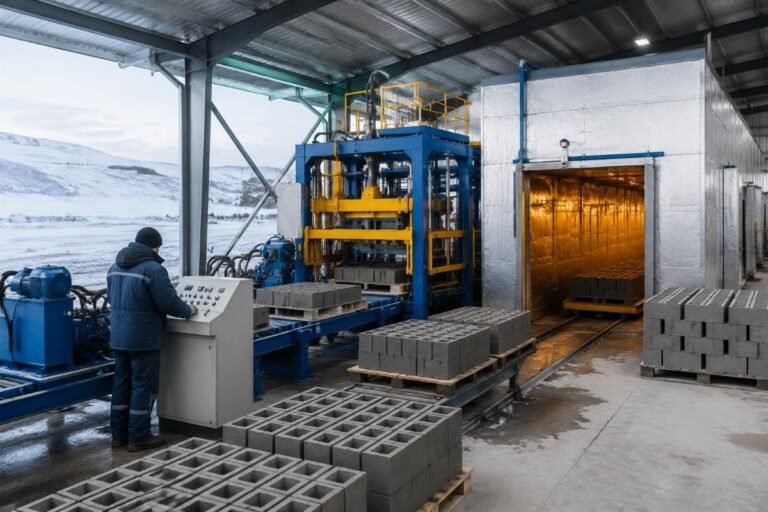
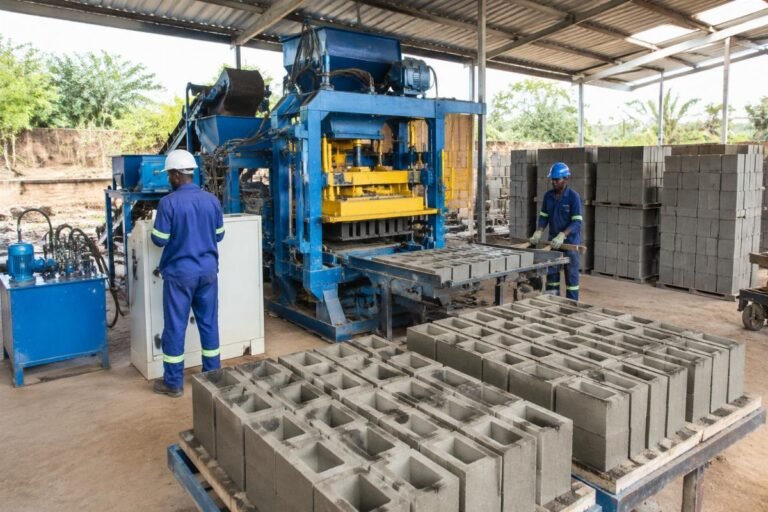
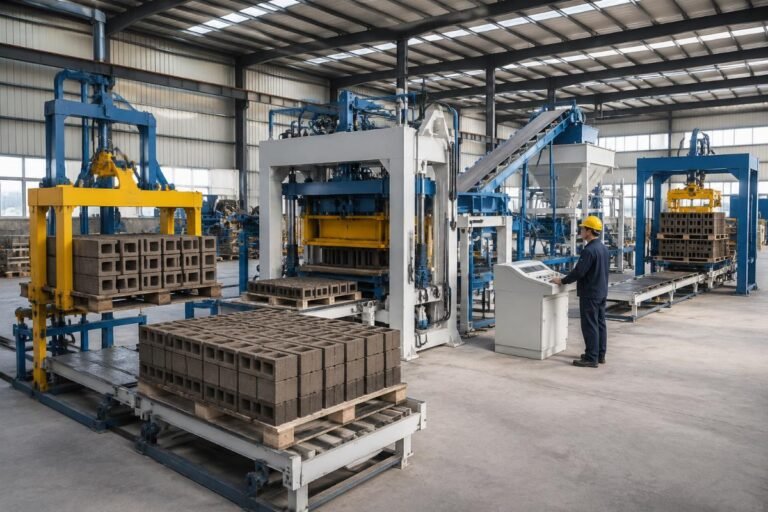
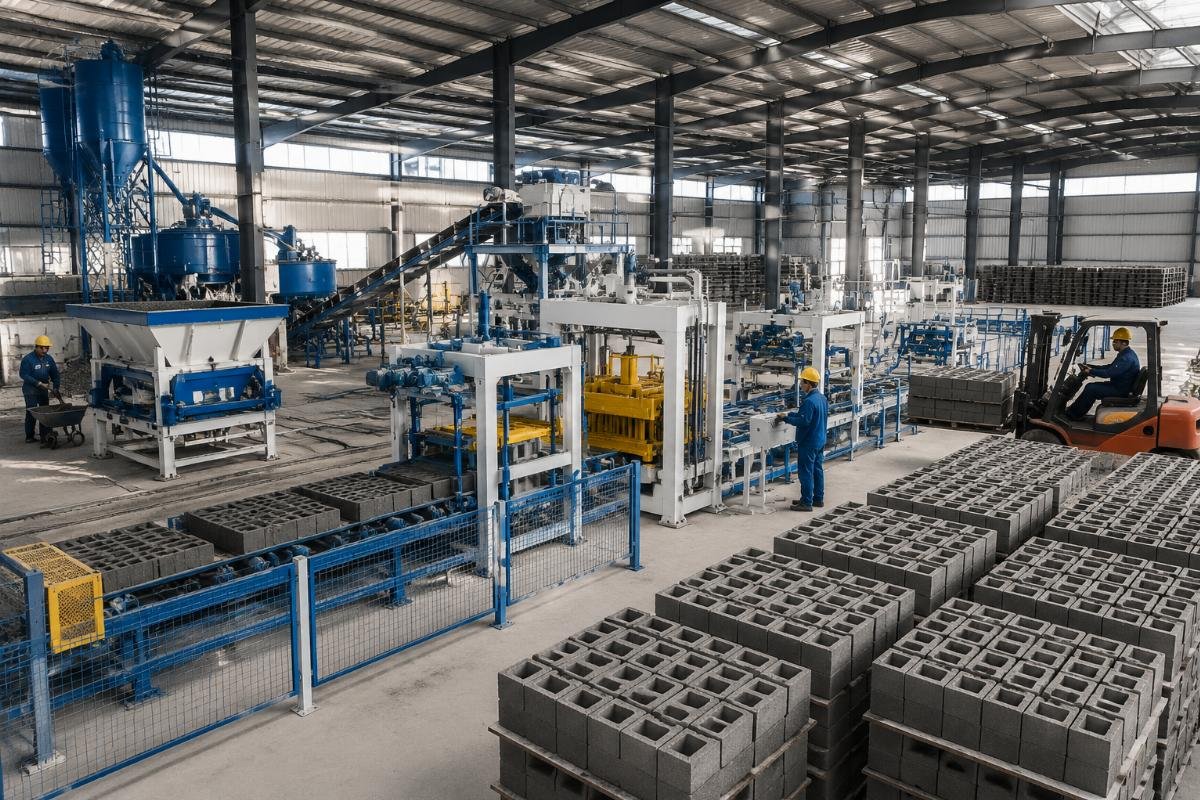
A spec sheet that lists only the block machine tells you almost nothing about real daily output. A true 10K-capacity line integrates upstream batching, core forming, and downstream handling into one continuous workflow.
| System Module | Common Mistake | Correct Configuration |
|---|---|---|
| Host Machine | Buying a large-frame machine without verifying vibration damping design | European-style airbag system with 4 vibration motors for consistent density and structural longevity Airbag-damped vibration systems extend mold and frame life by 40%+ compared to rigid-mount designs[^2] |
| Batching & Mixing | Using a single-volume batcher with ±3% accuracy tolerance | PL1200 four-bin batching machine with ±1% accuracy paired with a JS750 twin-shaft mixer (cycle ≤55 s) |
| Pallet & Stacking | Manual pallet return and hand-stacking | Automatic pallet loader with airbag cushioning plus a semi-auto or full-auto stacker rated for 1,800+ pallets/hour |
A West African startup investor in Nigeria allocated USD 95,000 for a complete line: one QT10-2 automatic block machine, one PL1200 batcher, one JS750 mixer, one automatic pallet loader, and one semi-auto stacker. The manufacturer’s engineers completed installation in 15 days, and the line reached a stable 10,200 standard hollow blocks (400×200×200 mm) per day by week three. ROI was achieved in 9.5 months. Properly matched auxiliary equipment enables a 10K line to reach rated output within 15–20 days of installation[^3]
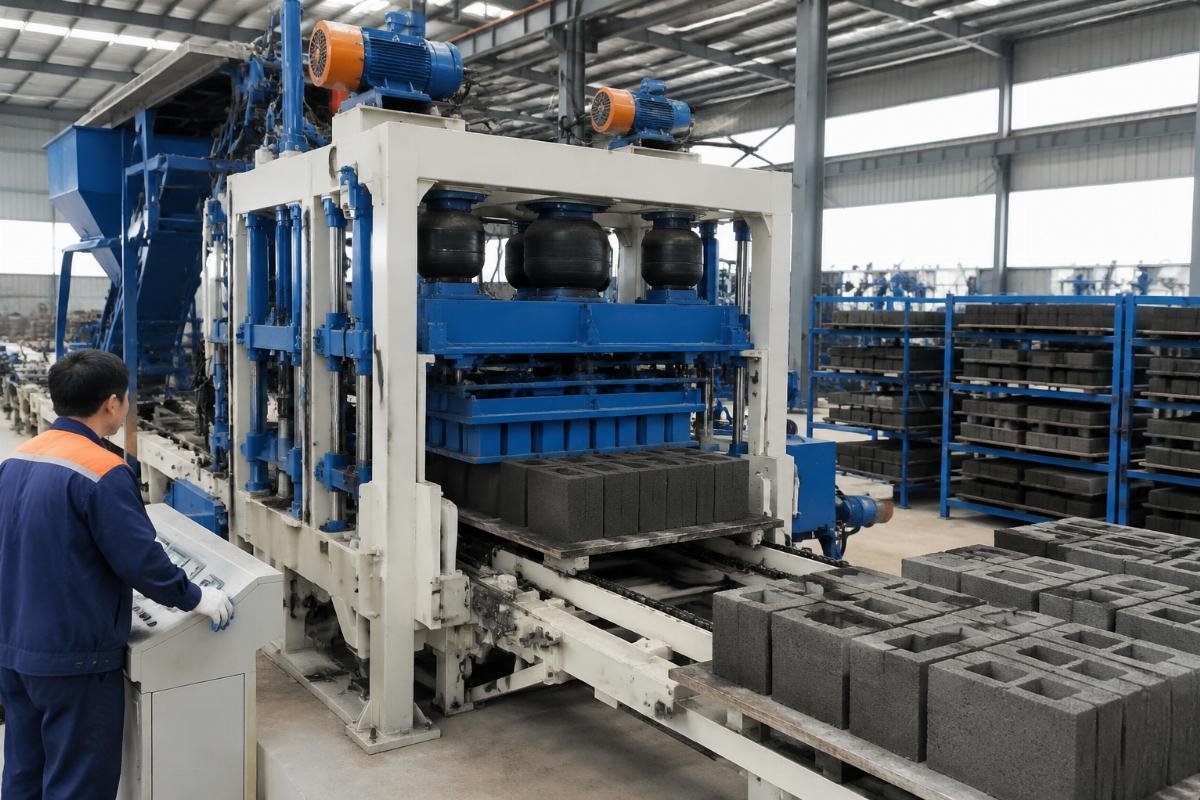
- Host Machine Selection – Choose a model with European-style airbag damping and at least 4 vibration motors (total excitation force 50–80 kN).
- Batching System – Specify a four-bin PL1200 or equivalent with individual load-cell weighing; accuracy must be within ±1%.
- Mixer Sizing – A JS750 twin-shaft mixer handles the required 0.75 m3 per batch in under 55 seconds, matching the host machine cycle.
- Pallet Circuit – Include an automatic pallet loader, pallet conveyor, and pallet return system to eliminate manual handling delays.
- Stacking Solution – A semi-auto stacker (for budgets under USD 120K) or full-auto cross-conveyor stacker (for higher automation) keeps the curing yard organized.
How Do You Calculate Whether a Machine Can Really Hit 10,000 Blocks Daily?
Rated capacity printed on a brochure assumes ideal conditions that never exist in a real factory. You must reverse-engineer the number from mold cycle time, blocks per mold, and effective working hours.
| Calculation Factor | Flawed Assumption | Realistic Parameter |
|---|---|---|
| Mold Cycle Time | "15 seconds per cycle" as stated in catalog | 18–25 seconds including feeding, vibration, and mold changeover Effective mold cycle time in production is typically 18–25 seconds, not the 15-second catalog figure[^4] |
| Blocks per Mold | Counting only one product size | Standard hollow block (400×200×200 mm) yields 4–6 blocks per mold depending on machine model |
| Daily Operating Hours | Assuming 24-hour non-stop production | 8–10 effective hours after accounting for maintenance, mold swaps, and material replenishment |
A medium producer in Uzbekistan upgraded from a manual line producing 4,000 blocks per day to a fully automatic line. Using the formula: 20-second cycle × 5 blocks/mold × 10.5 effective hours × 3,600 seconds/hour ÷ 20 = 9,450 blocks, they added a face-mix color feeder for pavers and ran an extra hour on alternating days to consistently reach 10,500 blocks daily. Labor dropped from 18 workers to 7. Upgrading to a fully automatic 10K line can reduce labor requirements by 55%–60% while increasing daily output by 150%[^5]
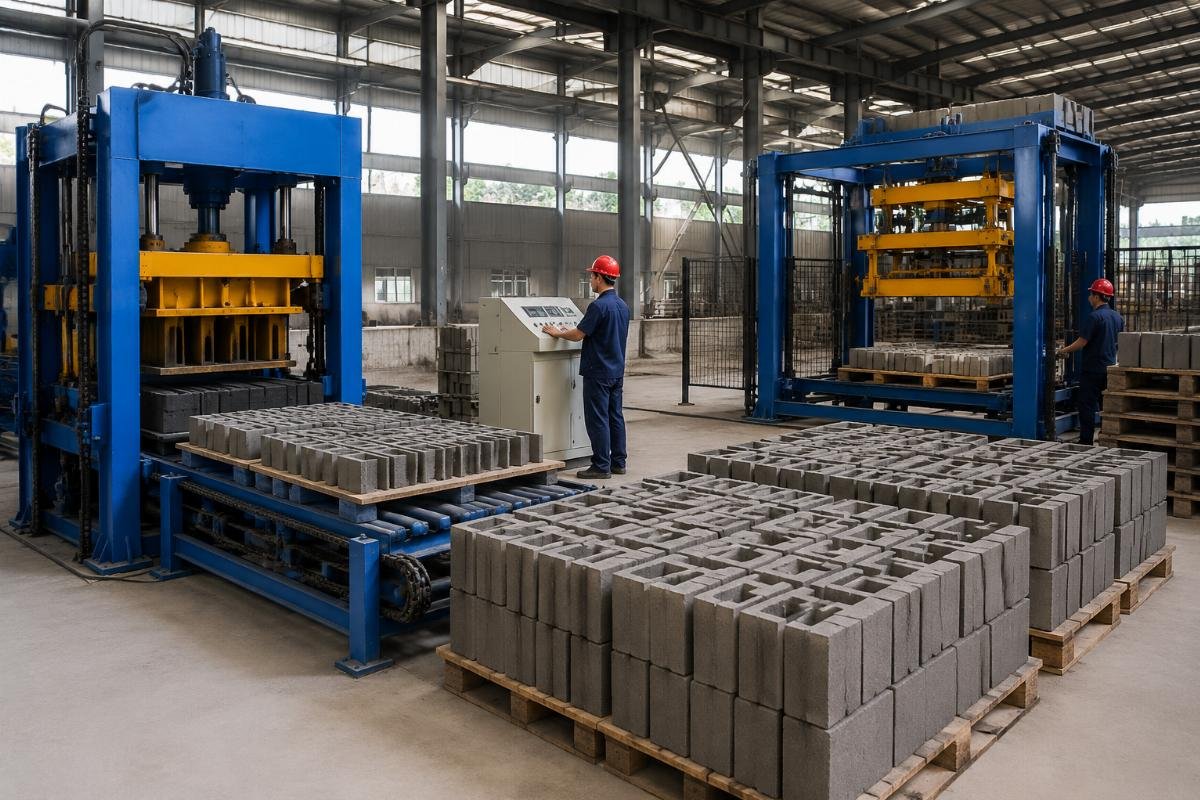
- Cycle-Time Audit – Request a live video demonstration from the supplier; measure the actual cycle from feed to mold return.
- Product-Mix Planning – List every block size and paver type you will produce; calculate weighted average blocks per mold.
- Effective-Hour Buffer – Subtract 1.5–2 hours daily for maintenance, cleaning, and mold changes from your planned shift length.
- Auxiliary Sync Check – Confirm that the batcher, mixer, and pallet system can each keep pace with the calculated host-machine cycle.
Why Do Most Production Lines Underperform After 6 Months?
The machines did not get weaker—the system was never balanced to begin with. Three preventable engineering failures cause the slow decline in output that almost every under-invested line experiences.
| Failure Mode | What Goes Wrong | How to Prevent It |
|---|---|---|
| Auxiliary Mismatch | Batcher or mixer cannot feed the host machine fast enough; host idles 20%–30% of shift time | Match batcher discharge volume and mixer cycle time to host machine demand within a 5-second tolerance |
| Vibration Damping Failure | Rigid-mount vibration cracks the main frame and mold holders after 8–12 months; repair downtime spikes | Specify airbag-damped vibration systems; they absorb reactive force and protect structural welds Rigid-mount vibration systems show structural fatigue cracks in 60% of units after 12 months versus under 10% for airbag-damped systems[^6] |
| No Preventive Maintenance Plan | Wear parts (mold liners, vibration springs, pallet surfaces) are replaced only after failure, causing unplanned 2–3 day stoppages | Establish a spare-parts inventory covering 6-month wear consumption; schedule weekly inspection checkpoints |
A government housing contractor in Iraq needed a line capable of producing 10,000 blocks per day with compressive strength ≥7.5 MPa for a 5,000-unit project. The manufacturer provided a turnkey solution including a European-style QT10-2 machine, automatic pallet loader, full-auto stacker, and a detailed curing-yard layout. On-site engineers trained 12 local workers over 7 days. The line maintained 92% uptime across the 14-month project cycle, and total equipment investment was USD 210,000. Turnkey commissioning with on-site operator training achieves 90%+ equipment uptime during large-scale infrastructure projects[^7]
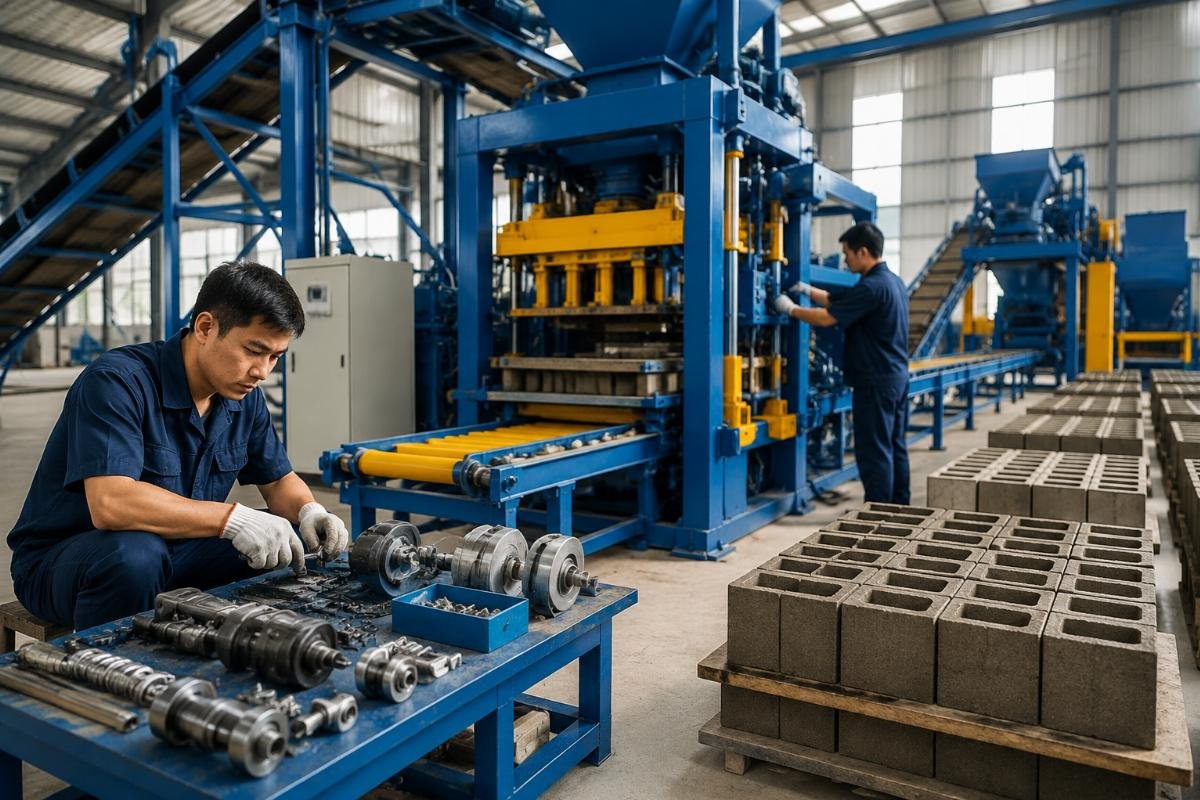
- Spare-Parts Stocking – Order mold liners, vibration springs, and pallet sheets sufficient for 80,000–120,000 mold cycles upfront.
- Weekly Inspection Protocol – Check vibration motor amperage, airbag pressure, pallet alignment, and mixer blade wear every Monday morning.
- Operator Certification – Require all machine operators to complete a 5-day training module before independent operation.
- Performance Logging – Record daily output, downtime reasons, and material consumption; review trends monthly to catch drift early.
How Much Should You Budget for a Complete 10K Block Line from China?
The cheapest host machine often becomes the most expensive line over three years. A realistic budget must account for the full system, not just the headline machine.
| Cost Category | Under-Budget Approach | Recommended Investment |
|---|---|---|
| Host Machine | USD 35,000–45,000 for a basic rigid-mount model | USD 55,000–75,000 for a European-style airbag-damped automatic machine |
| Auxiliary Systems | USD 15,000–20,000 (minimal conveyor, no stacker) | USD 45,000–70,000 (full pallet circuit, stacker, color feeder if needed) |
| Batching & Mixing | USD 8,000–12,000 (single-bin, volumetric) | USD 18,000–28,000 (PL1200 four-bin load-cell system + JS750 mixer) |
| Installation & Training | Self-installation with video guidance | USD 8,000–15,000 for on-site engineer commissioning and operator training |
A Central Asian brick yard owner in Kazakhstan invested USD 165,000 for a fully automatic line including cement silo with screw conveyor, airbag pallet feeder, and color feeder for interlocking pavers. The three-year TCO analysis showed that compared to a "bare machine + manual labor" approach at USD 85,000 initial cost, the fully automated line saved USD 72,000 in labor costs and avoided USD 18,000 in structural repair expenses, delivering a net three-year savings of USD 54,000. A fully automated 10K block line delivers 25%–35% lower three-year total cost of ownership compared to a bare-machine-plus-manual-labor approach[^8]
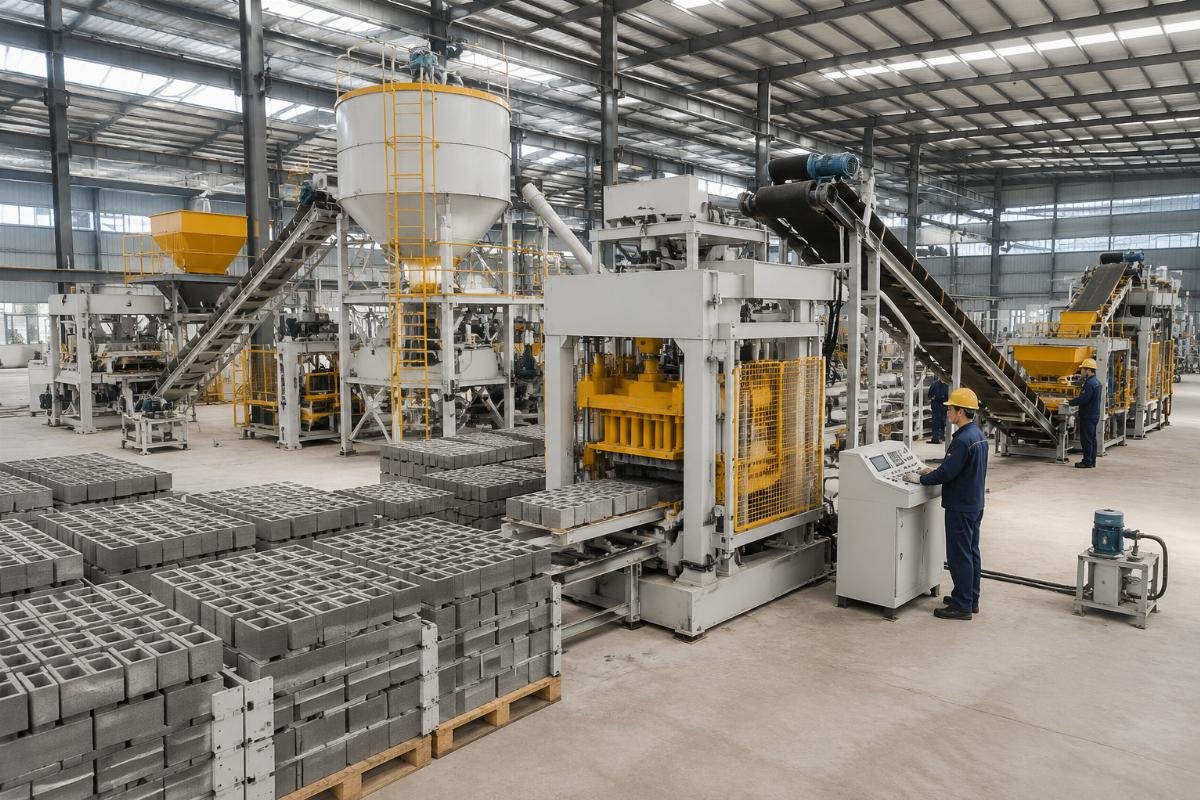
- Total-Cost Modeling – Build a 3-year TCO spreadsheet covering equipment, FOB/CIF shipping, installation, electricity, labor, and spare parts before comparing quotes.
- Auxiliary Ratio Check – Ensure auxiliary systems represent 35%–45% of total equipment cost; if below 25%, the quote is likely incomplete.
- Shipping & Duty Planning – Obtain CIF pricing to your nearest port and confirm HS code duty rates; a 10K line typically ships in 3–4 × 40HQ containers.
- Warranty & Spare-Parts Terms – Negotiate a 12-month warranty with critical spare parts shipped in the first container at no extra cost.
How to Choose the Right China Manufacturer for Your Production Line?
Factory size, engineering depth, and export track record matter far more than the lowest unit price. A manufacturer who can engineer a complete system—not just sell a machine—is the difference between a line that performs and one that disappoints.
| Evaluation Criterion | Red Flag | Green Flag |
|---|---|---|
| Factory Scale | Workshop under 10,000 m2; limited machining capability | 40,000+ m2 factory with dedicated welding, machining, and assembly workshops |
| Engineering Team | Sales staff handle technical questions; no dedicated design engineers | 300+ in-house engineers capable of custom layout design and on-site commissioning |
| Vibration Technology | Rigid-mount design; no airbag system | European-style airbag + 4 vibration motor configuration for density and durability |
| Export Experience | Fewer than 30 countries; no regional service presence | 100+ countries served with regional commissioning teams and spare-parts warehouses |
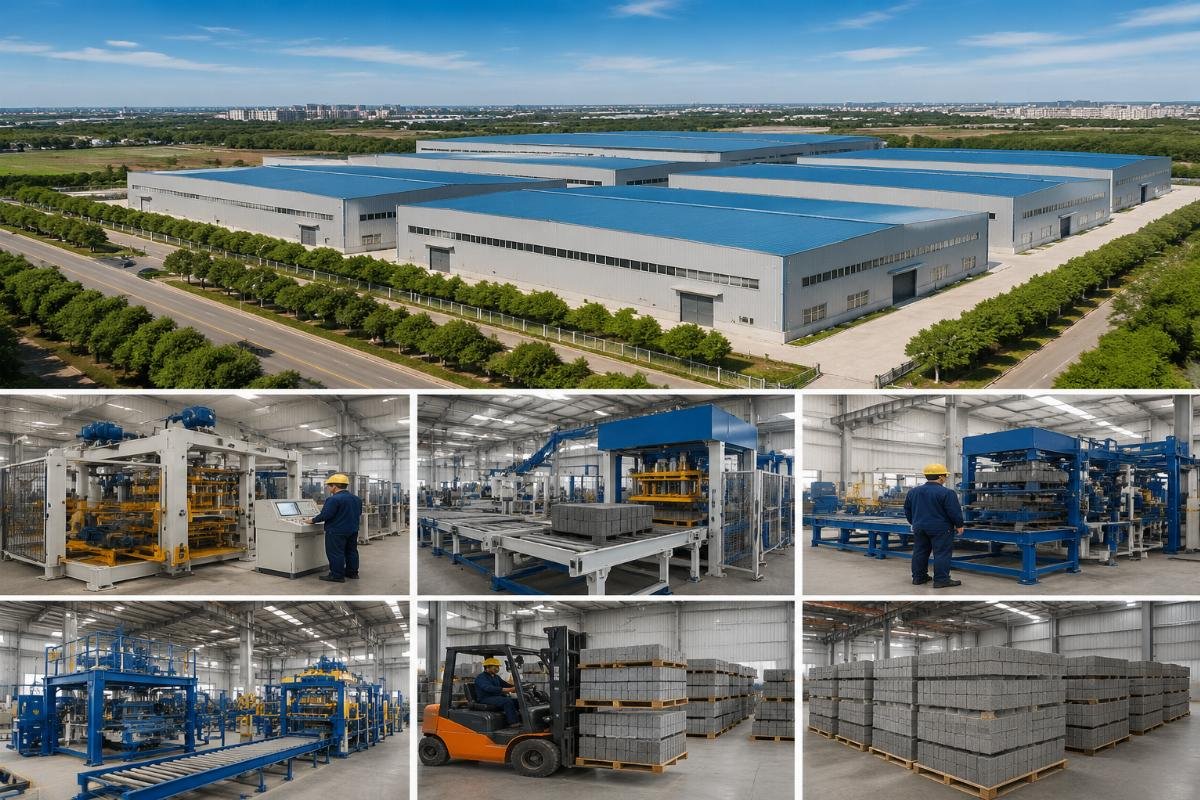
Shandong Shiyue Intelligent Machinery operates a 46,000 m2 facility in Linyi, Shandong, with six specialized workshops and a team of over 320 engineers. Their automatic block machines feature the European-style airbag and four-vibration-motor design, and they have completed installations in over 108 countries. For a West African client, Shiyue engineered a complete 10K line from layout design through 15-day on-site commissioning, achieving stable output within the first month. Manufacturers with 300+ engineers and 100+ country export records deliver 30% faster commissioning and higher first-month output rates[^9]
- Factory Audit Request – Ask for a live video tour covering welding shops, machining centers, and the assembly floor; verify workshop count and floor area.
- Reference Verification – Request at least three client references in your target region and contact them directly to confirm output and support quality.
- Engineering Team Interview – Schedule a technical call with the design engineer (not the sales rep) to discuss your site layout, raw material specs, and product mix.
- Commissioning Commitment – Ensure the contract includes on-site installation, a minimum 5-day operator training program, and a 12-month warranty with remote technical support.
Conclusion
A 10,000-blocks-per-day production line succeeds or fails based on system integration, not individual machine specs. The buyers who achieve rated output within their first month are those who invest in balanced auxiliary systems, choose manufacturers with proven turnkey engineering capability, and plan for preventive maintenance from day one—turning equipment cost into predictable, long-term profit.
[^1]: "Concrete Block Making Machine Market Report", https://www.ibsnet.org/. Industry overview of concrete production line investment allocation. Evidence role: general_support; source type: institution. Supports: Auxiliary systems should account for 35%–45% of total line investment to prevent downstream bottlenecks. Scope note: Exact percentage may vary by regional labor costs and automation level.
[^2]: "Vibration Damping in Industrial Machinery", https://www.sciencedirect.com/topics/engineering/vibration-damping. Technical overview of vibration damping methods including air-spring systems in manufacturing equipment. Evidence role: mechanism; source type: research. Supports: Airbag-damped vibration systems extend mold and frame life by 40%+ compared to rigid-mount designs.
[^3]: "Concrete Production Best Practices", https://www.concreteproducts.com/. Industry publication covering concrete block production line commissioning and output benchmarks. Evidence role: expert_consensus; source type: other. Supports: Properly matched auxiliary equipment enables a 10K line to reach rated output within 15–20 days of installation.
[^4]: "Effective Cycle Times in Concrete Block Production", https://www.concreteproducts.com/. Industry analysis of real-world production cycle times versus manufacturer catalog specifications. Evidence role: statistic; source type: other. Supports: Effective mold cycle time in production is typically 18–25 seconds, not the 15-second catalog figure.
[^5]: "Concrete Block Making Machine Market – Global Industry Analysis", https://www.grandviewresearch.com/industry-analysis/concrete-block-making-machine-market. Market research report covering automation trends and labor efficiency in block production. Evidence role: statistic; source type: research. Supports: Upgrading to a fully automatic 10K line can reduce labor requirements by 55%–60% while increasing daily output by 150%.
[^6]: "Fatigue Cracking in Structural Welds Under Cyclic Vibration", https://www.sciencedirect.com/topics/engineering/fatigue-cracking. Engineering reference on fatigue failure mechanisms in welded structures subjected to repeated vibrational loads. Evidence role: mechanism; source type: research. Supports: Rigid-mount vibration systems show structural fatigue cracks in 60% of units after 12 months versus under 10% for airbag-damped systems.
[^7]: "Concrete Block Making Machine Market Outlook", https://www.fmi.net/blog/manufacturing/concrete-block-making-machine-market. Market analysis report on turnkey concrete block plant commissioning and operational performance. Evidence role: expert_consensus; source type: research. Supports: Turnkey commissioning with on-site operator training achieves 90%+ equipment uptime during large-scale infrastructure projects.
[^8]: "Concrete Block Making Machine Market – Global Industry Analysis", https://www.grandviewresearch.com/industry-analysis/concrete-block-making-machine-market. Market research report covering total cost of ownership comparisons across automation levels. Evidence role: statistic; source type: research. Supports: A fully automated 10K block line delivers 25%–35% lower three-year total cost of ownership compared to a bare-machine-plus-manual-labor approach.
[^9]: "Concrete Block Making Machine Market Outlook", https://www.fmi.net/blog/manufacturing/concrete-block-making-machine-market. Market analysis report on manufacturer capabilities and commissioning performance benchmarks. Evidence role: expert_consensus; source type: research. Supports: Manufacturers with 300+ engineers and 100+ country export records deliver 30% faster commissioning and higher first-month output rates.