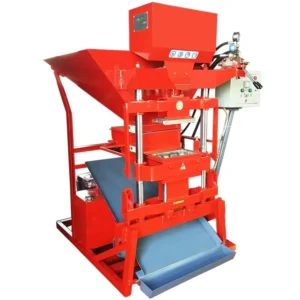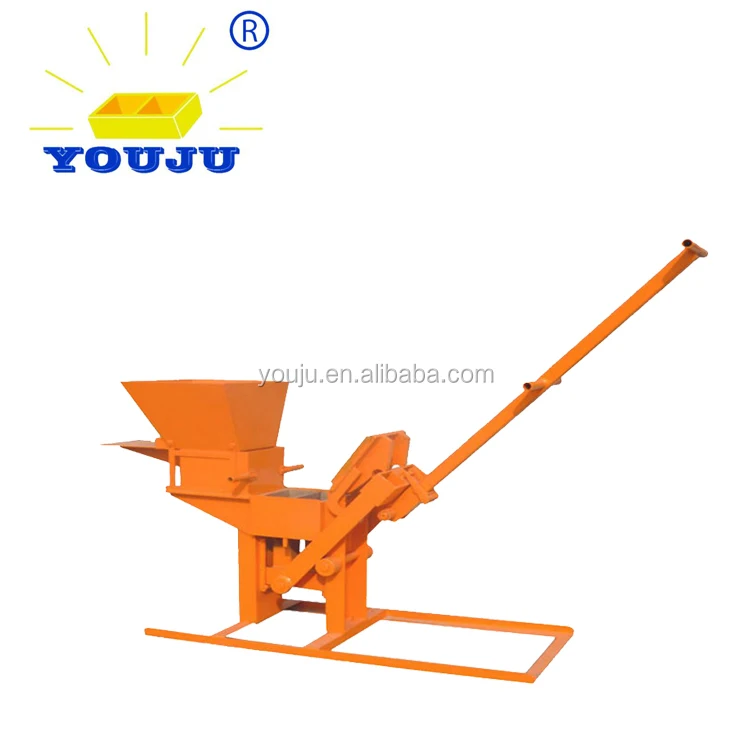
Station-Matched Line Design — the LY2-40 manual clay interlocking brick press is specified alongside its mixer, curing surface, and handling flow so the forming cycle is never starved of feed or buried under unstacked output.
Technical Specifications
| Parameter | Value |
|---|---|
| Product Type | Manual Clay Interlocking Brick Making Machine |
| Model | LY2-40 |
| Operation Type | Completely Manual (No Power Required) |
| Lifting System | Manual Lever Mechanism |
| Mobility | Steel Wheel Mobile Base |
| Overall Dimensions (L×W×H) | 1600 × 700 × 1200 mm |
| Net Weight | 200–240 kg |
| Total Power | None |
| Molding Cycle | 30–40 s (basis not stated in source — confirm block format / material / thickness) |
| Daily Capacity | 400–1000 pcs/day (basis not stated in source — confirm block format / material / thickness) |
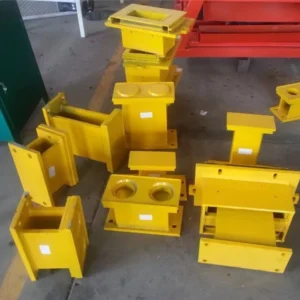
| Mould System | Changeable for Various Interlocking Formats |
| Recommended Mixer | JFA-1 or JQ350 |
| Control System | N/A (Manual Operation) |
| Voltage & Frequency | N/A |
| Warranty | 1 Year |
Application Suitability
| Application | Material or Output |
|---|---|
| Off-grid construction sites with no electrical supply | Soil-cement interlocking bricks formed and cured on-site |
| Small-scale ecological block production | Clay, laterite, or sandy loam blended with cement at controlled moisture |
| Housing and development project material supply | Interlocking bricks produced adjacent to the build location, eliminating transport |
| Existing concrete product plants adding clay formats | Soil-cement interlocking units integrated into current curing rack workflows |
Why "400 to 1000 Pieces per Day" Means Almost Nothing Without the Block Format
Capacity only becomes real when it is tied to a specific interlocking brick dimension, wall thickness, and soil-cement recipe.
I have watched plant owners sign purchase orders based on a headline daily output number, then discover on commissioning day that the figure assumed a thin paver while their market actually buys a thick-walled structural interlock. The molding cycle stretches, the mixer cannot keep pace, and the Manual Clay Interlocking Brick Making Machine production line / turnkey promise collapses into a press that sits idle half the shift [NEED_CITE: common discrepancies between quoted and actual block plant output]. The LY2-40 quotes 400–1000 pieces per day, but without the brick format stated, that range is a starting conversation, not a guarantee.
How the Mixing Station Sets the Rhythm for Everything Downstream
The LY2-40 completes one molding cycle every 30 to 40 seconds. If the JFA-1 or JQ350 mixer takes longer than that to deliver a homogeneous batch of soil-cement, the press waits. If the mixer finishes too quickly and the operator cannot move the batch in time, the mix begins to dry and lose workability. Matching mixer discharge rate to press cycle time is the single most important line-balancing decision in a Manual Clay Interlocking Brick Making Machine production line / turnkey setup, and it must be calculated before the line layout is drawn.
Curing and Handling — the Stations Most Quotations Leave Blank
Once the interlocking brick leaves the mould, it must be placed on a flat curing surface, protected from rapid moisture loss, and left undisturbed long enough for the cement to gain initial strength. Some buyers assume pallets are included; others assume the bricks stack directly on the ground. Neither assumption is safe. The choice between ground curing, pallet-based curing, and rack systems determines how much floor space the line consumes and whether the output can be moved in batches or only one brick at a time [NEED_CITE: curing method impact on early-age block strength].
Reading the Specs That Actually Shape Your Line Layout
The 1600 × 700 × 1200 mm footprint is compact, but the working envelope is larger once you account for the operator’s swing space on the manual lever, the mixer discharge chute, and the path to the curing area. The steel wheel mobile base means the press can be repositioned as the curing zone expands, but the wheels also mean the machine must be leveled and chocked before every production run to prevent vibration-induced misalignment during compaction. The 200–240 kg net weight keeps the unit movable by two people, yet heavy enough to resist walking during the compression stroke — provided the ground is firm and level. The changeable mould system allows multiple interlocking formats from one station, but each mould change requires the operator to release the retaining bolts, swap the cavity plate, and re-align the upper punch, a process that must be timed and included in daily capacity planning.
The Hidden Cost of Treating the Press as a Standalone Purchase
When only the forming station is quoted, the buyer is left to source a mixer, design a curing area, and figure out material staging alone. The result is a line where stations are mismatched — a mixer that overproduces, a curing zone that bottlenecks, and operators who spend more time moving bricks than pressing them [NEED_CITE: block plant downtime caused by line imbalance]. These problems do not show up in a factory test because the factory tests the press alone, not the line.
Why Sourcing the Full Line From One Supplier Matters Here
Block machinery is our single focus, which means the LY2-40 is not sold as a standalone press but as the forming node in a system where mixer output, mould format, and curing method are specified together. The line layout you receive states daily capacity per brick format, not a single headline number. Mixer-to-press cycle matching is calculated so the JFA-1 or JQ350 output rate aligns with the 30–40 second molding rhythm. Mould format lists and change procedures are documented so flexibility is verifiable. Voltage and control language confirmation is irrelevant for this manual unit, but if you later add an automated mixer or pallet station, the electrical scope is defined from the start. Factory test records cover the actual soil-cement mix you will run, not a generic sand blend.
Documentation & Verification
- Line layout with daily capacity calculated per specific interlocking brick format
- Mixer-to-press cycle matching sheet for JFA-1 or JQ350 discharge rate
- Mould format list with changeover procedure and tooling requirements
- Factory test record on buyer’s actual soil-cement blend before dispatch
- Pallet or ground curing specification confirming downstream handling method
Installation, Commissioning & Support
- Level and compact the ground surface to support the 200–240 kg frame without settling during compaction strokes
- Position the JFA-1 or JQ350 mixer within one-meter reach of the feed hopper to minimize batch transfer time
- Chock steel wheels before every production run to prevent frame walk during lever compression
- Conduct first-run mould alignment check with buyer’s specific soil-cement mix to verify brick dimensional tolerance
- Train operators on mould change procedure including retaining bolt torque sequence and upper punch re-alignment
- Supply wear parts list covering lever pivot pins, mould cavity liners, and punch face plates
What to Include in Your Inquiry
Provide the exact interlocking brick dimensions your market sells, including length, width, height, and interlock profile depth. State the soil type available on your site and the cement ratio you plan to use, so the mixer pairing can be confirmed. Describe your curing area dimensions and whether you intend to cure on the ground, on pallets, or on racks, so the handling flow downstream of the LY2-40 can be designed accordingly.
Frequently Asked Questions
Q: How is the 400–1000 pieces per day capacity calculated, and which interlocking brick format is the basis?
A: That range depends entirely on the brick dimensions, wall thickness, and soil-cement recipe. A small thin-wall ecological block cycles faster than a thick structural interlock. We provide a capacity calculation sheet that states the exact format assumed, so you can compare it against your actual product mix before confirming the order.
Q: How do I match the JFA-1 or JQ350 mixer output to the LY2-40 cycle so the press is never waiting?
A: The mixer must deliver a fully blended batch within the 30–40 second molding window. We calculate the batch volume per cycle, the mixer’s discharge rate, and the operator transfer time, then confirm whether one mixer is sufficient or a second unit is needed to maintain continuous pressing rhythm.
Q: What curing and handling stations complete the line after forming?
A: Options include flat ground curing, pallet-based curing, or rack systems. The choice depends on your available space, climate, and how quickly you need to move finished bricks. We specify the curing surface type and downstream handling method in the line layout so nothing is left undefined after the press.
Q: Can the LY2-40 be upgraded later with an automated pallet feeding or stacking station?
A: The manual press itself has no electrical interface, so adding automated handling requires introducing a separate pallet conveyor or stacking frame alongside it. We can plan the line layout with future automation zones reserved, so the upgrade path does not require repositioning the existing forming station.