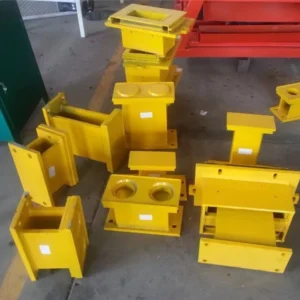
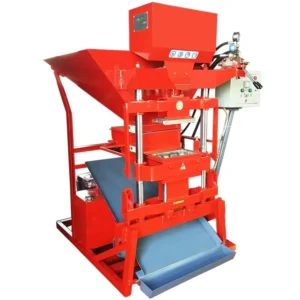
Fully Configured Line — Every station from the raw material mixer through to the curing rack is specified to match the LY4-10 cycle time, so the press never sits idle waiting for the next pallet or batch.
Technical Specifications
| Parameter | Value |
|---|---|
| Model | LY4-10 |
| Product Type | Clay Interlocking Brick Making Machine |
| Rated Power | 11 kW |
| Voltage & Frequency | Customized to local voltage (confirm exact V/Hz before order) |
| Control System | Automatic operation (feeding, mould pressing, mould lifting) |
| Overall Dimensions (L×W×H) | 2260 × 1500 × 2380 mm |
| Net Weight | 1500 kg |
| Hydraulic Pressure | 25–32 MPa |
| Moulding Cycle | 7–10 seconds (basis to be confirmed per block format, material and thickness) |
| Bricks per Mould | 4 pcs |
| Output Capacity | Basis to be confirmed per block format, material and thickness |
| Mould Format | Interlocking brick (custom mould design available per buyer drawings) |
| Warranty | 1 year (excluding wearing parts) |
Application Suitability
| Application | Material or Output |
|---|---|
| Interlocking clay brick production | Local clay blended with cement and water |
| Ecological soil block formats | Cement-stabilized soil and red laterite mixes |
| Small-to-medium brick plant output | Consistent daily production of interlocking pavers and wall blocks |
| On-site contractor production | Project-specific volumes using locally sourced aggregate |
| Existing product range expansion | Adding interlocking brick formats to concrete product lines |
What a "7-10 Second Cycle" Leaves Out of the Quotation
A fast press cycle is meaningless if the mixer or stacker cannot keep up with the same rhythm.
I have stood on sites where the clay interlocking brick machine production line was sold on a 7-second cycle, but the manual pallet feeding and hand-stacking meant the actual output was less than half of the promised number. The quotation often covers the press and nothing else, leaving the buyer to hire extra labor for curing and stacking. When the supporting stations are an afterthought, the press spends more time waiting than running [NEED_CITE: typical manual versus automatic line throughput comparison in block plants].
Matching the Mixer to the Clay-Cement Blend
The LY4-10 requires a consistent feed of clay, cement, and water to maintain the density and interlocking tolerances of every brick. If the mixer is undersized or the wrong type, the press will receive batches with uneven moisture, leading to weak bricks or jammed moulds. A complete clay interlocking brick machine production line specifies the mixer capacity and type — typically a pan mixer for sticky clay blends — to ensure the 7-10 second moulding cycle is fed without interruption.
Pallet Handling and Curing Rack Logistics
The four bricks produced per cycle need a pallet that matches the buyer’s existing curing area and forklift capacity. Specifying the wrong pallet size means the buyer must purchase new racking or manually rearrange stacks, which defeats the purpose of automation. The stacker and curing rack handling equipment must be included in the line layout so that output moves from the press to the curing zone at the same rate it is produced [NEED_CITE: pallet sizing and curing rack layout for interlocking block plants].
Reading the Pressure and Cycle Data
The 25–32 MPa hydraulic pressure range is not just a maximum rating; it is adjusted based on the buyer’s specific clay-cement ratio and local aggregate hardness. Higher pressure is needed for denser, load-bearing interlocking bricks, while lower pressure may suffice for non-structural ecological blocks. The 7-10 second cycle time depends on the brick thickness and the hydraulic flow rate, which must be confirmed against the target format before the line is built.
The Cost of Ignoring the Supporting Stations
When the line is quoted without pallet feeding, stacking, or curing rack handling, the buyer faces unexpected costs after the machine arrives. Extra labor must be hired to move wet bricks by hand, which introduces inconsistency and damage before the curing stage. In some cases, the buyer’s existing forklift cannot lift the pallets chosen by default, forcing a last-minute purchase of new handling equipment or a complete redesign of the curing yard [NEED_CITE: hidden costs of incomplete block line quotations].
Why Specify the Whole Line From One Source
- Single-Source Matching: The mixer, pallet feeder, stacker, and curing rack are selected as one system, not assembled from separate suppliers with mismatched cycle times.
- Mix-Design Configuration: The hydraulic pressure and vibration are set against the buyer’s actual clay source and cement ratio, not a generic catalogue default.
- Custom Mould Engineering: Moulds for the specific interlocking formats sold in the buyer’s market, including custom designs from buyer drawings.
- Automation Level Selection: The line can start with semi-automatic pallet handling and be upgraded to full stacking and cubing as production volume grows.
Documentation & Verification
- Line layout drawing showing each station and capacity matched to the LY4-10 cycle
- Hydraulic and electrical schematics with voltage and control language confirmed
- Mould drawing and format list for the interlocking brick profiles included in the order
- Factory test record run on the buyer’s specified clay-cement mix ratio
- Operation and maintenance manual with wear parts list for moulds and hydraulic seals
Installation, Commissioning & Support
- Foundation plan for the 2260 × 1500 mm footprint and 1500 kg weight, including mixer and stacker zones
- Power supply confirmation for the 11 kW rated load and local voltage before the control panel is wired
- On-site assembly of the press, pallet feeder, and curing rack handling system with alignment checks
- First-run parameter setting for hydraulic pressure and cycle time on the buyer’s local clay blend
- Operator training covering mould change procedure, daily lubrication points, and PLC fault codes
- Wear parts supply schedule for mould liners, hydraulic seals, and pallet return rollers
Preparing Your Inquiry
To specify the clay interlocking brick machine production line correctly, provide the exact clay-cement-water ratio you intend to use and a sample of the local aggregate. We need the target daily output and the specific interlocking brick format, including dimensions, to calculate the realistic capacity. Confirming the local voltage, frequency, and preferred PLC display language ensures the control system is ready upon arrival.
Frequently Asked Questions
Q: How is daily output calculated and which interlocking brick format does the figure assume?
A: The output figure must be based on the specific brick dimensions, the clay-cement mix density, and the actual moulding cycle achieved with that material. We provide a capacity calculation in the quotation that states the exact brick format assumed, so the daily number matches the product you intend to sell rather than a theoretical maximum.
Q: What supporting equipment is included in the line quotation?
A: The quotation covers the raw material mixer, pallet feeding system, the LY4-10 press, automatic stacker, and curing rack handling equipment. Each station is specified to match the cycle time of the press, ensuring the line runs as a continuous system rather than a standalone machine waiting for manual input between stages.
Q: How do we confirm voltage, frequency, and PLC display language before shipment?
A: We require the exact V/Hz rating of your site supply and the preferred language for the control interface during the inquiry stage. These parameters are locked in before the electrical panel is wired and the PLC is programmed, preventing commissioning delays or costly rewiring after the machine arrives at your site.
Q: How are pallet size and material chosen to match the curing area?
A: The pallet dimensions and material are selected based on the weight of the four wet interlocking bricks per cycle and the racking system in your curing yard. We also check compatibility with your existing forklift capacity to ensure smooth transfer from the stacker to the curing zone without purchasing new handling equipment.