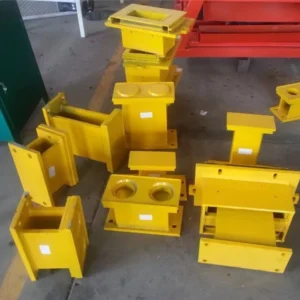
Hydraulic press at the centre — every upstream feeder, mixer discharge rate and downstream pallet loop is timed to the ECO 2700’s 10-second moulding cycle so no station waits.
Technical Specifications
| Parameter | Value |
|---|---|
| Model | ECO 2700 |
| Product Type | Hydraulic Clay Interlocking Brick Making Machine |
| Machine Power | 7.5 kW electric motor or 12 hp diesel engine |
| Molding Cycle | 10 s |
| Output Capacity | 2800 pcs / 8 hours (basis not stated in source — confirm block format / material / thickness) |
| Hydraulic Pressure | 16 MPa |
| Raw Material Compatibility | Clay, soil, earth, mud, concrete, sand, cement, fly ash |
| Machine Weight | 900 kg |
| Overall Dimensions (L×W×H) | 1600 × 1300 × 2330 mm |
| Workers Required | 3–4 |
| General Water Consumption | 4 t per day |
| Workshop Area | 150 m² |
| Mould Format | 300 × 150 × 100 mm or 250 × 125 × 75 mm (1 pc per mould) |
| Productivity | 350 pcs/h, 2800 pcs/8h (based on 300×150×100 mm or 250×125×75 mm interlocking block, 1 pc per mould) |
| Automation Level | Automatic material feeding, mould pressing, and mould lifting |
| Power Source Option | Electric motor or diesel engine |
| Mould System | Interchangeable moulds for varied block, brick and floor formats |
| Warranty | 1 year for the whole machine |
Application Suitability
| Application | Material or Output |
|---|---|
| Housing project brick production | Local clay and soil interlocking bricks |
| On-site construction block making | Earth and cement interlocking blocks with diesel power |
| Medium plant product expansion | Concrete, sand and fly ash interlocking formats |
| Rural building material supply | Mud and soil compressed bricks |
Why the Line Stops When the Mixer Cannot Keep Up
A 10-second press cycle demands a mixer that discharges a full batch in under 10 seconds — most standard pan mixers cannot match that tempo.
On project sites across Latin America, I watched clay interlocking brick machine production line setups stall because the upstream mixer discharged every 25 seconds while the ECO 2700 cycled every 10. The press sat idle, operators hand-fed material, and block density varied with every inconsistent batch. The bottleneck was never the press itself; it was the uncoordinated rhythm between stations [NEED_CITE: production line cycle time synchronisation in small block plants]. When you evaluate a clay interlocking brick machine production line, the press is only as productive as the slowest station feeding it.
Matching Every Station to the 10-Second Cycle
The ECO 2700 completes one moulding cycle in 10 seconds, which means raw material must arrive, pallets must be positioned, and finished bricks must be cleared at that same pace. A clay interlocking brick machine production line built around this press requires a feeder hopper with a gate that opens and closes within one to two seconds and a mixer that releases a full charge in well under the cycle window. When any station lags, the press waits, and daily output drops below the rated figure.
From Soil Hopper to Curing Rack
Beyond the press, the line includes a soil screening and feeding station, a water dosing unit calibrated to the 4 t/day general water consumption, and a pallet circulation loop that returns boards before the next cycle begins. The ECO 2700’s automatic material feeding, mould pressing, and mould lifting remove three manual interventions, yet pallet handling and stacking downstream still need specification [NEED_CITE: pallet handling integration in small hydraulic brick lines]. If the buyer’s curing area uses a specific forklift reach, the pallet dimensions must match that equipment before the line layout is finalised.
Reading the Numbers That Matter
Hydraulic pressure of 16 MPa compresses the clay-soil mix to a density that supports load-bearing wall construction, but only if the mix moisture sits within the range the pressure was calibrated for — too wet and the brick deforms on demoulding, too dry and edges crumble. The interchangeable mould system accepts both 300 × 150 × 100 mm and 250 × 125 × 75 mm formats, producing one piece per stroke; switching formats means changing the mould box, which requires a crane or hoist given the 900 kg machine weight and compact 1600 × 1300 × 2330 mm footprint. Dual power sourcing — 7.5 kW electric motor or 12 hp diesel engine — lets the line run on sites where grid supply is unreliable, a common condition in remote housing projects. The 150 m² workshop area requirement covers press, feeder, mixer and a short pallet return conveyor, but not the curing yard, which must be planned separately.
The Cost of Skipping Line-Level Planning
Quotations that list only the press leave pallet handling, stacking and curing to the buyer, which usually means bricks piled by hand beside the machine. Output then depends on how fast two workers can carry wet boards, and any bottleneck in that loop backs up into the press [NEED_CITE: manual handling bottleneck in brick production plants]. Voltage and control language confirmed after arrival delay commissioning by weeks while replacement contactors and relays are sourced locally [NEED_CITE: voltage and frequency mismatches at equipment import]. Moulds and hydraulic seals that are not included in the initial spare parts list cause a second production halt when the first replacement falls due.
Why Buyers Source the Full Line Here
Block machinery is a single focus, so the ECO 2700 press, its moulds, pallets and handling equipment are specified as one matched system rather than assembled from separate suppliers. Line configuration starts from the buyer’s actual mix design and local aggregate, not a catalogue default, ensuring the 16 MPa hydraulic pressure is calibrated to the soil-cement ratio available on site. Mould design covers the interlocking formats the buyer’s market actually sells, including custom drawings for non-standard dimensions. Automation level is selectable, so a buyer can begin with the ECO 2700’s automatic feeding and pressing and add pallet stacking later. Installation and commissioning support includes operator training so the three to four workers learn cycle timing and mould change procedures before handover.
Documentation & Verification
- Line layout showing ECO 2700 cycle time matched to each feeder and conveyor station
- Capacity calculation stating the block format behind the 2800 pcs/8h figure
- Mould drawing listing both 300 × 150 × 100 mm and 250 × 125 × 75 mm formats
- Hydraulic and electrical schematic for the 16 MPa circuit and 7.5 kW or 12 hp drive
- Voltage, frequency and control language confirmation sheet before dispatch
- Factory test record on the buyer’s specified clay-soil mix before shipment
Installation, Commissioning & Support
- Level concrete pad inside the 150 m² workshop sized to the 1600 × 1300 × 2330 mm footprint
- Dedicated circuit for 7.5 kW motor or diesel fuel supply for 12 hp engine variant
- Machine arrives as single skid; hydraulic hoses and feeder connections assembled on site
- First run verifies 10-second cycle timing with buyer’s actual clay and cement mix
- Operator training covers mould change between 300 × 150 × 100 mm and 250 × 125 × 75 mm formats
- Hydraulic seals, mould wear plates and feeder gate components stocked for first-year replacements
What We Need to Build Your Line Layout
To size the complete clay interlocking brick machine production line around the ECO 2700, share your target block format and daily volume requirement so the feeder and mixer can be matched to the 10-second cycle. Confirm local voltage, frequency and preferred control display language to avoid commissioning delays. Tell us your existing curing yard dimensions and forklift capacity so the pallet specification fits what you already handle on site.
Frequently Asked Questions
Q: How is the 2800 pcs/8h capacity verified and which block format does it assume?
A: The 2800 pcs/8h figure is based on either the 300 × 150 × 100 mm or 250 × 125 × 75 mm interlocking block format at one piece per mould. Capacity calculations provided with each quotation state the exact format and mix assumed, so buyers can compare against their actual product target rather than a generic number.
Q: How should upstream mixing and feeding stations be sized to match the 10-second press cycle?
A: The mixer must discharge a full batch in well under 10 seconds, and the feeder hopper gate must open and close within one to two seconds. Our line layout specifies mixer drum volume and feeder gate diameter against the ECO 2700 cycle so no station waits for material between strokes.
Q: What pallet size and material are recommended for the ECO 2700 line?
A: Pallet dimensions are chosen to match the buyer’s curing rack spacing and forklift fork width, not a default size. Material options include treated timber or bamboo-composite boards, selected based on the local climate and expected handling cycles before replacement.
Q: Can the line run on sites without grid electricity?
A: Yes. The ECO 2700 is available with a 12 hp diesel engine instead of the 7.5 kW electric motor, allowing the press and feeder to operate independently of grid supply. Fuel consumption and engine maintenance intervals are included in the operation manual.
Q: What documentation covers the full line from raw material feed to stacking?
A: Each shipment includes a line layout diagram, capacity calculation per block format, hydraulic and electrical schematics, mould drawings, factory test record on the buyer’s mix, voltage and language confirmation sheet, and an operation manual covering every station from soil hopper to pallet return conveyor.