Upstream-to-Press Workflow Matching — every station from the JFA-1 mixer through the LY2-40 manual press and outdoor curing area is specified as one continuous line, not a catalogue press sold in isolation.
Technical Specifications
| Parameter | Value |
|---|---|
| Model | LY2-40 |
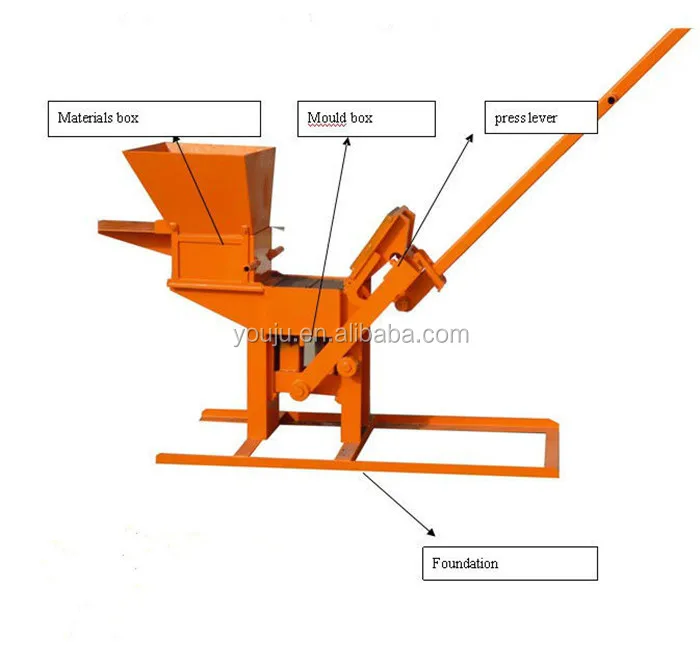
| Product Type | Manual Clay Interlocking Brick Making Machine |
| Power Source | No Power, Completely Manual |
| Lifting System | Manual |
| Mobility | Steel wheels for mobile operation |
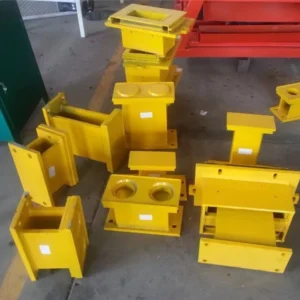
| Mould System | Changeable moulds for various block formats |
| Molding Cycle | 30-40s (basis not stated in source — confirm block format / material / thickness) |
| Output Capacity | 400-1000 pcs/day (basis not stated in source — confirm block format / material / thickness) |
| Overall Dimensions (L×W×H) | 1600 × 700 × 1200 mm |
| Net Weight | 200-240 kg |
| Recommended Mixer | JFA-1 Mixer or JQ350 Mixer |
| Warranty | 1 Year |
| Assembly State | Mobile unit, no fixed plant required |
| Key Features | Zero-power operation, hand-lever compaction, steel-wheel chassis, mould interchangeability |
Application Suitability
| Application | Material or Output |
|---|---|
| Rural housing construction on sites with no grid connection | Local clay or earth mixed with sand and water |
| Community-scale brick cooperatives with outdoor curing yards | Low-plasticity soil blends, hand-fed from batch mixer |
| Disaster-relief and remote infrastructure projects | Transportable press following a shifting work front |
| Small contractor yards producing interlocking bricks in limited runs | Clay, laterite or stabilized earth with site-available aggregate |
Why "400 to 1000 Pieces per Day" Means Almost Nothing Without the Rest of the Line
A press quoted in isolation leaves the buyer improvising everything downstream.
I remember a project in West Africa where the contractor received a manual interlocking brick press and immediately started production. By the second day, freshly moulded bricks sat on bare ground because no curing workflow had been planned, the mixer was undersized for the press cycle, and the clay source was too sandy for the default mould configuration. The quoted daily output was never reached. [NEED_CITE: common causes of low output in manual brick production]
The Manual Clay Interlocking Brick Making Machine production line on this page addresses that gap. The LY2-40 is treated not as a standalone tool but as the central station in a sequence: material arrives, the mixer homogenizes it, the operator feeds the mould, the lever compacts the brick, the brick is demoulded onto a flat surface, and curing follows. Each of these stages must be planned before the press is bolted down.
How the Upstream Stations Keep the Press Fed
The JFA-1 or JQ350 mixer sits at the start of this manual clay interlocking brick making machine production line. Its job is to blend the local clay with sand, water, and any stabilizer into a uniform feed before it reaches the LY2-40 hopper. Without consistent material, the operator spends more time adjusting the lever force than actually producing bricks. Mixer batch size and cycle time must overlap with the 30-40 second moulding stroke so the press never waits for the next batch.
Curing Workflow on a Mobile, Non-Fixed Layout
Because the LY2-40 rolls on steel wheels, the curing area is not a fixed rack system. Bricks are demoulded directly onto a prepared flat surface near the press. The operator moves the machine forward as the curing yard fills, which means the production floor plan must account for a moving press and an expanding curing zone behind it. [NEED_CITE: open-air curing requirements for clay interlocking bricks] Planning this flow before shipment prevents the common situation where bricks are stacked haphazardly and crack under their own weight before reaching full strength.
Reading the Specs That Actually Matter for This Line
The 200-240 kg net weight of the LY2-40 is low enough for two people to reposition on the steel wheels, but it also means the machine relies entirely on the operator’s lever force for compaction — there is no hydraulic assist or vibration motor. Clay mix consistency therefore becomes the primary variable controlling brick density. A mix that is too dry will resist compaction and produce weak bricks; a mix that is too wet will stick to the mould walls and slow the demould cycle. The 30-40 second moulding cycle is achievable only when the upstream mixer delivers material at the right moisture and the operator maintains a steady rhythm. Mould changeability lets one frame produce multiple interlocking profiles, but each format requires its own verified cycle time and daily output figure before a production plan can be trusted.
What Happens When the Line Stations Are Specified Separately
When the mixer, press, and curing plan come from different conversations — or when only the press is quoted — the mismatches surface on site. The mixer may produce batches faster than the operator can mould them, leaving wet clay sitting in the trough and drying unevenly. Or the curing yard may be too small, forcing the operator to stack bricks before they are ready to handle. These problems are not press failures; they are line-planning failures, and they cost time that no warranty covers. [NEED_CITE: manual brick production line coordination failures]
Why the Line Is Planned Here, Not Assembled from Catalogue Pages
Block machinery is our single focus, so the LY2-40, its mould set, and the recommended JFA-1 or JQ350 mixer are specified together against the buyer’s actual clay sample and target brick format. We test the buyer’s soil before confirming the mould configuration — a step that came from sending a machine to a site where the local clay cracked after drying, forcing a full parameter reset. Configuration is set against the buyer’s mix design and local aggregate, not a catalogue default. Mould design covers the interlocking profiles the buyer’s market actually sells. The automation level is honest: this is a fully manual line, and we make that clear upfront so there are no expectations of powered conveyors or stackers.
Documentation & Verification
- Line layout showing mixer, LY2-40 press, and curing area with distances
- Capacity calculation stating the interlocking block format assumed for cycle time
- Mould drawing and format list for included and optional profiles
- Mixer specification matching JFA-1 or JQ350 batch size to press feed rate
- Factory test record on the buyer’s shipped soil sample before dispatch
- Packing photographs showing dismantling state for container loading
Installation, Commissioning & Support
- Level ground preparation with a compacted base for the 1600 × 700 mm LY2-40 footprint
- No electrical supply required; the zero-power design eliminates wiring and voltage confirmation
- Machine arrives mobile on steel wheels; reassembly limited to lever arm and hopper attachment
- First-run commissioning includes moulding test bricks from the buyer’s own clay sample
- Operator training covers lever rhythm, mix moisture control, and mould change procedure
- Wear parts list identifies mould liner and lever pivot components for first reorder
What We Need From You to Plan This Line
Send us your target interlocking brick format, a representative clay sample from your site, and the dimensions of your available curing area. If you already own a mixer or other upstream equipment, include its model and batch capacity so we can confirm whether it pairs with the LY2-40 cycle or whether the JFA-1 or JQ350 is the better fit.
Frequently Asked Questions
Q: How is the daily output of 400-1000 pcs/day calculated, and which interlocking block format does it assume?
A: That range depends entirely on the block format, clay mix consistency, and operator rhythm. A larger interlocking profile with deeper cavities takes longer to fill and compact than a smaller solid brick. We calculate a specific daily output only after confirming your target format and testing your clay sample on the LY2-40 in our workshop.
Q: What upstream mixer and material feed setup is needed so the press is not left waiting between cycles?
A: The JFA-1 or JQ350 mixer is recommended because its batch size and blending time align with the 30-40 second moulding stroke of the LY2-40. If you use a different mixer, we need its batch volume and cycle duration to confirm that material arrives at the press hopper without gaps or pile-ups.
Q: How do I plan the curing area and pallet flow when the press produces bricks on a mobile, non-fixed layout?
A: The LY2-40 rolls on steel wheels, so bricks are demoulded onto a prepared flat surface and the machine is repositioned as the curing yard fills. Your site plan must allocate a growing curing zone behind the press, with enough flat area for the daily output to rest until handling strength is reached.
Q: What mould formats are available for the LY2-40, and how long does a mould change take in practice?
A: The press accepts changeable moulds for various interlocking profiles. Mould change involves unbolting the current cavity plate and fitting the new one, which a trained operator can complete within a single shift break. We provide a format list and mould drawing with every quotation so you know which profiles are included.
Q: Can the line be upgraded later to semi-automatic mixing or pallet handling without replacing the press?
A: The LY2-40 is a fully manual, zero-power press with no electrical interface, so upstream or downstream automation must connect through material transfer rather than signal integration. We can advise on adding a powered mixer or a simple pallet conveyor while keeping the LY2-40 as the moulding station in a semi-manual layout.