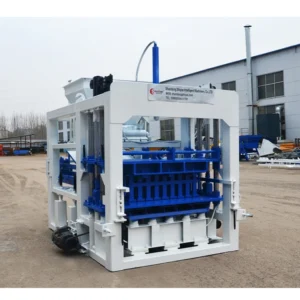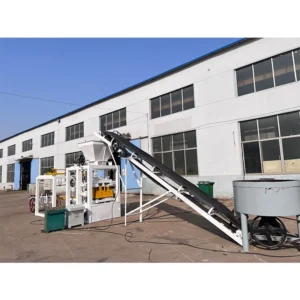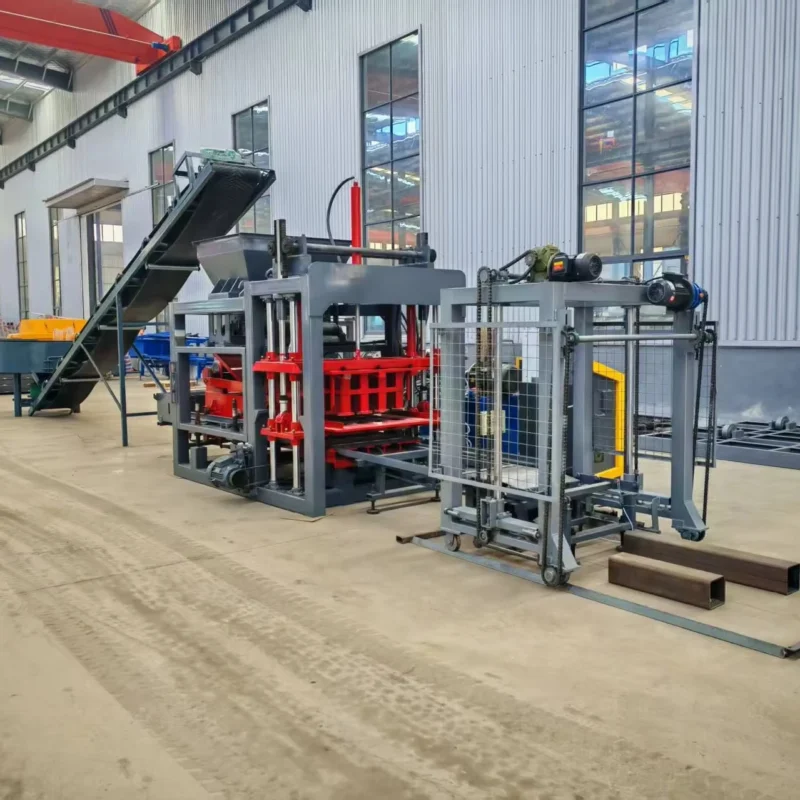
Matched System Integration — The QT4-15 sits at the center of a complete block production line where feeding, mixing, pallet circulation, and stacking stations are timed to the press cycle so no upstream or downstream bottleneck leaves the host machine idling.
Technical Specifications
| Parameter | Value |
|---|---|
| Model | QT4-15 |
| Product Type | Automatic Hydraulic Block Making Machine |
| Overall Dimensions (L×W×H) | 7100×1600×2610 mm |
| Host Machine Dimensions | 2800×1800×2550 mm |
| Rated Pressure | 16 MPa |
| Main Vibration Form | Platform Vibration |
| Vibration Frequency | 4600 r/min |
| Vibration Force | 40 kN |
| Pallet Size | 950×550×20/25 mm |
| Molding Cycle | 15–25 s |
| Overall Power | 27.5 kW |
| Host Machine Power | 19.2 kW |
| General Water Consumption | 4 T/day |
| Total Mass | 5 T |
| Control System | PLC (Siemens, independently developed program) |
| Motor Brand Options | Siemens or ABB |
| Hydraulic System | Double proportional hydraulic valve (Calyca or Youken) |
| Automation Level | Automatic (hydraulic press + platform vibration + PLC control) |
| Warranty | 1 year (excluding spare parts) |
Application Suitability
| Application | Material or Output |
|---|---|
| Stationary hollow block plant | Hollow brick 390×190×190 mm, 4 pcs/mold, 15–20 s cycle |
| Porous brick production | Porous brick 240×115×90 mm, 14 pcs/mold, 15–20 s cycle |
| Standard brick manufacturing | Standard brick 240×115×53 mm, 28 pcs/mold, 15–17 s cycle |
| Paving brick and interlocking paver line | Paving formats on 950×550 mm pallets with platform vibration |
Why the Mixer and Pallet Feeder Decide Your Real Daily Output
A block press can only run as fast as the slowest station feeding it.
I spent years on the assembly floor in Linyi before moving into line planning, and the most common failure I see is not the press itself breaking down. It is the press standing still. A buyer invests in a QT4-15, sees the cycles-per-hour figure on the quotation, and assumes that number will hold for an eight-hour shift. Then the mixer takes forty seconds to discharge a batch that the press consumes in twenty, or the pallet feeder jams because the return conveyor was never specified. The press waits. Daily output drops. The buyer blames the machine [NEED_CITE: typical block line bottleneck causes in stationary plants].
The supporting equipment for block making line determines whether the quoted molding cycle translates into actual pallets of cured product at the end of the day.
Synchronizing Every Station Around the 15–25 Second Molding Cycle
The QT4-15 completes a press cycle in 15 to 25 seconds depending on block format and mix design. That timing sets the heartbeat for the entire block production line equipment layout. The raw material batcher must deliver a homogeneous mix to the hopper before the press calls for the next charge. The pallet feeder must index a clean, dry pallet into position while the press is still vibrating the previous mold. If any of these transfers lag, the PLC holds the press in idle and the cycle time stretches well beyond the rated window.
Pallet Circulation as the Hidden Bottleneck
Pallets travel from the press to the curing rack, sit during hydration, and return to the feeder. A 950×550 mm pallet on a QT4-15 line means the curing rack spacing, the forklift fork width, and the return conveyor belt must all accommodate that exact dimension. We have seen plants where the pallet size was chosen to match the press catalog rather than the buyer’s existing curing infrastructure, forcing a separate pallet purchase or a rack modification that delayed commissioning by weeks [NEED_CITE: pallet and curing rack compatibility standards in block production].
Reading the Specs That Actually Matter for Line Balance
The 16 MPa rated pressure and 40 kN vibration force at 4600 r/min work together to compact the concrete mix into a dense, consistent block before the mold lifts. If hydraulic pressure is too low for the aggregate gradation, blocks crack during demolding. If vibration force is excessive for a lightweight mix, the material segregates and surface finish suffers. The double proportional hydraulic valve (Calyca or Youken) modulates press stroke speed so the transition from feed to compression to release stays smooth and repeatable, which matters when the downstream stacker is timed to receive a pallet every twenty seconds.
The 27.5 kW overall power draw includes the host machine at 19.2 kW plus auxiliary motors for the feeder and hydraulic pump. Confirming voltage and frequency before production avoids a situation where the motor contactors chatter on a 50 Hz supply that was wired for 60 Hz, holding up the entire line at commissioning.
The PLC control coordinates the press cycle with pallet feed and stacking station timing, so the operator monitors one screen instead of manually triggering each transfer.
What Happens When Line Stations Are Quoted Separately
When the mixer, pallet feeder, and stacker are sourced from different suppliers without a single party responsible for cycle matching, the gaps show up on day one. The mixer discharges too slowly and the press starves. The stacker gripper does not align with the pallet groove and blocks tip. The curing rack handler was never included in the quotation at all, so fresh pallets pile up on the floor and workers carry them by hand. None of these failures appear in a factory test because the factory test runs the press alone [NEED_CITE: risks of multi-supplier block line integration].
Why Buyers Source the Full Line from One Configuration Point
We specify the QT4-15 as part of a complete block production line equipment package, not as a standalone press. The line layout drawing shows every station from the raw material silo to the cubing station, with cycle times noted at each transfer point so the buyer can see where the press waits and where it runs flat-out.
Capacity calculations are stated per block format — hollow, porous, standard, or paver — with the mold cavity count and cycle time that each figure assumes, so the buyer is not misled by a single generic number.
Pallet specifications are confirmed against the buyer’s existing curing rack dimensions and forklift capacity before the order enters production, preventing a mismatch that would otherwise surface only when the container arrives on site.
Voltage, frequency, and PLC display language are locked in during the quotation stage so the control cabinet matches the destination market and the operator can read the screen on day one.
Mold design covers the formats the buyer’s market actually sells, including custom drawings when a standard mold does not match local block dimensions.
Documentation & Verification
- Line layout drawing with cycle time matching noted at each station transfer point
- Capacity calculation sheet stated per block format with mold cavity count and cycle assumption
- Pallet specification confirming size, material, and thickness against buyer’s curing racks
- Voltage, frequency, and PLC display language confirmation sheet signed before production
- Factory test record on buyer’s specified block format before dispatch
- Hydraulic and electrical schematic for on-site maintenance troubleshooting
Installation, Commissioning & Support
- Foundation plan sized to the 7100×1600 mm footprint with anchor bolt positions for the 5 T host mass
- Dedicated 27.5 kW power circuit with voltage and frequency matching the confirmed motor nameplate
- Host machine arrives as a single skid; auxiliary stations ship flat-packed and assemble on site
- First-run parameter tuning on buyer’s actual mix design to set hydraulic pressure and vibration timing
- Operator training on PLC interface in the confirmed display language covering cycle start, fault reset, and mold change
- Wear parts list covering hydraulic seals, vibration springs, and mold liners with reorder part numbers
What to Include in Your Inquiry
Send the block format you plan to produce, the daily output target in pieces, and the local aggregate and cement available at your site. Include the curing area dimensions and the forklift model you already operate so the pallet size and rack handler can be matched before the quotation is issued. State your local voltage, frequency, and preferred PLC language so the electrical cabinet is built to your market standard from the start.
Frequently Asked Questions
Q: How do I verify that the line’s daily output matches the quoted capacity for my specific block format?
A: The quotation includes a capacity calculation sheet that states output per format — for example, hollow brick at 390×190×190 mm, 4 pcs/mold, 15–20 s cycle — rather than a single generic cycles-per-hour number. You can cross-check that figure against your target shift length and confirm the mixer and pallet feeder are sized to keep up.
Q: What supporting equipment is included in the quotation versus quoted separately?
A: The line layout drawing lists every station from raw material feeding through stacking. Items included in the package are marked; any station the buyer will source locally is noted so there are no surprises at delivery. Pallet circulation, curing rack handling, and cubing are common items that get left out if not explicitly confirmed.
Q: How is the pallet size chosen to match my existing curing area and forklift?
A: The 950×550 mm pallet dimension is checked against your curing rack slot width and your forklift fork spread before production begins. If your existing racks or forklift require a different pallet size, the mold and press tooling are adjusted accordingly so the line integrates with infrastructure already on site.
Q: What voltage, frequency, and PLC language are confirmed before the machine ships?
A: Voltage and frequency are locked in during the quotation stage, and the PLC display language is confirmed in writing before the control cabinet is wired. This prevents commissioning delays caused by mismatched contactors or an interface the operator cannot read.
Q: How are cycle times balanced between the press and upstream and downstream stations?
A: Each transfer point on the line layout drawing carries a cycle time note. The mixer discharge, pallet feed, press cycle, and stacker indexing are all specified so no station forces the press to idle. If your site conditions require a slower mixer, the line is reconfigured to match rather than leaving the bottleneck undiscovered until startup.