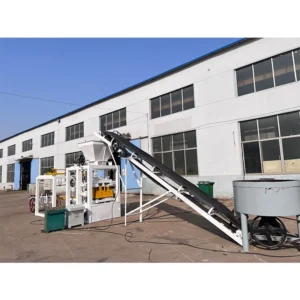
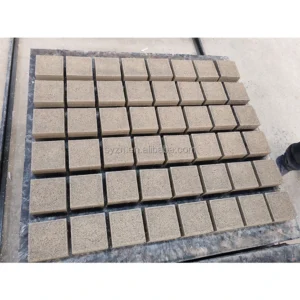
Line-First Engineering — Every QT5-15 stationary block making machine production line is specified around the buyer’s actual block format and site layout, not assembled from a generic press catalogue.
Technical Specifications
| Parameter | Value |
|---|---|
| Model | QT5-15 |
| Product Type | Hydraulic PLC Controlled Stationary Block Making Machine |
| Overall Dimension | 7400×1950×2800mm |
| Rated Pressure | 21MPa |
| Main Vibration Form | Platform Vibration |
| Vibration Frequency | 2800~4500 r/min |
| Pallet Size | 1100×550mm |
| Molding Cycle | 15-25s |
| Overall Power | 26.5KW |
| Demolding Method | Hydraulic |
| Control System | PLC |
| Output Capacity (Hollow Brick) | 1800 pcs/h (basis: 400×200×200mm, 5 pcs/mold, 16-20s cycle) |
| Output Capacity (Hollow Block) | 1300 pcs/h (basis: 400×150×200mm, 6 pcs/mold, 15-20s cycle) |
| Output Capacity (S Paver) | 3700 pcs/h (basis: 225×112.5×60mm, 16 pcs/mold, 15-17s cycle) |
| Raw Materials | Crushed stone, sand, cement, dust, fly ash, gravel, slag |
| Applied Products | Concrete blocks, hollow/solid blocks, pavers, interlocking blocks, curbstone, colored pavers |
| Voltage & Frequency | Configurable based on site requirements (basis to be confirmed) |
| Net Weight | Contact supplier for shipping specifications |
Application Suitability
| Application | Material or Output |
|---|---|
| Housing Project Block Production | Hollow and solid concrete blocks from crushed stone, sand, and cement |
| Paver Manufacturing Plants | Interlocking pavers and colored curbstone from fly ash and gravel |
| On-Site Construction Projects | Building blocks produced locally using available aggregate and slag |
| Concrete Product Manufacturers | Multiple block formats including porous brick and interlocking designs |
Why Quoted Capacity Numbers Mislead Plant Owners
A press that cycles 15 seconds means nothing if the stacker takes 30 seconds to clear the pallet.
Buying decisions based on "pieces per hour" without format specification lead to disappointment when actual daily output falls short. A stationary block making machine production line must account for mixer batch time, pallet return speed, and stacking tempo. When the upstream mixer cannot deliver fresh material every cycle, or the downstream stacker accumulates wet blocks faster than curing racks can absorb them, the press sits idle and quoted capacity evaporates [NEED_CITE: synchronization of block line stations for continuous operation].
How Station Integration Eliminates Press Idle Time
The QT5-15 platform vibration system operates at 2800-4500 r/min with 21MPa hydraulic pressure, completing a molding cycle in 15-25 seconds. For a stationary block making machine production line to sustain this tempo, raw material feeding must supply mixed concrete to the hopper before each cycle begins. Pallet feeding stations must position boards with precision timing so the press never waits. Downstream, automatic stacking equipment must remove cured pallets at a rate matching or exceeding press output. When any station in this chain operates slower than the QT5-15 cycle, the entire line bottlenecks at that point rather than at the press itself.
Calculating Real Throughput From Format Specifications
Capacity figures quoted without block format context create false expectations. The QT5-15 produces 1800 hollow bricks per hour when running 400×200×200mm blocks at 5 pieces per mold with a 16-20 second cycle. The same machine produces 3700 pavers per hour when running 225×112.5×60mm units at 16 pieces per mold with a 15-17 second cycle. A buyer whose market primarily purchases hollow blocks will never achieve the paver throughput figure. Line configuration must therefore specify which block format determines the capacity calculation for each station, ensuring the mixer, pallet system, and stacker all match that format’s specific demands [NEED_CITE: block format impact on production line throughput calculations].
Matching Vibration Force and Hydraulic Pressure to Local Aggregate
Platform vibration at 2800-4500 r/min combined with 21MPa rated pressure creates the compaction force necessary for block density. However, optimal vibration frequency and pressure settings depend on the buyer’s specific mix design and local aggregate characteristics. Coarse gravel requires different vibration profiles than fine fly ash or slag-based mixes. The QT5-15 vibration frequency range allows adjustment, but without proper configuration against actual raw materials, blocks may show inconsistent strength across production batches. Testing with buyer-supplied material samples before finalizing line configuration prevents costly adjustments after installation.
Pallet Dimensions and Curing Area Compatibility
The 1100×550mm pallet size must align with the buyer’s existing curing area dimensions and forklift capacity. Pallets too large for available curing space create storage bottlenecks. Pallets incompatible with site forklifts require manual handling, negating automation benefits. Material selection for pallets—whether wood, bamboo, or composite—affects both durability under vibration stress and weight during transport. Specifying pallet parameters against the buyer’s actual facility layout and handling equipment prevents mismatches that force operational compromises after the stationary block making machine production line is installed.
The Cost of Underspecifying Supporting Stations
Quotations listing only the press without raw material feeding, mixing, pallet handling, stacking, and curing rack coordination leave critical line functions undefined. Buyers then discover that pallet return systems, automatic stackers, and curing rack handlers were not included, requiring separate procurement and integration. Voltage, frequency, and PLC display language remain unconfirmed, delaying commissioning when the line arrives. Mould change systems unspecified in the original quote force operators to spend most of a shift swapping formats, eliminating the flexibility the buyer expected [NEED_CITE: complete block line specification requirements for procurement].
Why Configuration Against Actual Site Conditions Matters
Block machinery specified as a matched system rather than assembled from separate suppliers ensures every station coordinates with the others. Configuration set against the buyer’s actual mix design, local aggregate, and target block format prevents catalogue defaults that do not match site realities. Mould design for the formats the buyer’s market actually sells, including custom drawings when needed, eliminates paying for unused capabilities. Automation level selectable from semi-automatic to fully automatic allows buyers to start at one level and upgrade later as production volumes justify the investment. Installation support with operator training addresses the commissioning phase where most integration problems surface.
Documentation & Verification
- Line layout diagram showing station positioning and pallet flow path for QT5-15 integration
- Capacity calculation document stating block format assumptions for each throughput figure
- Machine specification sheet with hydraulic schematic and electrical diagram
- Pallet specification matched to buyer’s curing area dimensions and forklift capacity
- Voltage and control language confirmation form completed before production begins
- Factory test record demonstrating cycle times on buyer’s specified block format
Installation, Commissioning & Support
- Foundation requirements based on 7400×1950×2800mm overall dimension and vibration load specifications
- Power supply configuration for 26.5KW total system load with dedicated circuit protection
- On-site assembly from shipping configuration to operational line with pallet system integration
- First-run commissioning with cycle time verification against quoted 15-25 second molding range
- PLC control system parameter setup and operator training on mould change procedures
- Wear parts list covering hydraulic components and vibration system maintenance intervals
What Information Determines Your Line Configuration
Providing target block formats and daily output requirements allows calculation of which QT5-15 capacity tier applies to your production. Specifying local raw material sources and typical aggregate composition enables proper vibration and pressure configuration. Detailing available curing area dimensions, existing forklift capacity, and site voltage with frequency ensures pallet and control system compatibility. Clarifying whether semi-automatic operation with future upgrade potential or fully automatic line integration matches your labor model prevents overspecification or underspecification.
Frequently Asked Questions
Q: How do upstream mixer output and downstream stacking speed need to match the QT5-15 cycle time?
A: The QT5-15 completes a molding cycle in 15-25 seconds depending on block format. The mixer must deliver a fresh batch to the hopper before each cycle begins, meaning mixer batch time plus transfer time must stay under the shortest expected press cycle. Similarly, the stacker must remove and position pallets faster than the press deposits them. When either station operates slower than press tempo, the QT5-15 waits idle and actual throughput drops below quoted figures. Line configuration therefore calculates each station’s required speed against the specific block format determining production targets.
Q: What pallet size and material are specified, and how does that relate to the curing area?
A: The QT5-15 uses 1100×550mm pallets, but this dimension must be evaluated against your actual curing area layout and forklift capacity before finalizing. Pallets too large for available rack space create storage bottlenecks, while pallets incompatible with site forklifts force manual handling. Material selection—wood, bamboo, or composite—affects durability under the 2800-4500 r/min vibration frequency and weight during pallet return cycles. Specifying pallet parameters against existing facility infrastructure prevents mismatches requiring operational workarounds after installation.
Q: Which stations are included in the quotation for a complete production line?
A: A complete stationary block making machine production line quotation should specify raw material feeding, mixing, pallet feeding, automatic stacking, curing rack handling, and cubing systems—not just the QT5-15 press itself. Each station’s capacity must be calculated against the block format determining line throughput. Quotations listing only the press leave critical functions undefined, requiring separate procurement and integration efforts. Documentation should cover the full station chain with layout diagrams showing how pallet flow connects each operation.
Q: How is line capacity calculation stated per block format rather than as a single figure?
A: The QT5-15 produces 1800 pieces per hour when running 400×200×200mm hollow bricks at 5 pieces per mold, but produces 3700 pieces per hour running 225×112.5×60mm pavers at 16 pieces per mold. These figures assume specific cycle times of 16-20 seconds and 15-17 seconds respectively. Capacity calculations must therefore state which block format determines the figure, as a buyer whose market primarily purchases hollow blocks will never achieve paver throughput. Line configuration then ensures every supporting station matches that specific format’s demands.
Q: What voltage, frequency, and PLC display language need confirmation before shipment?
A: The QT5-15 PLC control system requires specification of local voltage and frequency standards before production begins, as electrical components must match site power supply. Display language configuration—whether English, French, Spanish, or other languages—must be confirmed so operators can navigate menus and diagnostics without translation barriers. These specifications remain undefined until the buyer provides site electrical details and language preferences. Confirmation documentation should accompany the machine specification sheet to prevent commissioning delays when the line arrives.