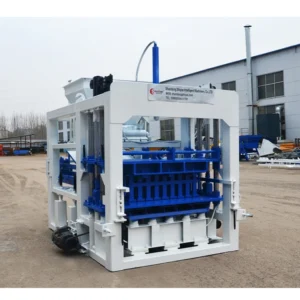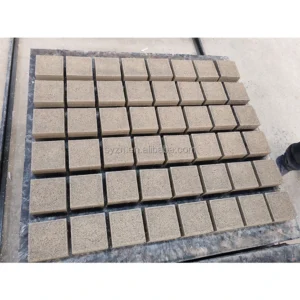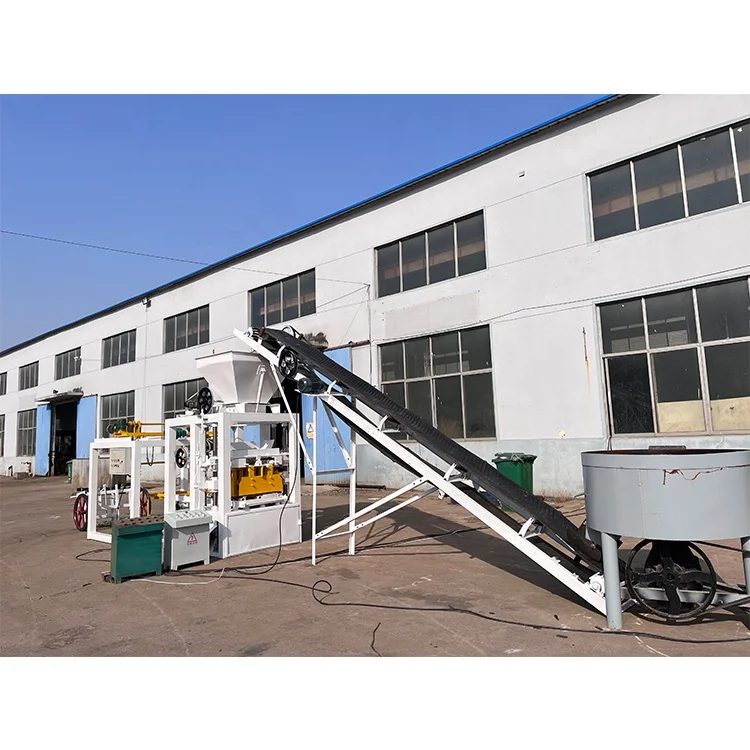
Complete line coordination — the QTJ4-24 stationary block making machine production line is specified as one system with upstream mixing and downstream stacking so the 24–26 s press cycle never waits for a pallet or a batch.
Technical Specifications
| Parameter | Value |
|---|---|
| Model | QTJ4-24 |
| Product Type | Stationary Concrete Block Making Machine |
| Molding Method | Mechanical (gear drive, engine powered) |
| Overall Dimensions | 3600 × 1700 × 2560 mm |
| Pallet Size | 850 × 450 mm |
| Molding Cycle | 24–26 s (basis not stated in source — confirm block format / material / thickness) |
| Overall Power | 11.95 kW |
| Vibration Force | 45 kN (2 × 3 kW lower vibrators + 2 × 1.5 kW upper vibrators) |
| Total Mass | 2 T |
| Reducer | 350-type (for mold lifting) |
| Material Distribution | Full-automatic spiral |
| Raw Materials | Cement, sand, stone |
| Control System | PLC controlled |
| Mould Format | Hollow block, solid block, interlocking brick, paving brick |
| Automation Level | Semi-automatic (mechanical molding, spiral feeding, manual pallet handling implied) |
| Voltage & Frequency | To be confirmed before order |
| Warranty | 1 year for whole machine (excluding spare parts) |
Application Suitability
| Application | Material or Output |
|---|---|
| Hollow block production for masonry walls | Cement, sand, crushed stone aggregate |
| Solid block production | Cement, sand, stone dust |
| Interlocking brick production | Cement, fine sand, stone powder |
| Paving brick production | Cement, coarse aggregate, sand |
| Small to medium block production plants | Fixed stationary setup with line-wide coordination |
| On-site block manufacturing | Local aggregate sourcing with cement binder |
Why the Line Layout Decides Your Real Daily Output
A press that cycles every 24–26 seconds means nothing if the mixer cannot discharge fast enough or the stacker cannot clear pallets in time.
Many buyers choose a stationary block making machine production line based on a headline cycles-per-hour number, only to find that the actual daily output falls far short once the machine sits inside a real plant. The bottleneck is rarely the press itself — it is the station before or after it. When the mixer takes longer to discharge than the press takes to mold, the operator stands idle. When pallets are not returned from the curing area quickly enough, the press stops again. These pauses accumulate across a shift, turning a theoretical output into a disappointing reality [NEED_CITE: block production line bottleneck analysis].
How the QTJ4-24 Fits Into a Coordinated Block Line
The QTJ4-24 stationary block making machine production line operates on a fixed rhythm: the full-automatic spiral feeds material into the mould cavity, the integrated vibration system compacts the mix, and the 350-type reducer lifts the mould to release the green block onto an 850 × 450 mm pallet. Each cycle occupies a defined window. The upstream batching and mixing station must deliver a homogeneous batch within that window, and the downstream pallet return system must supply an empty pallet before the next cycle begins. When these three stations are timed correctly, the press runs continuously without micro-stops.
Where Line Timing Breaks Down in Practice
On several installations across West Africa, I have watched a stationary block making machine production line lose significant portions of a shift because the pallet return conveyor was too slow for the press cycle. The operator would stand waiting, then rush to hand-feed a pallet, disrupting the spiral feed timing and producing a weak block. The fix is never faster pressing — it is matching the mixer discharge rate, the pallet conveyor speed, and the stacking station throughput to the same 24–26 s rhythm. Without that coordination, the highest-spec press in the line still underperforms [NEED_CITE: semi-automatic block line synchronization practices].
What the 45 kN Vibration System Means for Block Strength
The integrated vibration setup pairs two 3 kW lower vibrators with two 1.5 kW upper vibrators to produce 45 kN of total force. In a stationary block machine, vibration compacts the concrete mix into the mould cavity while mechanical pressure from the gear drive holds the material in place. If vibration is too strong relative to the cement content and aggregate grading, the mix segregates — fine particles rise and coarse aggregate sinks, weakening the block. If vibration is too weak, voids remain and the block crumbles after demoulding. The correct balance depends on the local sand and stone available at the plant site, which is why mix design confirmation must happen before the vibration settings are locked.
What Happens When Line Stations Are Specified Separately
A common pattern I have seen on project sites is a buyer purchasing the press from one supplier, the mixer from another, and pallet handling from a third, then expecting the three to work together. The result is usually mismatched cycle times. A mixer that discharges every 40 seconds paired with a 24–26 s press means the press sits idle for a third of every cycle. Pallets sized differently from the 850 × 450 mm specification will not ride the conveyor correctly, causing jams. Without a single supplier responsible for the full stationary block making machine production line, each gap between stations becomes a production loss that the buyer absorbs alone [NEED_CITE: risks of multi-supplier block line integration].
Why a Matched Line Specification Reduces Commissioning Time
When every station in the block line — raw material feeding, mixing, pallet feeding, stacking, and curing rack handling — is specified as one system, the commissioning phase shortens considerably. The PLC control on the QTJ4-24 can be wired to communicate with upstream batching controls and downstream stacking signals, so the entire line starts and stops as a unit. Voltage, frequency, and control language are confirmed once for the whole line rather than negotiated with each separate equipment vendor. The result is a faster path from container arrival to first saleable block.
Documentation & Verification
- Line layout drawing showing each station position and pallet flow direction for the QTJ4-24
- Capacity calculation stating the block format and mix design assumed for the 24–26 s cycle
- Pallet specification sheet confirming 850 × 450 mm dimensions and material grade
- Voltage and PLC display language confirmation signed before production begins
- Factory test record with the buyer’s target block format and local aggregate sample
Installation, Commissioning & Support
- Foundation plan based on the 3600 × 1700 mm footprint and 2 T operating mass
- Power supply circuit rated for 11.95 kW total draw with voltage and frequency confirmed to site
- Pallet return conveyor aligned to the 850 × 450 mm pallet size and curing rack spacing
- Vibration force calibrated to the buyer’s confirmed mix design during first-day commissioning
- Operator training covering mould change procedure, spiral feed adjustment, and daily greasing points
- Wear parts list identifying mould liners and vibrator mounts for first reorder planning
What to Prepare Before Requesting a Quotation
To size a stationary block making machine production line around the QTJ4-24, share the block format you intend to produce most, the local aggregate type and source, your available workshop dimensions, and the existing curing area setup. Include your site voltage and frequency so the electrical system can be confirmed before the machine enters production.
Frequently Asked Questions
Q: How is daily output calculated, and which block format is assumed in the cycle time figure?
A: The 24–26 s molding cycle is published without a stated block format or material assumption. Before quoting, we calculate realistic daily output based on your target block size, wall thickness, and confirmed mix design, so the capacity figure reflects what your plant will actually produce per shift.
Q: How do upstream feeding and downstream stacking stations sync with the press cycle?
A: The full-automatic spiral feed, mixer discharge rate, and pallet return speed are all matched to the 24–26 s cycle during line layout design. Each station is timed so the press never waits for material or an empty pallet, eliminating micro-stops that reduce daily output.
Q: What pallet size and material are specified, and does it match my existing curing racks?
A: The QTJ4-24 uses 850 × 450 mm pallets. We confirm this dimension against your existing curing rack spacing and forklift fork width before finalizing the line, so pallets move smoothly from the press through stacking to the curing area.
Q: Is raw material mixing, pallet feeding, and stacking included in the line quotation?
A: Every station around the press — batching, mixing, pallet feeding, stacking, and curing rack handling — can be included in one quotation. This ensures cycle times match across the full stationary block making machine production line and avoids gaps between separately sourced equipment.
Q: What voltage, frequency, and PLC language are confirmed before production?
A: We confirm your site voltage, frequency, and preferred PLC display language before the QTJ4-24 enters production. This avoids commissioning delays caused by mismatched electrical systems or controls the operator cannot read on arrival.