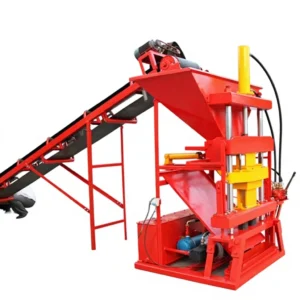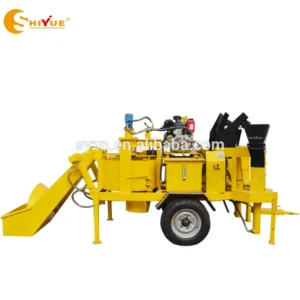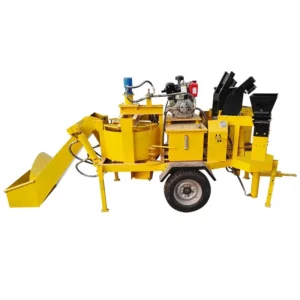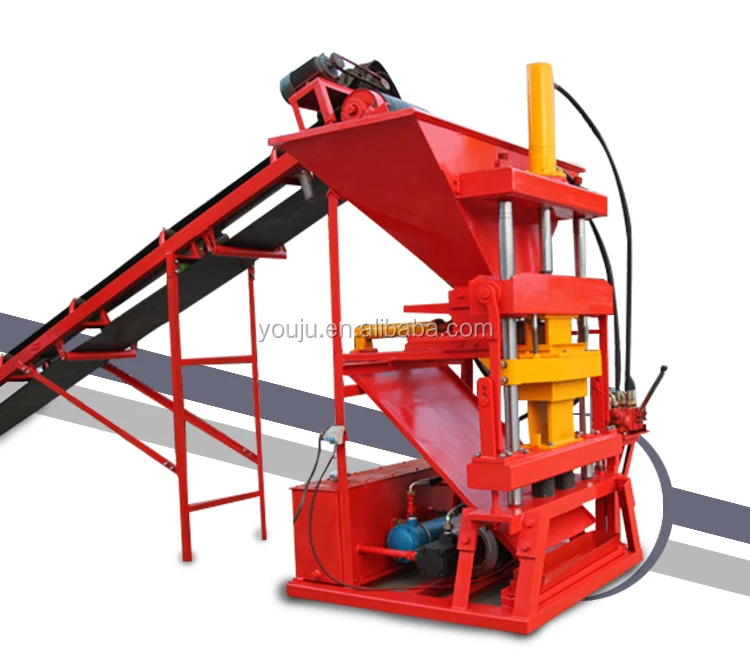
Matched Line Integration — The ECO2700 is specified alongside its mixer, pallet return and curing stations so cycle times align across the whole clay interlocking brick machine production line.
Technical Specifications
| Parameter | Value |
|---|---|
| Model | ECO2700 |
| Product Type | Hydraulic Clay Interlocking Block Making Machine |
| Overall Dimensions (L×W×H) | 1000 × 1000 × 1800 mm |
| Shaping Cycle | 15–20 seconds (basis not stated in source — confirm block format / material / thickness) |
| Rated Power | 5.5 kW |
| Hydraulic Pressure | 16 MPa |
| Total Weight | 1000 kg |
| Voltage & Frequency | 380V, 3-phase, 50Hz (configurable to local grid) |
| Mould Format | Interlocking clay brick (specific dimensions to be confirmed) |
| Automation Level | Manual / small-scale operation |
| Warranty | 1 year |
| Standards | CE |
Application Suitability
| Application | Material or Output |
|---|---|
| Small-scale interlocking brick plants | Local clay, laterite, and mud blends stabilized with cement |
| On-site housing and development projects | Raw soil excavated directly from the building site |
| Workshop-level block forming | Low-volume production runs for community building programs |
| Format expansion for existing producers | Adding clay interlocking formats to a concrete product range |
What a "15–20 Second Cycle" Hides About Your Daily Throughput
A press cycle only sets the floor — the mixer output and pallet return speed decide the actual ceiling.
Quoting a shaping cycle without stating the brick format or upstream feed rate leads buyers to overestimate daily volume. On a recent project site, a buyer assumed the press cadence alone determined throughput, only to find the manual pallet return could not keep pace, leaving the press idle between strokes [NEED_CITE: throughput bottleneck analysis for manual block lines]. The clay interlocking brick machine production line must be calculated end-to-end, not from a single station.
Matching Station Cadence Across the Line
The ECO2700 completes a pressing stroke within its rated cycle, but that number is meaningless if the upstream pan mixer delivers a fresh batch slower than the press consumes it. A clay interlocking brick machine production line built around this press must pair it with a mixer whose discharge volume per batch matches the mould cavity fill requirement. When the mixer becomes the constraint, operators stand idle waiting for material, and the effective daily output drops well below the theoretical figure.
Pallet Return and Curing Area Flow
Downstream, the used pallet must travel back to the feed end before the next stroke begins. On a compact footprint like the ECO2700’s 1000 × 1000 mm base, pallet routing must be planned so the return path does not cross the raw material feed zone. The curing rack layout must also accommodate the pallet dimensions chosen for this press — specifying pallets without checking forklift tine spacing or rack width creates a handling bottleneck that no press adjustment can solve [NEED_CITE: pallet handling and curing rack planning for interlocking brick plants].
Reading the Core Parameters in Context
The 16 MPa hydraulic pressure is the force available to compact the clay mix inside the mould cavity. For interlocking formats, this pressure must overcome the friction of the interlocking lips and keys, not just the flat face. If the local clay has high sand content, the mix may require higher moisture or a cement stabilizer to hold the interlocking geometry after demoulding. The 5.5 kW rated power covers the hydraulic pump and any vibration motor on the press itself — the total clay interlocking brick machine production line draw will be higher once the mixer, feeder, and any handling motors are included in the site electrical plan.
The Hidden Cost of Quoting the Press Alone
Leaving pallet handling, stacking, and curing out of the line quotation forces the buyer to improvise these stations after delivery. Hand-stacking freshly pressed clay bricks damages the interlocking edges before the cement stabilizer has gained any early strength. I have seen entire batches crack and crumble because the bricks were moved to a curing area on wheelbarrows instead of being carried on their pallets [NEED_CITE: early-stage handling damage in clay interlocking brick production]. The cost of replacing broken bricks far exceeds the cost of specifying a pallet return system from the start.
Why Source the Full Line From One Supplier
Block machinery is our single focus, so the press, mould, pallet, and handling equipment are specified as one matched system. The line layout is set against the buyer’s actual clay mix, local aggregate, and target brick format rather than a catalogue default. Mould design covers the interlocking profiles the buyer’s market actually sells, with custom drawings available. Automation level is selectable, allowing a buyer to start with manual pallet handling and add a return conveyor later. Installation support includes on-site commissioning and operator training on the complete line, not just the press in isolation.
Documentation & Verification
- Line layout drawing showing ECO2700 position relative to mixer, pallet return, and curing racks
- Capacity calculation stating the exact interlocking brick format and dimensions assumed
- Pallet specification matched to press platen size and buyer’s existing forklift
- Voltage and control language confirmation covering every station on the line
- Factory test record run on the buyer’s confirmed clay mix sample before dispatch
- Operation and maintenance manual covering all line stations in sequence
Installation, Commissioning & Support
- Foundation pad sized for the 1000 kg press weight plus dynamic hydraulic load
- Dedicated 3-phase circuit rated above the 5.5 kW press draw to cover line-wide startup surge
- Machine arrives partially assembled; hydraulic lines and mould bolt-on completed on site
- First-run parameter tuning against the buyer’s clay sample and stabilizer ratio
- Operator training covers press cycle, mixer batch timing, and pallet return coordination
- Wear parts list with reorder codes for hydraulic seals, mould liners, and pallet surfaces
Before You Request a Quotation
Provide your target interlocking brick dimensions and the clay or soil type available at your site, along with a three-kilogram sample for mix testing. Confirm the daily volume you need and the floor space available for the full line including curing racks. Specify your local voltage, frequency, and preferred control language so every motor and panel on the clay interlocking brick machine production line arrives ready for immediate commissioning.
Frequently Asked Questions
Q: How is line throughput calculated when the press cycle is faster than the mixer or pallet feeder?
A: The slowest station determines the effective rate. We calculate line throughput by mapping each station’s actual cycle — mixer batch time, pallet feed speed, press stroke, and return travel — then identify the constraint. The quotation states realistic daily output based on that bottleneck, not the press cycle alone.
Q: What supporting equipment must be included so the ECO2700 is not left idle between strokes?
A: At minimum, a pan mixer with matched batch volume, a pallet feed station, and a defined curing rack layout with pallet return path. Omitting any of these forces manual handling that slows the line and risks damaging the interlocking brick edges before the stabilizer cures.
Q: How does the 16 MPa pressing pressure match the local clay mix and moisture content?
A: We test a soil sample from your site to measure sand-to-clay ratio and natural moisture. The 16 MPa pressure is then matched to a specific stabilizer percentage and target moisture so the interlocking keys hold their shape after demoulding without cracking during early curing.
Q: What is the total line power draw when all stations are running together?
A: The ECO2700 press itself draws 5.5 kW, but the mixer motor, any conveyor drives, and lighting add to the total. We provide a complete load schedule listing every motor on the line so your site electrician can size the main breaker and wiring correctly before the equipment arrives.
Q: How is pallet size chosen to fit both the press and the existing curing area?
A: Pallet dimensions must match the ECO2700 platen while also fitting the buyer’s curing rack spacing and forklift tine width. We confirm rack and forklift details before specifying the pallet, so bricks travel from press to cure without rehandling.