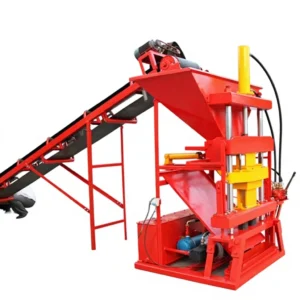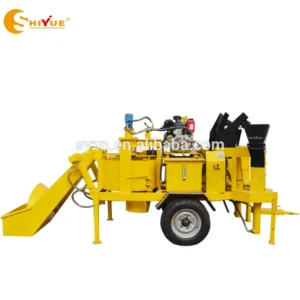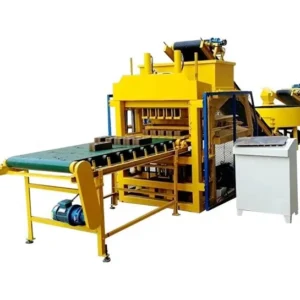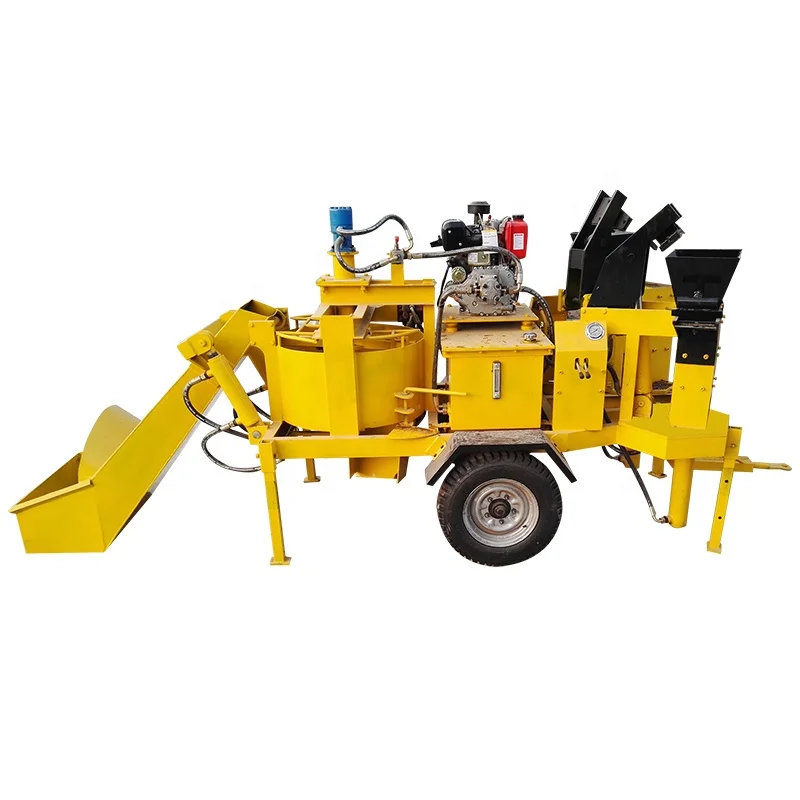
Integrated Pan Mixer and Press on One Mobile Frame — the entire clay interlocking brick production setup moves to the job site without requiring grid power or a separate batching station.
Technical Specifications
| Parameter | Value |
|---|---|
| Model | M7MI TWIN |
| Product Type | Clay Soil Interlocking Brick Making Machine |
| Block Size | 300×150×100 mm |
| Molding Cycle | 20s |
| Qty per Mould | 2 pcs |
| Output Capacity | 400 pcs/h (basis: 300×150×100 mm interlocking block) |
| Daily Output | 3,200 pcs/8hr (basis: 300×150×100 mm interlocking block) |
| Mixer Type | Integrated pan mixer |
| Power Source | Diesel engine |
| Assembly State | Mobile frame, integrated unit |
| Pressure Head | Two or One (configurable) |
| Automation Level | Manual / mobile egg-laying type |
| Voltage & Frequency | Not applicable (diesel powered) |
| Pallet Size | (basis to be confirmed) |
| Vibration Force | (basis to be confirmed) |
| Hydraulic Pressure | (basis to be confirmed) |
| Mould Change Time | (basis to be confirmed) |
| Overall Dimensions | (basis to be confirmed) |
| Net Weight | (basis to be confirmed) |
Application Suitability
| Application | Material or Output |
|---|---|
| On-site interlocking block production for housing projects | Clay soil stabilized with cement or lime |
| Mobile block production moving between construction sites | Local excavated soil mixed on-site |
| Non-burning brick production for community building | Clay-based soil without kiln firing |
| Small to medium-scale contractor block supply | Soil-cement interlocking bricks laid without mortar |
Why "400 Blocks per Hour" Can Mislead a Buyer Before Site Arrival
Capacity only holds when the block format, soil moisture, and stabilizer ratio match the test conditions exactly.
I have watched a mobile clay interlocking brick machine arrive on a job site where the contractor expected the brochure number to apply across every block size they planned to produce. The clay interlocking brick machine production line rated at 400 pieces per hour based on 300×150×100 mm blocks drops noticeably when the mould switches to a larger format or a thinner wall profile. The pan mixer also behaves differently when local clay has higher plasticity than the factory test sample, extending cycle time because the mix needs additional blending passes. Buyers who confirm only the headline figure end up short on the first week of production [NEED_CITE: clay moisture variation effect on cycle time in mobile block presses].
How the Line Connects Without a Fixed Plant
A mobile clay interlocking brick machine production line eliminates the need for conveyor belts and fixed feed hoppers, but the production rhythm still depends on every station keeping pace. The integrated pan mixer must discharge a batch within the same window the press completes its previous cycle, otherwise the operator stands idle. Diesel engine output must sustain both the hydraulic pressure head and the mixer simultaneously, meaning fuel consumption and thermal management become part of the line balance. Planning the curing area layout and block transport path around the machine’s movement radius is where most on-site setups lose time.
Matching the Mixer to Local Soil Behavior
The pan mixer on this clay interlocking brick machine production line handles the full blending task, but clay soil varies considerably between regions and even between excavation depths on the same site. High-plasticity clay retains more water and requires longer mixing to distribute stabilizer evenly, while sandy loam blends faster but may need a higher cement ratio for adequate block strength. Confirming the local soil profile through a simple geotechnical test before the machine ships allows the mixer configuration and recommended water-to-cement ratios to be set in advance rather than discovered through trial and error on the first production day [NEED_CITE: soil classification impact on stabilizer dosage in compressed earth blocks].
Reading the Specification Sheet Against Actual Conditions
The 20-second molding cycle producing two 300×150×100 mm interlocking blocks per stroke assumes the mix flows cleanly into the mould cavity and reaches full compaction within that window. Hydraulic pressure and vibration force work together — pressure alone compresses the soil-cement mix, while vibration removes trapped air and ensures uniform density across the block cross-section. Without published vibration force and hydraulic pressure values, a buyer cannot verify whether the machine suits their specific clay type and target block strength. The dual pressure head option allows adjustment between single and double compaction strokes, which directly affects block density and cycle time. Pallet size remains unconfirmed, though egg-laying mobile machines typically deposit blocks directly on the ground, removing pallet dependency but requiring a level, prepared surface at each site.
When the Curing Area Becomes the Real Bottleneck
A mobile block line produces interlocking bricks at a pace that demands an organized curing zone immediately adjacent to the machine path. Without a planned layout for block placement, wet curing, and drying, freshly pressed blocks get stacked too early or walked on before initial set. The contractor who skipped this planning step found that surface cracking appeared on blocks handled within the first hours after pressing, and the rejection rate climbed without any change to the machine settings [NEED_CITE: early handling damage in cement-stabilized soil blocks]. The machine itself ran correctly — the failure sat downstream of the press.
Why Buyers Choose This Configuration Path
Block machinery as a single focus means the M7MI TWIN ships with the press, pan mixer, and diesel engine specified as one matched unit rather than assembled from separate suppliers. Configuration starts from the buyer’s actual soil test report and target block format, not a catalogue default. Mould design covers the interlocking profiles the local market actually builds with, including custom drawings when standard formats do not fit the project specification. The automation level allows a contractor to begin with manual egg-laying operation and add upstream or downstream handling later. Installation support includes operator training on-site, covering mix ratios, mould change procedure, and diesel engine maintenance schedules specific to this integrated unit.
Documentation & Verification
- Line layout drawing showing mixer-to-press flow and curing zone footprint for your site dimensions
- Capacity calculation sheet stating the 300×150×100 mm format basis with alternate format cycle estimates
- Machine specification sheet with confirmed hydraulic pressure and vibration force after soil sample review
- Factory test record run on a soil-cement mix matching your geotechnical report before dispatch
- Operation and maintenance manual covering diesel engine service intervals and pan mixer liner replacement
Installation, Commissioning & Support
- Ground preparation guide specifying level tolerance for the mobile frame at each job site
- Diesel engine commissioning checklist with fuel grade and break-in run schedule for the integrated power unit
- First-day production run supervised with mix ratio adjustment based on your local clay sample
- Mould change procedure training on-site so operators switch formats within a single shift
- Wear parts list identifying pan mixer blades, hydraulic seals, and mould liner replacement intervals
- Follow-up remote support for vibration force and pressure head fine-tuning during the first production weeks
What to Prepare Before Requesting a Quotation
Share your local soil classification report or a description of the clay type and moisture range at your project site. Confirm the target interlocking block format and the daily volume you need to sustain your construction schedule. Specify whether the machine will stay on one site or rotate between multiple locations, as this affects the curing area plan and supporting equipment scope.
Frequently Asked Questions
Q: Does the 3,200 pieces per day figure apply to other interlocking block sizes?
A: The 3,200 pieces per 8-hour day is rated at 300×150×100 mm interlocking blocks. Larger formats or thinner wall profiles extend the molding cycle and reduce daily count. Before ordering, request a capacity recalculation based on the exact block dimensions your project requires.
Q: How does the integrated pan mixer handle high-plasticity clay?
A: High-plasticity clay retains more water and may require extended mixing time to distribute cement stabilizer evenly through the batch. Share your soil test report before shipment so the mixer configuration and recommended water ratios are adjusted to your local material rather than set to a generic default.
Q: What site preparation does a mobile egg-laying unit need at each location?
A: The ground must be level within a tolerance that prevents the machine frame from twisting under hydraulic pressure. A compacted gravel surface is typical. The curing area must be planned adjacent to the machine movement path so freshly pressed blocks are not disturbed before initial set.
Q: What supporting equipment should surround this mobile press to sustain output?
A: Raw material stockpiling, water supply, and block transport from the curing zone all need to keep pace with the 400 pcs/h press output. Even without conveyors, a site layout that minimizes manual carrying distance between mixing, pressing, and curing areas prevents the operator from waiting on material.
Q: What wear parts should I stock for the first six months of operation?
A: The pan mixer blades, hydraulic seals, and mould liner surfaces experience the highest wear. Request the specific wear parts list with recommended replacement intervals for your production volume. Diesel engine consumables such as filters and belts follow the engine manufacturer’s standard service schedule.