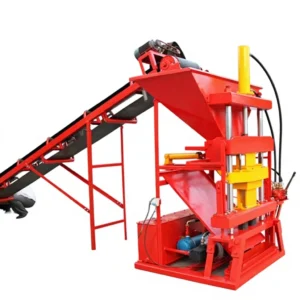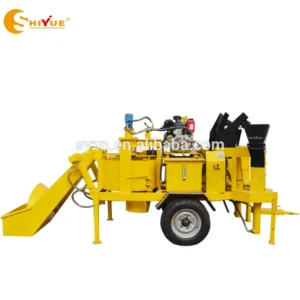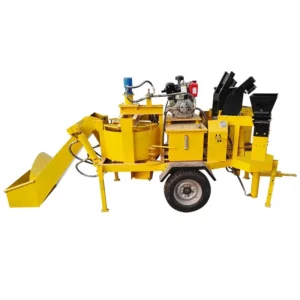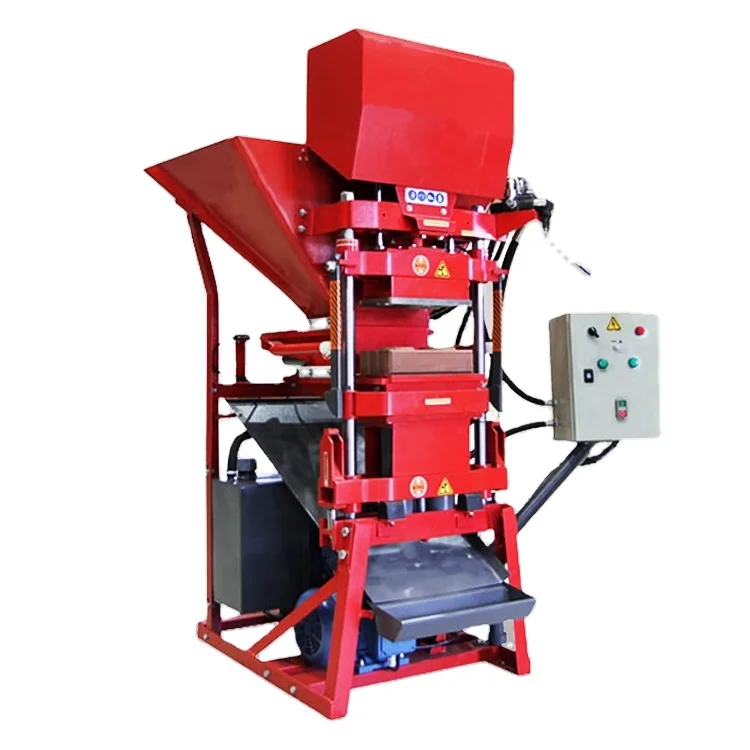
Line-Centered Engineering — Every station around the ECO 2700 is timed so the press never waits and the curing rack never jams, built from one matched specification rather than assembled from separate vendors.
Technical Specifications
| Parameter | Value |
|---|---|
| Model | ECO 2700 |
| Product Type | Clay Interlocking Brick Making Machine |
| Overall Dimensions (L×W×H) | 1000×1000×1800 mm |
| Shaping Cycle | 15-20 seconds |
| Rated Power | 5.5 kW |
| Hydraulic Pressure | 16 MPa |
| Total Weight | 1000 KGS |
| Voltage & Frequency | 380V, 3-phase, 50Hz (customizable) |
| Power Source | Electric |
| Mould Format | Interlocking clay brick (basis not stated in source) |
| Output Capacity | basis not stated in source |
| Pallet Size | basis not stated in source |
| Motor Brand | Siemens |
| Warranty | 1 year |
Application Suitability
| Application | Material or Output |
|---|---|
| Small-scale interlocking clay brick production | Clay and local soil mixes |
| On-site brick forming for construction projects | Site-sourced earth and clay |
| Low-investment brick plant setup | Clay, stabilizer blends |
| Ecological brick production | Clay with natural aggregate |
Why the Line Layout Matters More Than the Press Alone
A clay interlocking brick machine production line only runs as fast as its slowest upstream or downstream station.
When a plant owner looks at the ECO 2700, the 15-20 second shaping cycle is just one number. If the mixer upstream takes 45 seconds to deliver a batch the press can use in 20, the press sits idle for half the shift. I have seen this exact mismatch on site: the host press and the curin*e clay interlocking brick machine production line spent weeks running below its real capacity while the crew figured it out. The bottleneck is rarely the press itself [NEED_CITE: typical bottleneck analysis in small block plants].
Matching Every Station to the Shaping Cycle
The ECO 2700 completes a forming cycle every 15-20 seconds, which sets the pace for everything connected to it. The raw material feeder must deliver a measured charge into the mixer within that same window, and the mixer must finish blending before the press calls for the next batch. When the clay interlocking brick machine production line is specified as one system, each motor, conveyor belt length and hopper gate is sized against that 15-20 second baseline rather than chosen from a catalogue default.
Pallet Return and Curing Rack Synchronization
After the press releases a formed brick, the pallet carrying it must travel to the curing rack before the next pallet enters the press. If the curing rack handler takes longer than the shaping cycle, the press waits. If it runs faster, pallets pile up on the floor waiting for a rack slot. I spent two weeks on site last year because the curing rack station was four seconds slower than the press cycle, and no one had checked that number before shipping. Getting this timing right on paper saves that kind of disruption [NEED_CITE: pallet handling cycle time alignment in block lines].
Reading the Numbers That Actually Matter
The 16 MPa hydraulic pressure is matched to the density requirements of interlocking clay brick, where insufficient pressure leaves bricks that crack during curing or fail a drop test. The 5.5 kW rated power tells you the upstream mixer motor must not exceed the available electrical capacity once the press, feeder and conveyor are all running simultaneously. The compact 1000×1000×1800 mm footprint means station spacing can be tight, but the pallet return path still needs enough length for a pallet to cool slightly before re-entering the press zone. Voltage at 380V three-phase 50Hz is standard, but confirming your site frequency before dispatch avoids a commissioning stall the day the container opens.
What Happens When Stations Are Specified Separately
I once visited a plant where the buyer sourced the press from one supplier, the mixer from another, and built the curing rack locally. The mixer output was too wet for the press cycle, the pallet size did not match the rack spacing, and the voltage on the mixer motor was wrong for the site transformer. Each piece worked alone. Together they produced bricks for two hours before the line stopped. Every one of those problems was solvable before the machines left the factory, but only if someone had looked at the whole line as one specification [NEED_CITE: consequences of unmatched station specifications].
Why Buyers Choose This Line Configuration
Block machinery is our single focus, so the ECO 2700 press, its moulds, pallets and handling equipment are specified as one matched system. Configuration is set against your actual clay mix design and local soil conditions, not a generic default. Mould design covers the interlocking format your market sells, with custom drawings available. The automation level is selectable — start with manual pallet handling and add automatic stacking later when volume grows. Installation includes operator training so your crew understands the cycle time relationship between every station from day one.
Documentation & Verification
- Line layout drawing showing station spacing matched to the ECO 2700 footprint
- Capacity calculation stating the interlocking brick format assumed at each station
- Hydraulic and electrical schematic showing press connections to mixer and feeder
- Pallet specification sheet matched to your curing area and forklift capacity
- Voltage and control language confirmation document before dispatch
- Factory test record on your clay mix before the line ships
Installation, Commissioning & Support
- Foundation plan sized for the ECO 2700 total weight of 1000 KGS with anchor points marked
- Electrical connection schedule for 5.5 kW press plus upstream mixer and feeder loads
- Machine arrives as a single unit fitting the 1000×1000×1800 mm envelope, no field assembly of the press frame required
- Commissioning includes setting the 15-20 second shaping cycle against your actual clay mix
- Operator training covers pallet loading, mould change and daily hydraulic checks
- Wear parts list covers hydraulic seals and mould liners with reorder part numbers
Before You Request a Quote
Send us your target interlocking brick dimensions, the clay or soil mix you plan to use, and your available curing area dimensions so we can size the pallet and rack system. Let us know your site voltage and frequency, and whether you have existing conveyor or mixing equipment the line needs to connect to. If you have a daily output target, tell us which brick format that figure assumes so the capacity calculation is honest from the start.
Frequently Asked Questions
Q: How is line capacity calculated and which interlocking brick format is assumed?
A: Capacity is calculated per brick format based on the 15-20 second shaping cycle of the ECO 2700 and the number of cavities in the selected mould. The calculation states the exact brick dimensions, the cycle time used, and the operating hours assumed. Without a stated format, any throughput number is meaningless, so we always provide it tied to the specific interlocking brick you will produce.
Q: How do upstream mixer and feeder cycle times match the press cycle?
A: The mixer batch time and feeder delivery rate are both sized so that a finished charge arrives at the press within the 15-20 second shaping window. If the mixer takes longer, the press idles. We specify the mixer volume, motor power and conveyor speed against the ECO 2700 cycle so no station waits for another under normal running conditions.
Q: What pallet size and material does the line require, and does it fit my curing area?
A: Pallet size is chosen to match the mould format and the curing rack spacing at your site. We confirm the pallet dimensions, material and weight against your existing forklift capacity and curing floor area before the line is built, so pallets stack correctly in the rack and your forklift can handle them fully loaded.
Q: Which stations can be added or upgraded later to increase line automation?
A: The ECO 2700 can start with manual pallet handling and later accept an automatic pallet feeder, a stacking station and a cubing system. The electrical and mechanical interfaces for these additions are built into the base machine so you do not need to replace the press or rewire the control panel when you add automation at a later date.