
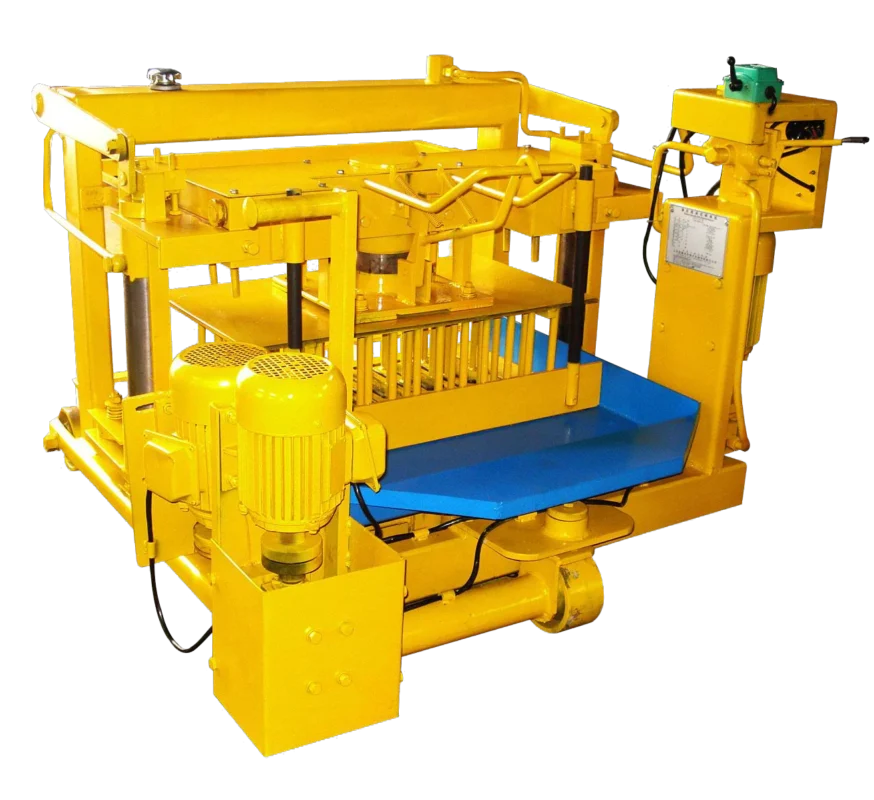
Line integration expertise — The QMY4-30 mobile egg-laying block machine is specified alongside its feeding and mixing stations so upstream output matches the press cycle, preventing the bottleneck that leaves operators standing idle on remote job sites.
Technical Specifications
| Parameter | Value |
|---|---|
| Model | QMY4-30 |
| Product Type | Mobile Egg-Laying Block Making Machine |
| Machine Type | Mobile hydraulic egg-laying block machine (palletless) |
| Transmission | Hydraulic transmission with mold box excitation |
| Pallet Requirement | None (palletless egg-laying design) |
| Automation Level | Manual operation |
| Operating Environment | Mountainous, hilly, industrial mining, desert, and coastal areas |
| Mold Technology | Heat treatment and carburization |
| Certification | ISO9001:2000, CE (basis not stated in source) |
| Output Capacity | (basis to be confirmed) |
| Overall Dimensions | (basis to be confirmed) |
| Rated Power | (basis to be confirmed) |
Application Suitability
| Application | Material or Output |
|---|---|
| On-site housing project construction | Hollow concrete blocks from locally sourced aggregate and cement |
| Remote infrastructure development | Standard masonry units produced directly on uneven terrain |
| Small-scale decentralized block yards | Pavers and solid blocks without fixed plant investment |
| Post-disaster or temporary site rebuilding | Rapid deployment block production without pallet logistics |
Why Mixer Sizing Dictates the True Output of a Mobile Egg-Laying Block Machine Production Line Supporting Equipment Setup
A press is only as fast as the mixer feeding it.
When contractors buy a mobile egg-laying block machine production line supporting equipment package, they often focus entirely on the press cycle time. I have walked onto sites where the QMY4-30 was waiting for the next batch of concrete for minutes at a time because the portable mixer was undersized for the mold volume. The daily output ends up being a fraction of the theoretical capacity simply because the supporting equipment was an afterthought. Matching the batch size and discharge rate of the mixer to the actual consumption rate of the press is the only way to get realistic throughput [NEED_CITE: matching portable mixer discharge rates to mobile block press consumption].
Eliminating the Pallet Bottleneck from the Line Layout
The defining feature of this mobile egg-laying block machine production line supporting equipment configuration is the complete absence of pallets. Traditional stationary lines require a pallet feeding station, a return conveyor, and a curing rack handling system. By laying blocks directly on the ground, the QMY4-30 removes those stations entirely. This simplifies the supporting equipment requirement down to raw material batching and mixing, which is a significant advantage when working on constrained or remote sites where space and capital for auxiliary conveyors are limited.
Planning the Supporting Stations Around Manual Pacing
Because the QMY4-30 operates manually, the rhythm of the entire mobile egg-laying block machine production line supporting equipment setup depends on the operator. The mixer must deliver a fresh batch exactly when the operator completes a cycle and moves the machine forward. If the mixing station is too far from the production path, or if wheelbarrow transport introduces delays, the press sits idle. Line planning must therefore account for the physical distance between the mixing point and the laying path, keeping material transport as short as possible to sustain a steady working pace [NEED_CITE: material transport logistics in manual mobile block production].
Interpreting the Hydraulic and Mechanical Specifications
The hydraulic transmission with mold box excitation is a critical specification for a mobile unit. Unlike purely mechanical vibration systems, hydraulic excitation delivers consistent compaction force regardless of the ground surface minor irregularities, directly influencing block density and demolding strength. The heat-treated and carburized mold technology extends the service interval for the mold cavity, which is vital because replacing a worn mold on a remote site means waiting for parts rather than a quick workshop swap. For manual operation, the hydraulic system must be responsive enough to allow the operator to control the cycle without complex interface delays, keeping the physical workflow intuitive and continuous.
The Cost of Ignoring Ground Preparation in the Line Plan
The QMY4-30 lays blocks directly on the earth, meaning the ground itself becomes part of the production tooling. If the site is not graded and compacted before production begins, the blocks will settle unevenly, leading to height variation and potential breakage during the curing period. I have seen entire production runs scrapped because the laying area was soft or sloped, forcing the contractor to halt and re-grade the path. The supporting line plan must include a site preparation phase and a designated curing area that protects the fresh blocks from weather and site traffic [NEED_CITE: ground preparation standards for palletless egg-laying block production].
Why Line Matching Matters More Than the Press Alone
Our approach treats the QMY4-30 not as an isolated unit but as the center of a coordinated material flow. We specify the mixing station capacity based on the actual mold volume and cycle rhythm, ensuring the press never waits for concrete. The hydraulic pressure and vibration settings are confirmed against your specific aggregate mix, preventing the common issue where blocks crumble upon demolding. We provide a clear line layout showing the relationship between the batching point, the laying path, and the curing zone. Every machine leaves with a documented factory test record, and we confirm voltage and control requirements before dispatch so the site is ready the moment the equipment arrives.
Documentation & Verification
- Line layout calculation stating the specific hollow block format and daily volume assumption.
- Machine specification sheet confirming hydraulic pressure ratings and mold box excitation parameters.
- Mold drawing and format list for all compatible block sizes.
- Voltage and frequency confirmation record matching your site electrical supply.
- Factory test record demonstrating cycle operation with your specified mix design.
- Operation manual covering ground preparation and manual cycle procedures.
Installation, Commissioning & Support
- Site grading and compaction requirements for the palletless laying path before first operation.
- Electrical supply verification for the hydraulic pump motor voltage and frequency at the job site.
- Assembly of the mobile chassis and mold box on-site with hydraulic line connection checks.
- First-run parameter adjustment for hydraulic pressure and vibration timing based on local aggregate.
- Operator training on manual cycle pacing and mold changeover procedures.
- Wear parts list identifying high-friction components for initial spare stock ordering.
What We Need to Configure Your Line
To propose the correct supporting equipment for your QMY4-30 setup, please provide the specific hollow block dimensions you intend to produce and your target daily volume. We also need details on your local raw materials, particularly the aggregate type and cement availability, as well as the electrical supply specifications at your project site.
Frequently Asked Questions
Q: How do we verify the realistic daily output for our specific block size?
A: Output must be calculated based on the specific hollow block format, the cycle time including manual movement, and the mixer batch size. We provide a capacity calculation that states the assumed block dimensions and the supporting equipment rate required to sustain that pace, avoiding theoretical figures that ignore the actual material flow on your site.
Q: What ground conditions are required before the egg-laying machine can operate?
A: The laying surface must be level, compacted, and free of debris to ensure blocks cure with uniform dimensions. We specify the ground preparation standards required for the palletless design, including the necessary curing area layout, so you can prepare the site before the machine arrives and avoid breakage caused by uneven settling.
Q: How do we size the mixer and feeding station to prevent the press from waiting?
A: The mixer batch volume and discharge rate must match the mold consumption per cycle multiplied by the target cycles per hour. We calculate the required mixer capacity based on your chosen block format and operator pace, ensuring the mobile egg-laying block machine production line supporting equipment delivers concrete continuously without bottlenecks.
Q: Which hollow block sizes can the QMY4-30 produce and how long does a mold change take?
A: The machine accepts various hollow block molds designed for the palletless laying method. We supply a mold format list showing compatible sizes, and the changeover procedure is designed for on-site execution with basic tools, allowing you to switch formats as project requirements shift without returning to a fixed workshop.


