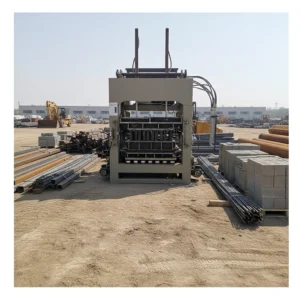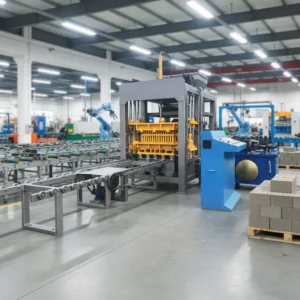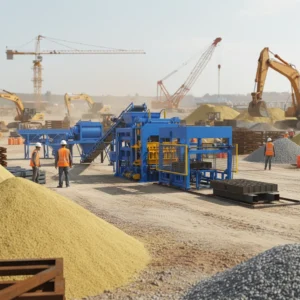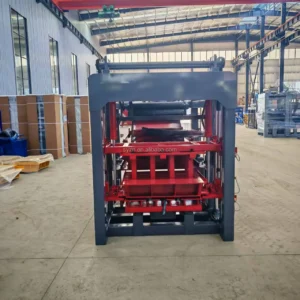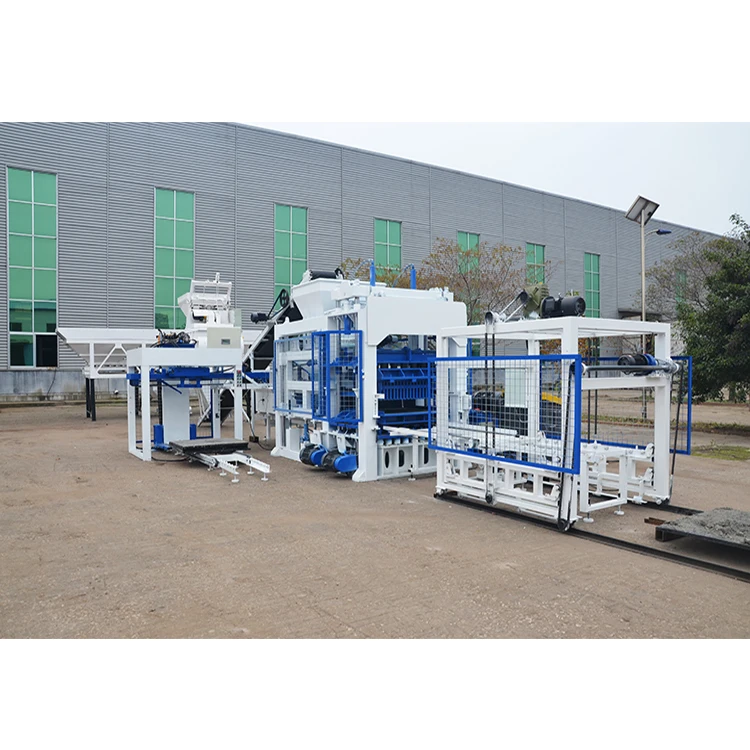
System-Synchronized Line Design — every upstream feeder, mixer, pallet circulator and downstream stacker is specified around the QT10-15 press cycle so no station starves or queues.
Technical Specifications
| Parameter | Value |
|---|---|
| Model | QT10-15 |
| Product Type | Concrete Block Making Machine |
| Control System | PLC control cabinet |
| Hydraulic System | Independent integrated hydraulic station |
| Vibration Mode | Vertical station mode resonance, automatic FM-AM |
| Components Included | Pallet feed machine, block making machine, storage hopper, conveyor, hydraulic unit, PLC control cabinet |
| Mould Change | Simple replacement for multi-format production |
| Output — 400×200×200mm hollow block | 1,800–2,400 pcs/hour (15–20s cycle, 10 pcs/mould) |
| Output — 400×150×200mm hollow block | 2,160–2,880 pcs/hour (15–20s cycle, 12 pcs/mould) |
| Output — 240×115×53mm solid brick | 8,928–11,160 pcs/hour (15–20s cycle, 62 pcs/mould) |
| Output — 200×100×60mm paver | 5,184–6,480 pcs/hour (20–25s cycle, 27 pcs/mould) |
| Output — 225×112.5×60mm paver | 4,032–5,040 pcs/hour (20–25s cycle, 24 pcs/mould) |
| Cycle Time — Hollow block | 15–20 seconds |
| Cycle Time — Paver formats | 20–25 seconds |
| Warranty | 1 year for whole machine (excluding spare parts) |
| Assembly State | Factory-assembled, container-shipped |
| Voltage & Frequency | Basis not stated in source — confirm with buyer’s local grid |
| Overall Dimensions | Basis not stated in source — confirm with manufacturer |
| Net Weight | Basis not stated in source — confirm with manufacturer |
| Pallet Size | Basis not stated in source — confirm pallet specification |
| Rated Power | Basis not stated in source — confirm with manufacturer |
| Hydraulic Pressure | Basis not stated in source — confirm MPa rating |
| Vibration Force | Basis not stated in source — confirm kN rating |
| Automation Level | Basis not stated in source — confirm semi-auto or fully auto configuration |
Application Suitability
| Application | Material or Output |
|---|---|
| Hollow block production plants | Crushed stone, sand, cement, fly ash blends for 400×200×200mm and 400×150×200mm formats |
| Multi-cellular brick manufacturing | Standard solid brick at 240×115×53mm from local aggregate and cement |
| Paving brick production | High-density pavers at 200×100×60mm and 225×112.5×60mm from fine aggregate mixes |
| On-site construction block supply | Housing and infrastructure projects producing hollow and solid blocks locally |
| Format expansion for existing plants | Adding paver or interlocking formats to an established block range via mould swap |
Why "Cycles per Hour" Means Nothing Without the Rest of the Line
A press that finishes a cycle in 15 seconds still waits idle if the pallet feeder takes 22 seconds to deliver.
When I first started commissioning lines in West Africa, the QT10-15 concrete block making machine production line would arrive on site and the host would run perfectly during the factory test. But once the mixer, conveyor and pallet feeder were bolted in place beside it, the press sat idle for several seconds every cycle waiting for the next pallet or the next batch of wet mix. The rated cycle time was correct — the line around it was not. That mismatch between press speed and station-to-station transfer time is the single biggest reason buyers see daily output fall well below the numbers in the brochure [NEED_CITE: station-to-station timing in block production lines].
How Every Station Must Keep Pace With the Press
The QT10-15 press completes a hollow block cycle in 15–20 seconds, which means the pallet feed machine must position a fresh pallet, the storage hopper must discharge a measured batch into the mould box, and the conveyor must carry the finished pallet away — all within that same window. If any single station runs slower, the entire QT10-15 concrete block making machine production line drops to the pace of its slowest link. Line layout drawings must therefore show transfer times at every junction, not just the press cycle.
Where Mixer Capacity and Conveyor Speed Create Hidden Bottlenecks
A mixer that takes 90 seconds per batch may feed two or three press cycles, but only if the conveyor moves the mixed material to the storage hopper fast enough. On a QT10-15 concrete block making machine production line, the storage hopper acts as a buffer between batch mixing and continuous pressing, and its volume must be sized so the press never empties it before the next mixer discharge arrives. When I have reviewed line plans where the mixer was undersized for the press tier, the result was always the same: the press ran at full speed for a few minutes, then paused repeatedly while the mixer caught up [NEED_CITE: mixer-to-press capacity ratio in block plants].
Reading the Specs That Actually Determine Line Throughput
The independent integrated hydraulic station sits apart from the main frame, which isolates hydraulic oil from the vibration and dust generated during compaction. On a production line running two shifts daily, this separation keeps seal life and oil cleanliness at a level where hydraulic maintenance does not interrupt the press schedule. The vertical station mode resonance with automatic FM-AM vibration adjusts frequency and amplitude to match the mould installed, so a hollow block cycle and a paver cycle each receive the compaction profile suited to their format. This matters for line throughput because inconsistent compaction forces operators to slow the cycle down to protect block quality. The PLC control cabinet coordinates the pallet feed machine, storage hopper discharge and conveyor start-stop signals with each press stroke, which is what keeps station-to-station timing aligned across the full QT10-15 concrete block making machine production line.
What Happens When the Pallet Spec Is Wrong
Pallet size and material are decided early in a line plan, often before the curing area and forklift are finalised. If the pallets are too large for the curing racks, finished blocks pile up on the floor instead of entering the rack system, and the pallet feeder runs out of returning pallets within the first hour of production. I have watched a complete line in Nigeria stop for four days because the pallet dimensions did not match the buyer’s existing rack spacing, and new pallets had to be sourced locally at short notice [NEED_CITE: pallet dimension compatibility in block curing systems]. The pallet specification on a QT10-15 concrete block making machine production line must therefore be confirmed against the buyer’s curing rack width, forklift tine spacing and floor area before the pallet feed machine is built.
What You Receive Before Shipment
- Line layout drawing showing every station position, conveyor length and pallet circulation path for the QT10-15 configuration
- Capacity calculation sheet stating the assumed block format and cycle time for each output figure listed
- Pallet specification confirming dimensions, material and weight matched to your curing rack and forklift
- Hydraulic and electrical schematics with circuit numbering for on-site troubleshooting by local technicians
- Voltage, frequency and PLC display language confirmed in writing before production begins
- Factory test record showing the press running with the pallet feeder and conveyor connected
Setting the Line Up on Arrival
- Foundation plan marking load points for the QT10-15 hydraulic station and vibration table
- Dedicated power circuit rated for the confirmed voltage and frequency before the PLC cabinet is energised
- Pallet feeder and conveyor alignment checked against the press infeed height before first cycle
- Mixer discharge timing verified against the storage hopper fill rate during initial dry runs
- Operator training covering PLC fault codes, mould change sequence and daily vibration plate inspection
- Wear parts list identifying hydraulic seals, vibration springs and mould liner replacement intervals
Before You Request a Quote
To size the line correctly around the QT10-15 press, share the block formats your market sells along with the daily volume you need for each format. Confirm your local voltage and frequency, the PLC display language your operators will use, and whether you already have a mixer, curing racks or forklifts on site. If the line is replacing an existing press, send the dimensions of your current pallets and the layout of your curing area so the pallet circulation loop can be matched from the start.
Frequently Asked Questions
Q: How is realistic daily output calculated across the full line, not just the press cycle rate?
A: Daily output starts from the press cycle time for each block format, then accounts for pallet transfer time, mixer batch interval, mould change duration and planned stops. The capacity calculation sheet provided with the QT10-15 line shows output per format with every upstream and downstream station factored in, so the number reflects what the complete line produces in an eight-hour shift rather than what the press alone could theoretically achieve.
Q: What upstream equipment must match the QT10-15 press to avoid bottlenecks?
A: The mixer batch size and discharge rate, the conveyor belt speed and width, and the storage hopper volume must all be sized so that wet mix arrives at the mould box before the press completes its current cycle. If the mixer takes longer per batch than two to three press cycles, the line will pause repeatedly. Line layout documents confirm each station’s timing relative to the press.
Q: How are pallet size and material selected to fit the curing rack system?
A: Pallet dimensions are confirmed against the buyer’s curing rack width and forklift tine spacing before the pallet feed machine is manufactured. Material — typically bamboo, PVC or steel — is chosen based on the block weight and the curing environment humidity. A pallet specification sheet is issued for buyer sign-off before production starts.
Q: What voltage and frequency configuration is confirmed before the line ships?
A: Voltage, frequency, plug type and PLC display language are confirmed in writing during the quotation stage and printed on the electrical schematic. The PLC cabinet and all motors are then wired to that specification before the factory test. This avoids rewiring delays when the line arrives at the buyer’s site.
Q: How is on-site installation sequenced so each station is commissioned correctly?
A: Installation begins with the QT10-15 press foundation and vibration table, followed by pallet feeder alignment, conveyor positioning and finally the mixer and storage hopper. Each station is tested individually before being linked through the PLC cabinet. Full line commissioning runs only after every station passes its standalone dry cycle test.