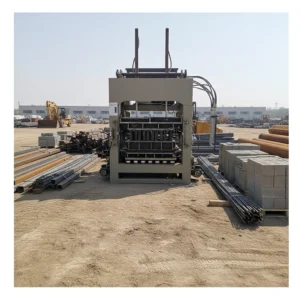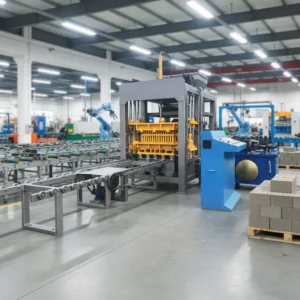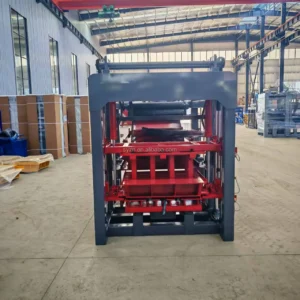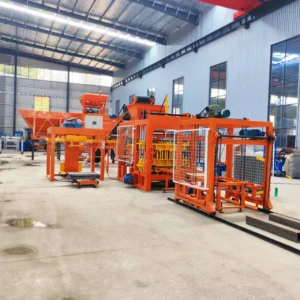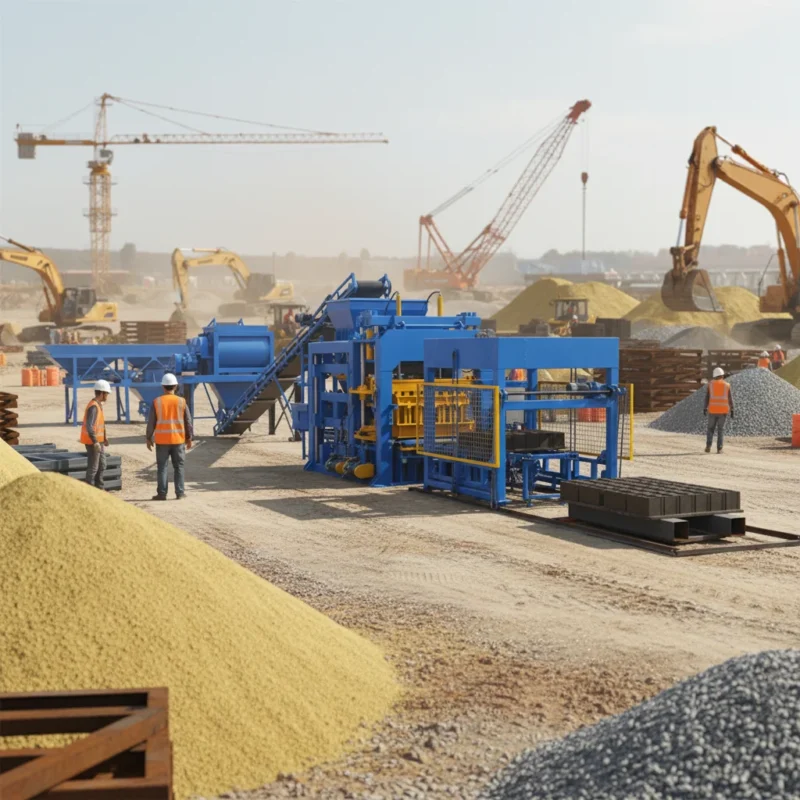
Coordinated Line Engineering — every station from raw material feeding through curing rack handling is specified as one matched system around the QT12-15 press.
Technical Specifications
| Parameter | Value |
|---|---|
| Model | QT12-15 |
| Product Type | Hydraulic Block Making Machine |
| Total Power | 62 kW |
| Pallet Size | 1300 × 900 mm |
| Moulding Cycle | 15–30 seconds (basis not stated in source — confirm block format / material / thickness) |
| Vibration Technology | Four-axis vibration with dynamic and static table plus frequency conversion |
| Vibration Force | 120 KN (source value — verify against manufacturer catalog) |
| Feeding System | Press-in arch breaker with 360° rotation |
| Noise Reduction | Flexible vibration reduction on pressure head; adjustable air bag vibration reduction in mold box |
| Control System | PLC with frequency conversion control |
| Voltage | Customized according to local industrial voltage |
| Moulds | Customized according to target block format |
| Standards | CE declaration available |
Application Suitability
| Application | Material or Output |
|---|---|
| Hollow block production | Crushed stone, cement, sand, and fly ash blends |
| Solid wall block manufacturing | Dense aggregate and cement mixes |
| Pavement brick and paver forming | Fine sand, pigment, and cement surface layers |
| Porous brick and slope protection brick | Lightweight aggregate with controlled porosity |
| Kerbstone and interlocking brick | High-density concrete with extended vibration |
Why Quoted Cycles Per Hour Rarely Survive the First Shift
The press never runs faster than the slowest upstream or downstream station. When buyers evaluate block production line equipment QT12-15, the focus usually lands on the press cycle time. Yet in actual plant operation, raw material feeding delays, pallet circulation bottlenecks, and manual stacking routines quietly consume the headroom the press was supposed to deliver. A QT12-15 pressing at its shortest stated cycle is only productive if the mixer can supply material, the pallet feeder can deliver boards, and the stacker can clear cured output at the same rhythm. Where any one station lags, the entire line waits [NEED_CITE: block plant cycle synchronization and throughput loss].
How Stations Connect Around the Press
The block production line equipment QT12-15 sits at the centre of a material flow chain that starts at the batching and mixing station. Raw material arrives via the press-in arch breaker, which rotates through 360 degrees to distribute the concrete mixture evenly into the mould cavity. This feeding action must complete within the press cycle window; otherwise, the vibration phase begins with an underfilled mould, producing blocks with inconsistent density. Downstream, the 1300 × 900 mm pallets exit the press carrying freshly formed blocks and must reach the curing rack before the next pallet arrives.
Where Cycle Time Matching Prevents Bottlenecks
Each supporting station has its own cycle that must align with the 15–30 second moulding window. The pallet feeder must index a new board into position before the press closes. The automatic stacker must lift and transfer cured blocks before the returning pallet re-enters the line. If the curing rack handler cannot clear a full rack and present an empty one, the stacker pauses, the pallet loop backs up, and the press idles. Specifying these stations as individual purchases from separate suppliers almost guarantees a timing mismatch that no amount of operator intervention can fully correct [NEED_CITE: multi-station line integration in concrete product plants].
Reading the Specifications for Line Impact
The four-axis vibration system with dynamic and static table, combined with frequency conversion, controls how quickly the concrete settles into the mould and reaches target density. Shorter cycle times demand higher vibration energy to achieve the same block strength; the frequency conversion allows the operator to adjust vibration intensity per block format rather than applying a single fixed setting. The adjustable air bag vibration reduction in the mould box isolates vibration from the machine frame, which matters in a line environment where continuous operation transmits stress into pallet guides, stacking arms, and curing rack interfaces. The 62 kW total power rating reflects the combined draw of vibration motors, hydraulic pump, and feeding system — buyers must verify that the plant electrical supply can sustain this load alongside the mixer, conveyor, and stacker motors without voltage sag.
The Cost of Treating Supporting Equipment as Optional
Leaving pallet handling, stacking, and curing rack systems out of the initial quotation creates a cascade of problems once the press is running. Workers manually lifting wet blocks from the press output slow the pallet return loop, forcing the press to idle between cycles. Pallets selected without regard to the buyer’s existing forklift capacity or curing area dimensions create a secondary handling problem that no press specification can solve. When vibration force and pallet stiffness are not matched, blocks crack during transfer to the curing rack, and the rejection rate climbs quietly until someone notices the pattern [NEED_CITE: pallet specification and block damage during transfer].
Why Sourcing the Full Line from One Supplier Matters
Configuring the block production line equipment QT12-15 as a complete system means every station is selected against the same block format, pallet size, and target output. The feeding system, press, pallet circulation, stacking, and curing rack handling share a single control logic rather than communicating through improvised relay wiring. The 1300 × 900 mm pallet is specified alongside the buyer’s curing area layout and forklift rating, not chosen from a standard catalogue page. Voltage, frequency, and PLC display language are confirmed once for the entire line before production begins, avoiding the situation where the press arrives configured for one standard and the stacker for another.
Documentation & Verification
- Line layout drawing showing station spacing, pallet loop path, and curing rack positions
- Capacity calculation sheet stating the block format assumed for each cycle time
- Pallet specification matched to buyer’s curing area dimensions and forklift capacity
- Voltage, frequency, and PLC display language confirmation signed before production
- Factory test record with actual cycle times measured per block format
- Hydraulic and electrical schematic covering all line stations
Installation, Commissioning & Support
- Foundation plan reflecting the 62 kW load distribution and vibration isolation requirements
- Electrical supply verification for customized voltage and dedicated circuit capacity
- Pallet loop alignment calibrated to 1300 × 900 mm board dimensions and return speed
- PLC programme loaded with confirmed display language and station synchronization logic
- Operator training covering mould change, vibration adjustment, and pallet handling routines
- Wear parts list for press, feeder arch breaker, and pallet guide components
What We Need to Configure Your Line
To size the supporting equipment around the QT12-15, share the target block formats, the daily output you need per format, and the raw materials available locally. Let us know your existing curing area dimensions, forklift capacity, and the industrial voltage and frequency at your site. If you already operate upstream mixers or downstream stacking stations, tell us the make and cycle times so we can verify compatibility.
Frequently Asked Questions
Q: How is daily output calculated for the QT12-15, and which block format is assumed?
A: The quoted moulding cycle of 15–30 seconds applies to a specific block format, material mix, and thickness that must be confirmed before the figure is meaningful. Daily output is then derived by multiplying the per-format cycle rate by the number of operating hours, minus pallet return time and mould change intervals. We provide a capacity calculation sheet that states the exact format assumption behind every output number.
Q: Which supporting stations are included in the line quotation?
A: The quotation covers raw material feeding, the QT12-15 press, pallet feeding and return, automatic stacking, and curing rack handling as one package. Each station is selected so its cycle time matches the press window. If you already own certain stations, we scope around them and confirm timing compatibility before finalizing the line layout.
Q: How do pallet size and material affect curing area and forklift requirements?
A: The 1300 × 900 mm pallet must physically fit the curing rack spacing and be liftable by the forklift already on site. Heavier pallets demand higher forklift capacity; pallet material affects block adhesion and release during stacking. We confirm pallet specification against your curing area drawing and forklift rating plate before the order is placed.
Q: Can the automation level be staged over time?
A: Yes. A buyer can start with manual pallet handling and semi-automatic stacking, then add automatic cubing and curing rack handling as volume grows. The PLC control system accommodates future station additions without replacing the press controller. We document the upgrade path in the initial line layout so electrical and mechanical interfaces are reserved from the start.
Q: What electrical details must be confirmed before shipment?
A: We need the site voltage, frequency, and phase configuration, plus the preferred PLC display language. These are confirmed in writing before production begins so that motors, control panels, and sensor wiring all match the destination electrical standard. Arriving with the wrong voltage configuration delays commissioning by weeks.