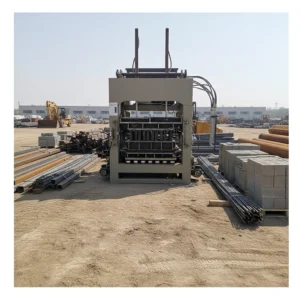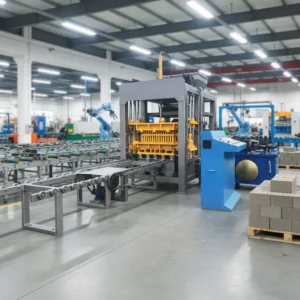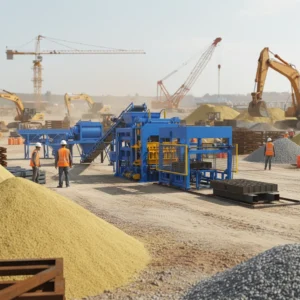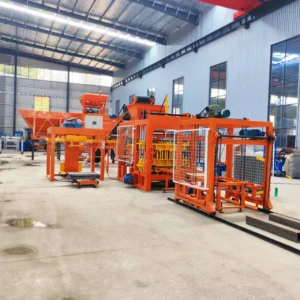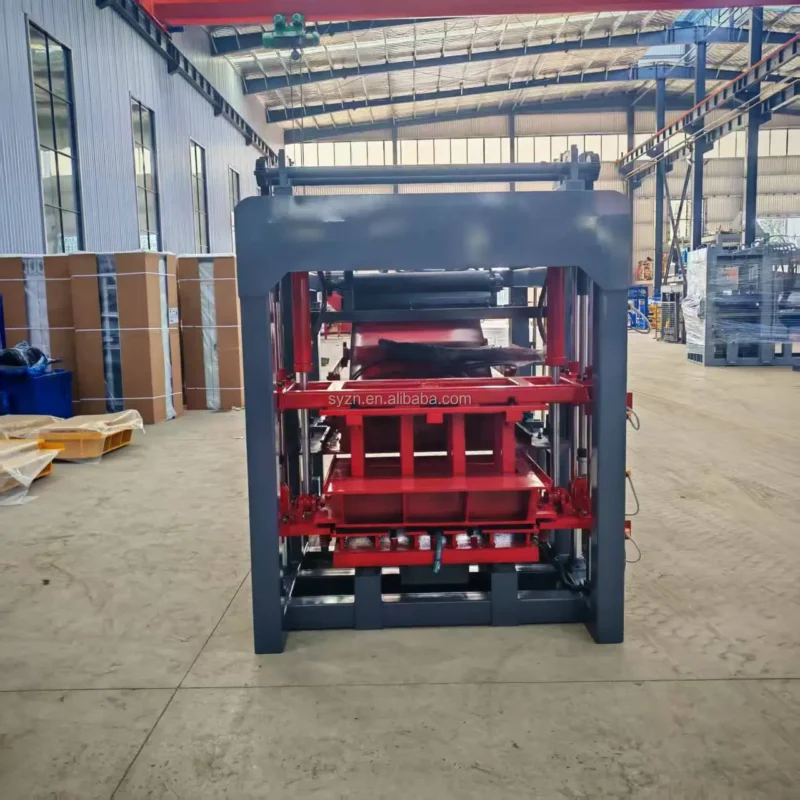
Line-Matched Engineering — Every QT4-15A automatic block making machine production line is specified so the mixer, pallet return, and stacking stations keep pace with the 25–30s press cycle, eliminating the idle seconds that quietly erase daily output.
Technical Specifications
| Parameter | Value |
|---|---|
| Model | QT4-15A |
| Product Type | Fully Automatic Concrete Brick Making Machine |
| Overall Dimensions (L×W×H) | 4100×1600×2600 mm |
| Rated Pressure | 16–21 MPa |
| Vibration Form | Platform Vibration |
| Vibration Frequency | 4200 r/min |
| Vibration Force | 55 kN |
| Pallet Size | 880×550 mm |
| Molding Cycle | 25–30 s (basis not stated in source — confirm block format / material / thickness) |
| Overall Power | 18.45 kW |
| Total Mass | 4 T |
| Demolding Method | Hydraulic |
| Factory Area Requirement | 300 m² |
| Control System | PLC (brand / model to be confirmed) |
| Applied Products | Hollow blocks, solid blocks, pavers, interlocking blocks, curbstone, colored pavers |
| Raw Materials | Crushed stone, sand, cement, dust, fly ash, gravel, slag |
| Warranty | 1 year (excluding spare parts) |
Application Suitability
| Application | Material or Output |
|---|---|
| Hollow block production for masonry walls | Crushed stone, sand, cement, fly ash blends |
| Solid block manufacturing for load-bearing structures | Gravel, cement, and slag mixes |
| Interlocking paver production for driveways and walkways | Fine sand, cement, pigment additives |
| Curbstone and kerb forming for road projects | Coarse aggregate with cement binder |
| Colored paver runs for landscaping contractors | Pigmented face mix over standard base mix |
Why "25–30 Seconds per Cycle" Rarely Translates to Quoted Daily Output
The press cycle is only as fast as the slowest station around it.
I once stood on a site in the Middle East where a mid-tier automatic block making machine production line sat idle forty seconds every cycle — not because the press was slow, but because the pallet feeder could not return a board in time and the mixer was still discharging into the hopper. The owner had paid for a machine rated at a certain cycles-per-hour figure, yet real daily tonnage fell noticeably short. That gap is almost always a line-matching problem, not a press problem [NEED_CITE: line balancing principles in concrete block production].
Upstream Stations Must Feed the Press Without Pause
Raw material batching, mixing, and hopper delivery have to complete within the 25–30 s press window. If the mixer discharges slower than the press consumes, the hopper runs dry and the automatic block making machine production line stalls mid-cycle. Sizing the mixer volume and belt conveyor speed to the press consumption rate is the first step in holding cycle time.
Downstream Handling Cannot Be an Afterthought
Wet blocks leaving the press need immediate pallet transfer, stacking, and movement to the curing area. When stacking is manual, workers fall behind the press rhythm within the first hour of a shift, forcing the operator to pause the PLC sequence. Matching the pallet return conveyor speed and stacker indexing to the press ejection rate keeps the automatic block making machine production line running continuously.
Reading the Numbers That Actually Matter
The 55 kN vibration force and 16–21 MPa hydraulic pressure must be evaluated together against the buyer’s mix design. High pressure alone on a lean mix produces lamination cracks; high vibration alone on a wet mix causes slump after demolding. The 880×550 mm pallet dimension dictates curing rack spacing and forklift tine width — changing it after the line is built means replacing every board in stock. The 4 T total mass and 300 m² factory area requirement indicate that foundation loading and building layout must be finalized before the machine arrives, not after [NEED_CITE: foundation engineering for vibrating block presses].
The Hidden Cost of Mis-Matched Line Stations
When a buyer focuses only on the press price and treats pallet handling, stacking, and curing rack transfer as optional add-ons, the line operates at a fraction of its designed rhythm. Workers manually hauling wet pallets create micro-stoppages that add up to hours of lost production per week. Inconsistent block strength follows when the press is force-paused and restarted, because the vibration dwell time varies cycle to cycle [NEED_CITE: effect of intermittent cycling on concrete block compressive strength].
Why Sourcing the Full Line From One Supplier Matters
Block machinery is our single focus, so the QT4-15A press, moulds, pallets, and handling equipment are specified as one matched system rather than assembled from separate vendors. Configuration is set against the buyer’s actual mix design, local aggregate, and target block format — not a catalogue default. Mould design covers every format the buyer’s market sells, with custom drawings available. Automation level is selectable, allowing a start at semi-automatic with a defined upgrade path. Installation includes operator training and a documented wear-parts list so the first replacement does not catch the plant off guard.
Documentation & Verification
- Line layout drawing showing each station position and pallet flow path for the QT4-15A
- Capacity calculation sheet stating the block format and mix assumed for the 25–30 s cycle
- Pallet specification covering size, material, and weight matched to the 880×550 mm press table
- Hydraulic and electrical schematic for local panel planning before the machine ships
- Voltage, frequency, and PLC display language confirmation form signed before production
- Factory test record run on the buyer’s chosen block format prior to container loading
Installation, Commissioning & Support
- 300 m² factory area divided into mixing, pressing, and curing zones per the layout drawing
- 18.45 kW total power requires a dedicated circuit with voltage and frequency confirmed pre-production
- Machine ships fully assembled and container-loadable in one 40HQ for straightforward site placement
- Hydraulic demolding system calibrated on-site against the buyer’s mix during commissioning
- PLC display language and control parameters set to operator preference before handover
- Wear parts list and mould maintenance schedule provided with the operation manual
What We Need From You to Size the Line
Share your target block formats with dimensions, daily output goal, and the local aggregate types available on site. Confirm the voltage, frequency, and preferred PLC display language for your market. Let us know your existing curing rack dimensions and forklift capacity so the 880×550 mm pallet can be validated or adjusted before the automatic block making machine production line is finalized.
Frequently Asked Questions
Q: How is the 25–30 s molding cycle measured and on which block format?
A: The cycle time is measured from pallet entry to block ejection on a specific format and mix. Without stating the block size, wall thickness, and aggregate blend, the number is not comparable across quotations. We provide a capacity calculation that names the exact format assumed, so you can verify it matches the product your market actually buys.
Q: What upstream and downstream equipment must match the press cycle?
A: The mixer discharge rate, belt conveyor speed, pallet feeder return time, and stacker indexing all have to complete within the press window. If any station is slower, the PLC pauses the press and daily output drops. The line layout we supply shows the timing relationship between every station so bottlenecks are visible before the equipment is built.
Q: Can the 880×550 mm pallet size be changed to fit my curing racks?
A: Pallet dimensions affect press table design, mould cavity layout, and curing rack spacing. A change is possible at the configuration stage but requires matching the new size to the vibration platform and hydraulic ram stroke. We confirm pallet size against your existing curing racks and forklift before the machine enters production.
Q: What does the 300 m² factory area include?
A: The footprint covers the raw material storage zone, mixing station, press area, pallet return loop, wet-block stacking point, and curing rack access aisles. It does not include finished-goods storage or aggregate stockpiling. A scaled layout drawing is provided so you can verify clearances against your building dimensions.
Q: Which voltage, frequency, and PLC language options are available?
A: Voltage and frequency are configured to match the buyer’s local grid standard, and the PLC display language is set before the control panel is wired. These three items must be confirmed in writing before production begins, because changes after wiring are costly and delay commissioning.