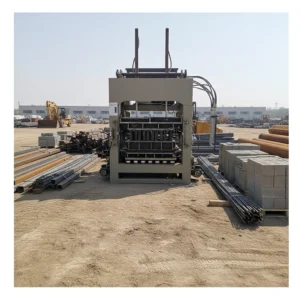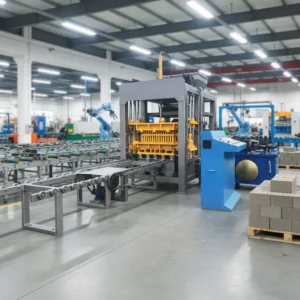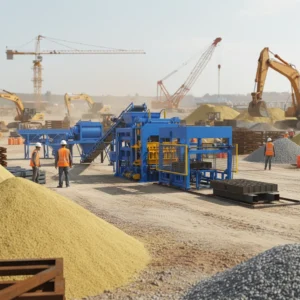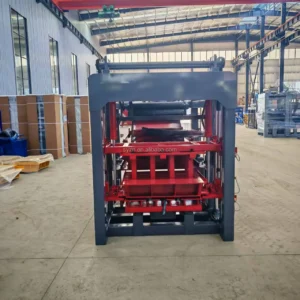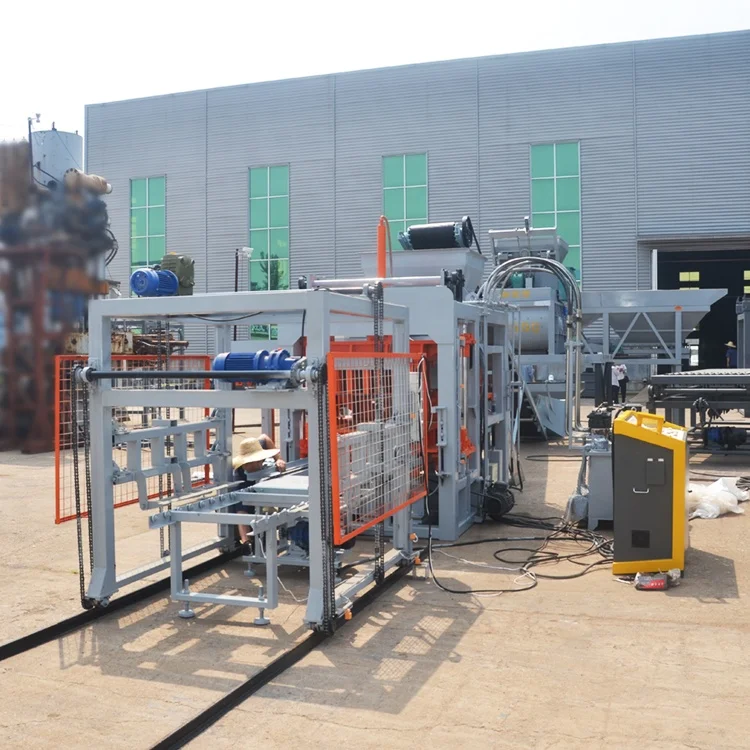
Integrated System Planning — The QT6-15 press is specified alongside raw material feeding, mixing, pallet circulation and stacking stations so that every cycle aligns with upstream and downstream timing rather than running in isolation.
Technical Specifications
| Parameter | Value |
|---|---|
| Model | QT6-15 |
| Product Type | Hydraulic Concrete Block Making Machine |
| Overall Dimensions (L×W×H) | 8200 × 1700 × 2950 mm |
| Total Mass | 7 T |
| Vibration Frequency | 0–60 Hz |
| Vibration Force | 45 kN |
| Vibration Form | Platform Vibration |
| Moulding Mode | Automatic loading with vibration moulding |
| Demolding Method | Hydraulic |
| Pallet Size | 880 × 850 mm |
| Molding Cycle | 15–20 s (basis to be confirmed by block format and material) |
| Overall Power | 37 kW |
| Control System | PLC with touch screen HMI, fault diagnosis and action interlock |
| Hydraulic System | Independent integrated station, isolated from main vibration and dust |
| Recommended Factory Area | 1200 m² |
| Block Compressive Strength | ≥15 MPa (source value — verify with manufacturer) |
| Voltage & Frequency | Configurable (to be confirmed before order) |
| PLC Display Language | Configurable (to be confirmed before order) |
| Warranty | 1 year for whole machine (excluding spare parts) |
Application Suitability
| Application | Material or Output |
|---|---|
| Hollow block production for load-bearing walls | Crushed stone, sand, cement and waste ash blends; 6 pcs per mould at 400×200×200 mm format |
| Solid brick manufacturing for masonry infill | Local aggregate and cement mixes; 32 pcs per mould at 240×115×53 mm format |
| Rectangular paver production for walkways and yards | Fine aggregate and pigment layers; 21 pcs per mould at 200×100×60 mm format |
| Zigzag interlocking paver for driveways | Graded aggregate with colour facing; 15 pcs per mould at 225×112.5×60 mm format |
| On-site block production for housing projects | Site-sourced aggregate with reduced cement dosage |
What a Quoted Cycle Time Leaves Out About Line Output
A press rated at 15–20 seconds per cycle only achieves that tempo when every upstream and downstream station is timed to match it.
When I first started commissioning block lines in West Africa, I watched a QT6-15 block machine production line sit idle for nearly half of each shift. The press itself cycled fine, but the mixer could not deliver batched material fast enough and the pallet return conveyor jammed every few minutes. The quoted cycle rate assumed a continuous feed that the rest of the line simply could not sustain. [NEED_CITE: line synchronisation standards in concrete product manufacturing] Buyers who focus only on the press specification end up with a bottleneck they did not plan for, and the real daily tonnage falls well short of expectations.
How Each Station Must Keep Pace with the Press
The QT6-15 block machine production line centres on a press that completes a moulding cycle in 15–20 seconds, which means the mixer must deliver a fresh batch within that same window and the pallet feeder must present a clean pallet before the press opens. If the batching plant delivers material in surges followed by gaps, the press idles and the effective hourly output drops. Matching the raw material feed rate, mixer discharge speed and pallet circulation quantity to the press tempo is the core of line design, and it starts long before the machine arrives on site.
Pallet Circulation as the Invisible Constraint
A pallet size of 880 × 850 mm determines not only the mould footprint but also how many pallets must be in continuous rotation to keep the press running. Each pallet travels through the press, into the curing rack, through cooling and back to the return conveyor, a loop that can take several hours depending on the curing method. If the pallet count is too low for the recommended 1200 m² factory area, the press stops waiting for empty pallets to come back. Planning the pallet pool against the curing rack capacity and the forklift schedule is what keeps the QT6-15 block machine production line running uninterrupted through a full shift. [NEED_CITE: pallet pool calculation methods in block production]
Reading the Specs That Actually Shape Daily Output
The independent hydraulic station sits apart from the main frame, isolated from vibration and dust that would otherwise degrade valve response over a long shift. Consistent hydraulic pressure during demolding prevents corner damage, especially on thinner paver formats where the block is still fragile at ejection. Platform vibration at 0–60 Hz with 45 kN force compacts the mix from below, and the frequency range lets the operator dial in the right amplitude for different aggregates — a coarser crushed stone needs a different setting than a fine fly ash blend. The PLC touch screen coordinates press timing with pallet feed and stacking sequences, so a fault in any station triggers an interlock that stops the press before a jam propagates through the line. Voltage and frequency remain configurable, which matters because a 37 kW motor wound for the wrong supply will overheat within days and stall the entire production setup.
When Supporting Equipment Is Left Off the Quotation
I have seen contractors receive a press and a set of moulds, only to realise that the pallet return system, stacking station and curing rack handling were never included. Finished blocks then sit on pallets stacked by hand while the press waits, and the real output per shift is a fraction of what the cycle time suggests. [NEED_CITE: common omissions in block line quotations] A balanced QT6-15 block machine production line quotation must list every station from raw material intake through to cubing, so the buyer knows exactly which items are supplied and which remain site-procured.
Why Procurement Starts with Line Balance
Block machinery is our single focus, so the press, moulds, pallets and handling equipment are specified as one matched system rather than assembled from unrelated suppliers. The configuration is set against the buyer’s actual mix design, local aggregate and target block format — not pulled from a catalogue default. Mould design covers the formats the buyer’s market actually sells, and custom drawings are available when standard formats do not match local building codes. Automation level is selectable, meaning a buyer can begin with semi-automatic pallet handling and add stacking later as volume grows. Installation support includes operator training so the maintenance team can read the hydraulic and electrical schematics independently from day one.
Documentation & Verification
- Line layout drawing showing each station position relative to the 1200 m² recommended area
- Capacity calculation stating which block format and cycle time each output figure assumes
- Pallet specification sheet confirming size, material and quantity against curing rack plan
- Hydraulic and electrical schematic for on-site fault tracing by the maintenance team
- Voltage, frequency and PLC language confirmation recorded before production begins
- Factory test record on the buyer’s chosen block format before dispatch
Installation, Commissioning & Support
- Foundation plan matched to the 8200 × 1700 mm footprint and 7 T operating mass
- Dedicated power circuit sized for the 37 kW total load with confirmed voltage and frequency
- Machine shipped in dismantled modules with reassembly supervised on site
- First-run parameter setting covering vibration frequency, hydraulic pressure and cycle timing
- PLC language and HMI layout configured to the operator team’s working language
- Wear parts and mould list supplied with recommended replacement intervals
Preparing Your Line Inquiry
To build an accurate QT6-15 block machine production line proposal, share the target block formats, the local aggregate and cement types available, the planned daily output per format, and the dimensions of the site including curing area. Confirming the local voltage, frequency and preferred PLC display language at this stage prevents commissioning delays once the equipment arrives. If existing mixers, conveyors or forklifts will be integrated into the line, their specifications help us size the pallet circulation and station timing correctly.
Frequently Asked Questions
Q: How is line capacity calculated and which block format does each output figure assume?
A: Every output figure in the quotation states the exact block format, pieces per mould and cycle time it is based on. For example, hollow block capacity assumes a 400×200×200 mm format at 6 pieces per mould. Buyers can compare these figures directly against their daily product mix to verify realistic shift output.
Q: How must upstream mixing and feeding stations be timed so the press is not left idle?
A: The mixer discharge rate and raw material feed conveyor speed are calculated against the 15–20 second moulding cycle so that a fresh batch arrives before each press stroke. If the mixer batch size or discharge time does not match, the line proposal adjusts mixer capacity or adds a buffer hopper.
Q: What pallet quantity is required to keep the press running through a full shift?
A: The pallet pool is calculated from the 880 × 850 mm pallet size, the curing duration and the return conveyor speed. A longer curing cycle requires more pallets in rotation. The quotation includes a pallet count matched to the buyer’s planned curing rack area and shift length.
Q: How should the curing rack area be laid out relative to the recommended factory area?
A: The 1200 m² recommended area covers press operation, pallet circulation, curing rack rows and forklift lanes. Rack rows are positioned so that loaded pallets move from the stacking station into curing and back to the return conveyor without crossing the raw material feed path.
Q: Which supporting equipment is included in the line quotation and which items are buyer-supplied?
A: The quotation itemises every station from raw material feeding through to cubing. Items such as the cement silo, water supply and workshop power distribution are typically buyer-supplied. Each line item is marked clearly so there are no surprises at the installation stage.