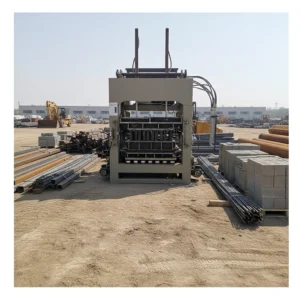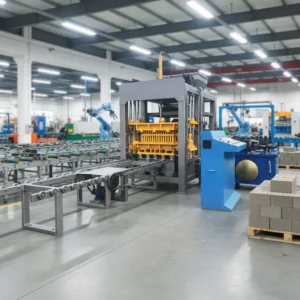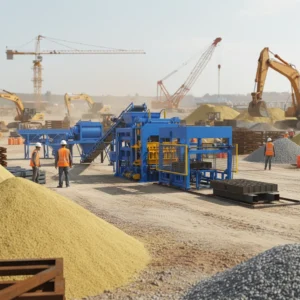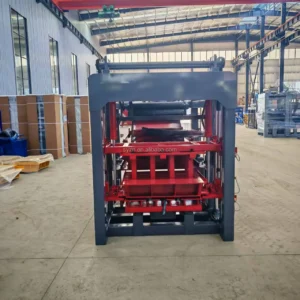
Station-Synced Line Design — Every upstream and downstream station around the QTJ4-40 is sized to its 40-second molding cycle so the press never idles waiting for material or pallets.
Technical Specifications
| Parameter | Value |
|---|---|
| Model | QTJ4-40 |
| Product Type | Semi-Automatic Concrete Block Making Machine |
| Machine Power | 10.4 kW |
| Molding Cycle | 40 s |
| Output Capacity | 2800 pcs/day (based on 400×200×200mm hollow block, 4 pcs/mould) |
| Output Capacity | 3600 pcs/day (based on 400×150×200mm hollow block, 5 pcs/mould) |
| Output Capacity | 6400 pcs/day (based on 225×112.5×60mm solid brick, 9 pcs/mould) |
| Raw Materials | concrete, sand, cement, fly ash, lime, gypsum |
| Machine Weight | 1 T |
| Overall Dimensions | 1350 × 1460 × 1800 mm |
| Pallet Size | 850 × 450 mm |
| Voltage | according to buyer local voltage (exact value to be confirmed) |
| Automation Level | semi-automatic |
| Vibration Method | bed mould vertical vibration + upper mould compression vibration |
| Mould Operation | top die push-pull with automatic scraper |
| Key Features | CE declaration where applicable |
Application Suitability
| Application | Material or Output |
|---|---|
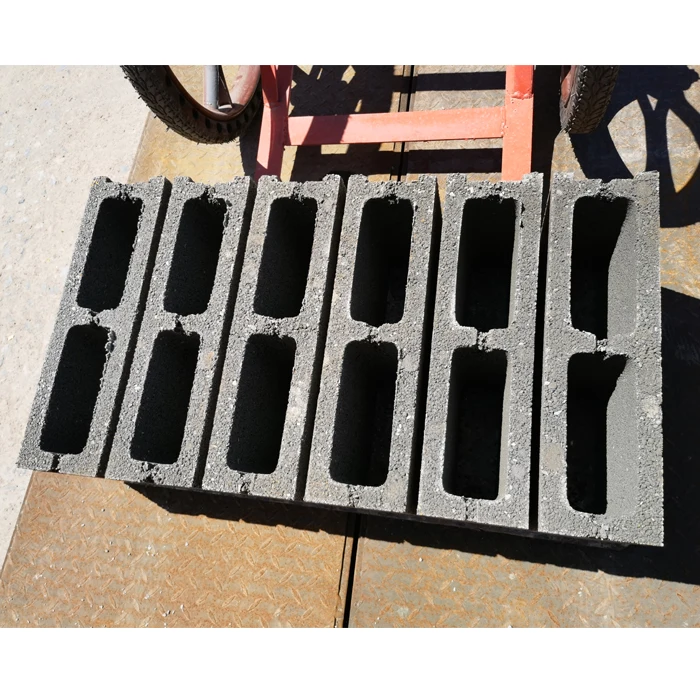
| Small to medium block production plants | Hollow blocks from crushed stone, sand and cement |
| Entrepreneurs establishing a first block plant | Solid bricks from fly ash, lime and gypsum blends |
| Construction contractors producing blocks on-site | Hollow and solid blocks using locally available aggregate |
| Small-format paver production | Paving units from concrete and sand mixes |
Why the Press Should Never Wait for the Mixer
A block line is only as fast as its slowest supporting station.
When I helped a European buyer set up a QTJ4-40 hollow block line, the mixer discharge rate fell behind the press rhythm. Every three cycles the operator stood idle while the hopper refilled, cutting realistic daily throughput by roughly four tenths. That mismatch was invisible on paper because the quotation only listed cycles per hour without showing which block format that figure assumed [NEED_CITE: capacity calculation standards for concrete block plants].
With the QTJ4-40 block machine production line, the 40-second molding cycle becomes the metronome. The raw material feeder, mixer batch size, pallet return conveyor and manual stacking pace are all calculated so that one finished pallet clears the press before the next charge lands. Without that station-by-station timing, even a well-built press delivers below its rated capacity.
Matching the Mixer Batch to the 40-Second Rhythm
The QTJ4-40 block machine production line pairs the press with a pan or ribbon mixer whose batch volume covers at least two full molding cycles. This buffer prevents the hopper from running dry between discharges and keeps the vibration table fed continuously. When the mixer output is undersized, the press operator must pause, and those pauses compound across a shift.
Pallet Flow as the Hidden Bottleneck
Pallets move from the stacking area through curing and back to the press in a loop that must close within the cycle window. The 850 × 450 mm pallet size was chosen so that standard two-wheel carts and small forklifts can handle them without custom attachments [NEED_CITE: pallet handling logistics in small block plants]. If the pallet return leg takes longer than 40 seconds, the press stalls regardless of how fast the mixer runs.
Reading the Specs That Actually Matter
The 10.4 kW machine power covers both the vibration motor and the hydraulic top-die compression. Vertical bed vibration compacts the aggregate from below while upper mould compression seals the surface, together producing a denser block than vibration alone. The semi-automatic configuration means pallets are fed by hand, which keeps capital outlay low but demands that the operator’s pace match the cycle timer. Voltage must be confirmed against the buyer’s site supply before the motor is wound, because a rewound motor on arrival delays commissioning by weeks [NEED_CITE: industrial voltage standards by export region]. The 1 T machine weight and compact 1350 × 1460 × 1800 mm footprint allow installation on a simple concrete pad without heavy foundation work.
The Cost of a Misaligned Station
When the curing rack layout ignores the 850 × 450 mm pallet dimension, workers spend extra time repositioning blocks before stacking, and that dead time eats into the shift. Undersized mixers force the press into stop-start operation, accelerating wear on the vibration bearings because each restart hits peak load from cold. Buyers who skip the pallet return conveyor altogether end up carrying pallets by hand, which limits the line to a fraction of its designed output and raises the risk of workplace injury [NEED_CITE: manual handling injury rates in masonry production].
Why Source the Full Line from One Supplier
Block machinery is our single focus, so the QTJ4-40 press, its moulds, pallets and handling gear are specified as one matched system. Configuration starts from the buyer’s actual mix design and target block format rather than a catalogue default. Mould design covers the formats the local market sells, with custom drawings accepted for non-standard shapes. Automation level is selectable — a buyer can begin with the semi-automatic QTJ4-40 and add automatic stacking later. Installation support includes operator training so that cycle timing discipline is understood from day one.
Documentation & Verification
- Line layout drawing showing each station and its cycle time relative to the 40-second press rhythm
- Capacity calculation sheet stating block format and mould cavity count for every output figure
- Pallet specification matched to buyer’s curing rack spacing and forklift fork width
- Hydraulic and electrical schematic with voltage and frequency noted per order
- Factory test record run on the buyer’s chosen block format before dispatch
- Operation and maintenance manual covering vibration bearing greasing intervals
Installation, Commissioning & Support
- Concrete pad leveled to ±3 mm across the 1350 × 1460 mm base footprint
- Dedicated circuit sized for 10.4 kW plus mixer starting surge current
- Machine shipped as a single skid; top die and scraper assembled on site
- First run calibrates vibration duration and top-die pressure to local aggregate
- Operator training covers pallet loading rhythm aligned to the 40-second cycle
- Wear parts list includes vibration springs, scraper blades and hydraulic seals
Before You Request a Quote
To size the QTJ4-40 block machine production line accurately, share the block formats your market demands along with the daily volume you need for each. Let us know the raw materials you can source locally and any existing mixers, pallets or forklifts the new press must integrate with. Confirming your site voltage, frequency and preferred control language early prevents rework during commissioning.
Frequently Asked Questions
Q: How do upstream and downstream stations stay in sync with the QTJ4-40 cycle?
A: Each station — mixer discharge, pallet feed, stacking — is timed against the 40-second molding cycle. The mixer batch volume covers at least two cycles, and the pallet return loop is designed to close within one cycle window. If any station runs slower, the line layout is revised before the quotation is finalized so the press never idles.
Q: How is daily output calculated for different block formats?
A: Output is stated per format with the mould cavity count and block dimension as the basis. For example, 2800 pieces per day assumes 400×200×200mm hollow blocks at 4 pieces per mould, while 6400 pieces per day assumes 225×112.5×60mm solid bricks at 9 pieces per mould. Each figure appears on the capacity sheet with its full assumption set.
Q: How should pallet size be chosen for the QTJ4-40 line?
A: The standard 850 × 450 mm pallet is matched to the press platen. Before confirming, we check the buyer’s curing rack spacing and forklift fork width. If the existing curing area uses a different pallet dimension, we adjust the pallet spec so that no manual repositioning is needed between pressing and stacking.
Q: Can the semi-automatic line be upgraded later?
A: Yes. The QTJ4-40 can start with manual pallet feeding and stacking. When volume grows, an automatic pallet feeder and stacker can be added without replacing the press. The upgrade path is discussed during the initial line layout so that mechanical mounting points and electrical capacity are reserved from the start.