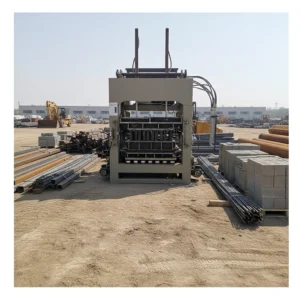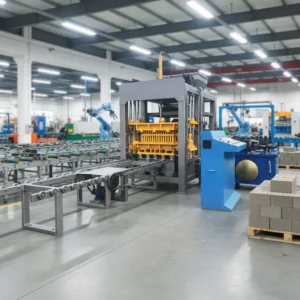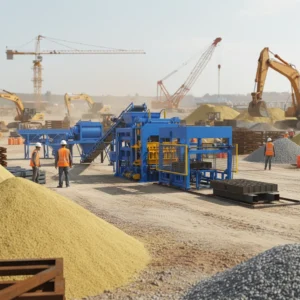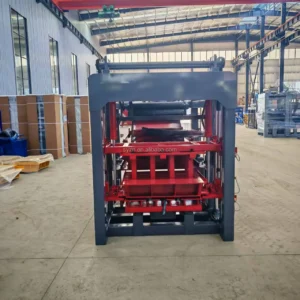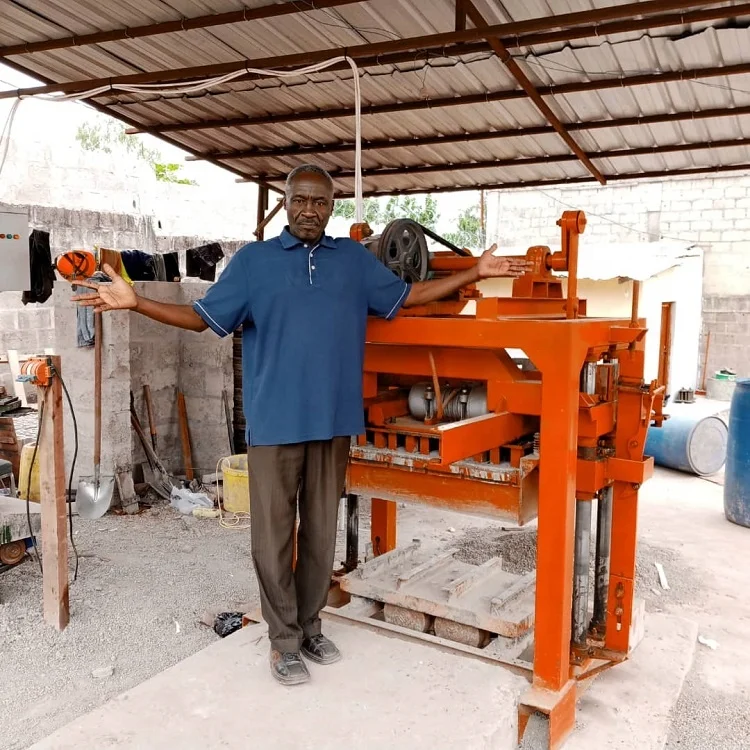
Coordinated Line Design — mixer, pallet loop and press cycle mapped together so the QTJ4-40 never idles waiting for upstream feed or downstream clearing.
Technical Specifications
| Parameter | Value |
|---|---|
| Product Type | Semi-Automatic Cement Block Making Machine |
| Model | QTJ4-40 |
| Rated Power | 9.5 kW |
| Molding Cycle | 40 s |
| Output Capacity | 2000–2500 pcs / 8 h (basis not stated in source — confirm block format) |
| Theoretical Productivity | 360 pcs/h for 400×200×200 mm hollow block, 4 pcs/mould; 2800 pcs/day |
| Theoretical Productivity | 450 pcs/h for 400×150×200 mm hollow block, 5 pcs/mould; 3600 pcs/day |
| Theoretical Productivity | 800 pcs/h for 225×112.5×60 mm solid/paver, 9 pcs/mould; 6400 pcs/day |
| Vibration System | Bed mould vertical vibration + upper mould compression vibration |
| Mould Actuation | Top die push-pull with automatic scraper |
| Pallet Size | 850 × 450 mm |
| Overall Dimensions (L×W×H) | 1350 × 1460 × 1800 mm |
| Machine Weight | 1 T (source value — verify against manufacturer catalog) |
| Raw Materials | Concrete, sand, cement, fly ash, lime, gypsum |
| Automation Level | Semi-automatic (manual pallet handling implied) |
| Voltage | Configured to buyer’s local voltage and frequency |
Application Suitability
| Application | Material or Output |
|---|---|
| Small-scale hollow block plant | Crushed stone, sand and cement blends for 400×200×200 mm and 400×150×200 mm formats |
| Paving brick and solid brick manufacturing | Fine aggregate and cement mixes for 225×112.5×60 mm interlocking or solid units |
| On-site production for building contractors | Local sand, fly ash and cement combinations in temporary workshop setups |
| Fly ash brick workshop | Fly ash, lime, gypsum and sand blends for lightweight masonry units |
What "2800 Blocks a Day" Actually Requires from Your Supporting Block Machine Line
A 40-second press cycle is only as fast as the slowest station around it.
Many buyers focus on the press output number without checking whether the mixer can deliver a fresh batch every four or five cycles, or whether one operator can pull and replace pallets within that same window. When the supporting block machine line is not matched to the press tempo, the QTJ4-40 sits idle while material or pallets catch up [NEED_CITE: line balancing principles for semi-automatic block plants]. The result is a daily tally that falls noticeably short of the quoted figure, and a buyer who blames the press for a line-level problem.
Mixer Batching Rhythm and the 40-Second Cycle
The QTJ4-40 completes a moulding cycle every 40 seconds, which means roughly 1.5 cycles per minute. For the press to run continuously, the mixer must discharge a batch into the hopper before the previous batch is exhausted. A pan mixer with a batch volume matched to two or three mould fills, discharging into a belt or bucket elevator feeding the press hopper, keeps the material flow steady. If the mixer batch is too large, material sits and begins to set; if too small, the press starves between batches.
Pallet Circulation Defines the Downstream Bottleneck
On a semi-automatic setup, an operator pulls the filled pallet from the press table, carries or carts it to the curing area, and returns an empty pallet. The 850×450 mm pallet format sets the dimensions of every curing rack, cart and forklift tine spacing downstream. When pallets are spec’d without checking the buyer’s existing racks, the whole block production line equipment layout must be redesigned after arrival [NEED_CITE: pallet standardization in concrete product curing]. Mapping pallet size to the curing area before the order is placed avoids costly re-racking later.
How Vibration and Compression Interact at the Press
The QTJ4-40 uses dual vibration — vertical vibration from the bed mould and compression vibration from the upper mould — to compact the mix. This combination determines block density and green strength, which in turn affects how soon a freshly moulded block can be moved off the pallet without edge damage. The vibration force must be matched to the buyer’s specific mix design and local aggregate gradation; a mix with excessive fines or insufficient cement will not consolidate properly regardless of vibration intensity [NEED_CITE: vibration force and aggregate matching in concrete block forming].
The Cost of Spec’ing the Press in Isolation
When the supporting block machine line is assembled piecemeal, mismatches surface during commissioning. A mixer with insufficient discharge height forces a manual transfer step. Pallets that are too thin flex under vibration, producing uneven block bases. Curing racks built for a different pallet size mean every pallet must be re-stacked by hand before curing begins. These issues do not show up on a press-only quotation but they consume labour and time every single shift [NEED_CITE: hidden integration costs in block plant setup].
Why Buyers Source the Line as One Package
Our approach starts with the buyer’s target block format, daily output goal and local raw material profile, then works backward to specify every station. The QTJ4-40 is positioned within a line layout drawing that shows mixer placement, pallet feed path and curing rack arrangement with cycle times reconciled at each handoff point. Pallet material and thickness are confirmed against the buyer’s existing forklift and rack dimensions. Voltage, frequency and control language are documented before production begins, not discovered at commissioning. Moulds are designed for the formats the buyer’s market actually sells, with custom drawings available when standard formats do not match local demand.
Documentation & Verification
- Line layout drawing showing QTJ4-40 station positions, mixer feed path and pallet loop with cycle reconciliation
- Pallet specification sheet confirming 850×450 mm dimensions, material grade and load rating for your curing racks
- Factory test record on your chosen block format with actual cycle time and demoulding result
- Voltage, frequency and control panel language confirmation documented before shipment release
- Mould drawing and format list with realistic output stated per block type, not a single generic figure
Installation, Commissioning & Support
- Foundation plan matching the 1350×1460 mm footprint with level tolerance and anchor bolt positions for the QTJ4-40
- Dedicated circuit sizing for the 9.5 kW rated power with voltage and frequency confirmed to your local grid supply
- Mixer discharge height and belt conveyor alignment checked against the press hopper entry during first-day commissioning
- Operator training covering the 40-second moulding cycle rhythm, pallet exchange sequence and mould change procedure
- Wear parts list identifying high-wear items on the vibration table and mould faces with recommended replacement intervals
What to Include with Your Inquiry
To build a line proposal around the QTJ4-40, share your target block formats with dimensions, the daily output you need for each format, and the raw materials available locally including aggregate gradation. Confirm your site voltage, frequency and preferred control panel language. If you have existing curing racks, forklifts or mixers on site, send their dimensions and capacity so the supporting block machine line equipment can be matched to what you already have rather than duplicated.
Frequently Asked Questions
Q: How do I verify the daily output claim for the QTJ4-40?
A: The 2000–2500 pcs per 8 hours figure does not state which block format it assumes. We provide a capacity calculation that lists output per specific format — for example, 2800 pcs/day for 400×200×200 mm hollow blocks at four per mould, or 6400 pcs/day for 225×112.5×60 mm pavers at nine per mould. Ask for the format-specific table before confirming your order.
Q: Will the 850×450 mm pallet fit my existing curing setup?
A: That depends on your current rack slot width and forklift tine spacing. We confirm pallet dimensions, material and thickness against your curing area layout before the line is finalized. If your racks are built for a different pallet size, we adjust the pallet specification or advise on rack modification so the block production line equipment integrates without rehandling.
Q: How should the mixer be matched to the 40-second press cycle?
A: The mixer must discharge a fresh batch before the press hopper runs empty, which typically means a batch volume covering two to three mould fills with a discharge interval under two minutes. We specify mixer capacity and feed conveyor speed as part of the line layout so the supporting block machine line keeps the press running at its rated cycle without starvation or overflow.
Q: What electrical supply does the QTJ4-40 require?
A: The machine draws 9.5 kW and is configured to your local voltage and frequency before production. We document the exact voltage rating, phase configuration and control panel language in writing before the machine is built, so commissioning is not delayed by electrical mismatches when the supporting block machine line equipment arrives on site.
Q: Is pallet feeding and stacking included in the quotation?
A: On a semi-automatic line, pallet handling is done manually, but we still specify pallet quantity, material and circulation path in the proposal. If you want to move toward automatic pallet feeding or stacking later, the QTJ4-40 line layout can accommodate that upgrade path. We clarify exactly which stations are quoted so there are no unpriced gaps in the block production line equipment scope.