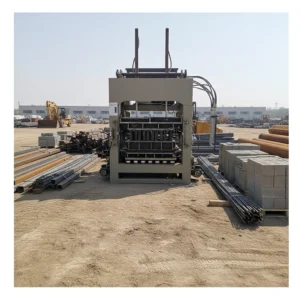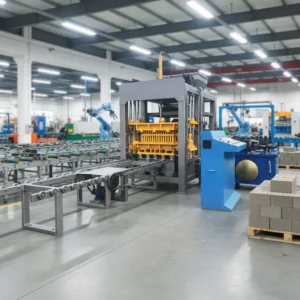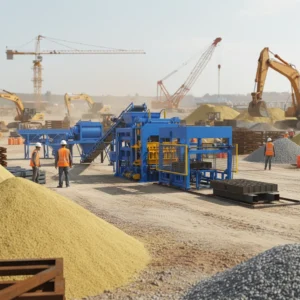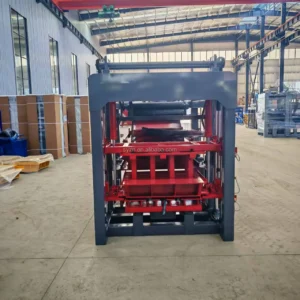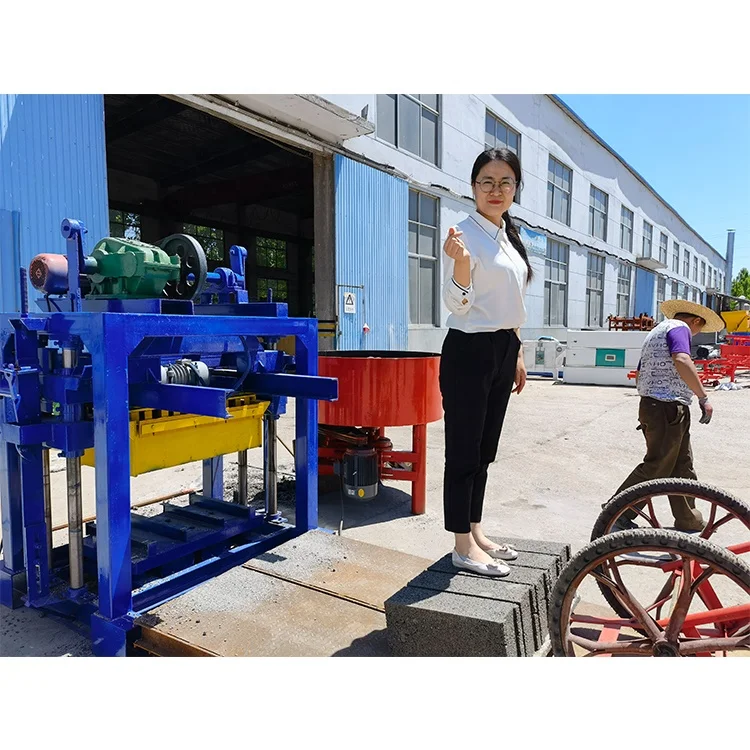
Matched Line Integration — the QTJ4-40 block machine production line is specified so that feeding, mixing, pallet handling and stacking stations keep pace with its 40-second moulding cycle, eliminating the common gap between quoted press speed and actual daily output.
Technical Specifications
| Parameter | Value |
|---|---|
| Model | QTJ4-40 |
| Product Type | Semi-Automatic Concrete Block Making Machine |
| Rated Power | 10.4 kW |
| Voltage & Frequency | Configured to buyer’s local standard (basis to be confirmed) |
| Control System | Semi-automatic with top die push/pull and automatic scraper |
| Overall Dimensions (L × W × H) | 1350 × 1460 × 1800 mm |
| Net Weight | 1 T |
| Moulding Cycle | 40 s |
| Pallet Size | 850 × 450 mm |
| Vibration System | Bed mould vertical vibration + upper mould compression vibration |
| Output Capacity | 2000–2500 pcs / 8 hours (basis not stated in source — confirm block format) |
| Theoretical Output (400×200×200 mm hollow block, 4 pcs/mould) | 360 pcs/h, 2800 pcs/day |
| Theoretical Output (400×150×200 mm hollow block, 5 pcs/mould) | 450 pcs/h, 3600 pcs/day |
| Theoretical Output (225×112.5×60 mm solid brick, 9 pcs/mould) | 800 pcs/h, 6400 pcs/day |
| Raw Materials | Concrete, sand, cement, fly ash, lime, gypsum |
Application Suitability
| Application | Material or Output |
|---|---|
| Small to medium-scale hollow block plants | Crushed stone, sand and cement mix for 400×200×200 mm hollow blocks |
| On-site block production for building contractors | Locally sourced aggregate and cement for solid brick and hollow block formats |
| First block plant for entrepreneurs | Fly ash, sand and cement blends for standard walling blocks |
| Paving block and kerbstone runs | Fine aggregate and cement with colour oxide where required |
| Regional block supply by distributors | Multiple mould formats on a single pallet size across the QTJ4-40 block machine production line |
Why the Press Cycle Is Never the Whole Story
A 40-second moulding cycle only becomes real daily output when every station before and after the press is sized to match it.
Quotations that list only the press leave buyers discovering on commissioning day that the mixer cannot feed fast enough, or that workers are still carrying pallets by hand while the press sits idle. I have watched a semi-automatic line in East Africa lose half its shift because the pallet return loop was added as an afterthought, forcing two operators to walk pallets back to the feed side in the heat [NEED_CITE: common causes of block line downtime in small plants]. The QTJ4-40 block machine production line avoids this by specifying each upstream and downstream station against the same 40-second baseline from the first drawing.
Stations That Must Keep a 40-Second Rhythm
Every station on the QTJ4-40 block machine production line is matched to the press cycle. The mixer discharge rate, the raw material feeder belt speed and the pallet feed mechanism are all set so that a fresh pallet and a full mould box arrive within the 40-second window. When any single station runs slower, the press waits and the quoted output drops proportionally.
Where Semi-Automatic Ends and Manual Begins
The top die push/pull and the scraper operate automatically, but pallet loading onto the feed table and pallet removal from the delivery side remain manual tasks on this line. Understanding that boundary before the line is built prevents the surprise of needing extra operators on day one. The layout drawing shows each manual station so labour planning is accurate from the start [NEED_CITE: labour allocation for semi-automatic block lines].
Reading the Numbers Behind the Output
The 40-second moulding cycle sets the theoretical ceiling: 360 pcs/h on a 400×200×200 mm hollow block with 4 cavities, or 800 pcs/h on a 225×112.5×60 mm solid brick with 9 cavities. The bed mould vertical vibration combined with upper mould compression vibration determines block density and demoulding strength. If the vibration force is not matched to the buyer’s specific mix design and local aggregate gradation, blocks may crack on demoulding regardless of cycle speed. The 850 × 450 mm pallet size must align with the curing rack spacing and the forklift tine width already on site; a mismatch here slows the entire curing rotation and chokes output downstream of the press.
The Cost of Leaving Stations Off the Quote
When a buyer receives a quotation covering only the press, the missing stations do not disappear — they become hidden labour costs. I once commissioned a line where the pallet handling was left to manual carrying, and the operators could not sustain the feed rate past the third hour of the shift [NEED_CITE: impact of manual pallet handling on daily block output]. Block stacking by hand also introduces breakage that does not appear in the press specification sheet. Specifying the full QTJ4-40 block machine production line from raw material intake to stacking removes these gaps before the machine ships.
Why This Line Comes From One Source
Block machinery is our single focus, which means the press, mould, pallet and handling equipment are specified as one matched system rather than assembled from separate suppliers. Configuration is set against the buyer’s actual mix design and local aggregate, not a catalogue default. Mould design covers the formats the buyer’s market actually sells, including custom drawings when standard formats do not fit. The automation level is selectable, so a buyer can start with semi-automatic pallet handling and add automatic stacking later. Installation support includes operator training on the specific line layout delivered to site.
Documentation & Verification
- Line layout and capacity calculation stating the block format assumed for every output figure
- Machine specification sheet covering the 10.4 kW drive and 850 × 450 mm pallet size
- Mould drawing and format list for hollow block, solid brick and paving block options
- Pallet specification matched to the buyer’s curing rack dimensions and forklift capacity
- Voltage, frequency and control language confirmation signed off before production begins
- Factory test record on the buyer’s target block format before dispatch
Installation, Commissioning & Support
- Foundation pad sized to the 1350 × 1460 mm footprint with vibration isolation for the 1 T press frame
- Dedicated circuit matching the confirmed voltage and frequency for the 10.4 kW rated load
- Press, mixer and pallet feed stations dismantled for container loading and reassembled on site
- First-run moulding cycle verified at 40 s on the buyer’s chosen block format during commissioning
- Operator training covering semi-automatic scraper, top die push/pull and manual pallet handling sequence
- Wear parts list with hydraulic seals and vibration springs identified for first reorder cycle
What to Share With Your Next Enquiry
Tell us the block formats your market sells and the daily volume you need for each one, so the QTJ4-40 block machine production line capacity can be calculated per format. Share your local raw material sources and any existing mix design data. Confirm the voltage, frequency and control display language for your site, and describe the curing area layout and forklift you already have so the 850 × 450 mm pallet specification is validated before the line is built.
Frequently Asked Questions
Q: How is daily output calculated for each block format on this line?
A: Output is calculated from the 40-second moulding cycle multiplied by the cavity count per mould, then adjusted for realistic shift conditions. The capacity table on this page shows figures for a 400×200×200 mm hollow block at 4 cavities, a 400×150×200 mm hollow block at 5 cavities, and a 225×112.5×60 mm solid brick at 9 cavities. Each figure states its format so buyers can match it to their product range.
Q: Which stations sit between the mixer and the curing rack?
A: The raw material feeder delivers aggregate into the mixer, which discharges into the mould box feed hopper. The press forms blocks on an 850 × 450 mm pallet, then the pallet moves to the delivery side where blocks are removed and the pallet returns to the feed table. Bottlenecks most often appear at pallet return and block removal when these stations are not matched to the 40-second cycle.
Q: How does the 850 × 450 mm pallet size affect the curing area?
A: The pallet size determines curing rack shelf spacing, rack capacity per square metre and the forklift tine width required to move loaded racks. If the curing area is laid out for a different pallet size, racks must be rebuilt or replaced before the line starts. We confirm pallet dimensions against the buyer’s existing curing layout and material handling equipment before production begins.
Q: Where does semi-automatic end and manual work begin?
A: The top die push/pull and the scraper are automatic, so the operator does not handle the mould head during the press cycle. Pallet loading onto the feed table, pallet transfer from the delivery side back to the feed, and block stacking for curing remain manual tasks. Knowing this boundary lets the buyer plan the correct number of operators per shift.
Q: Can downstream automation be added after the line is running?
A: Yes. The QTJ4-40 block machine production line supports a staged upgrade path. A buyer can begin with manual pallet return and hand stacking, then add an automatic pallet return conveyor and an automatic stacker as volume grows. The press, mould and pallet size remain unchanged, so the upgrade does not require replacing existing tooling or curing racks.