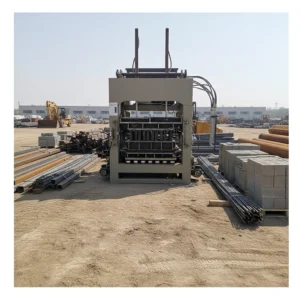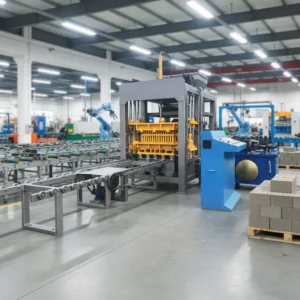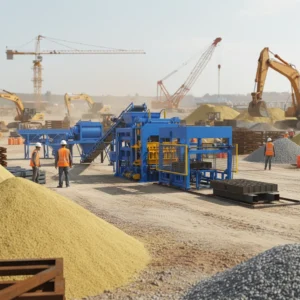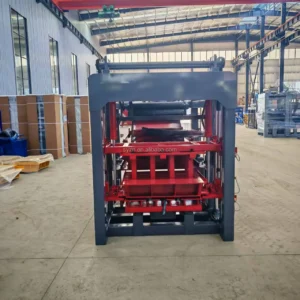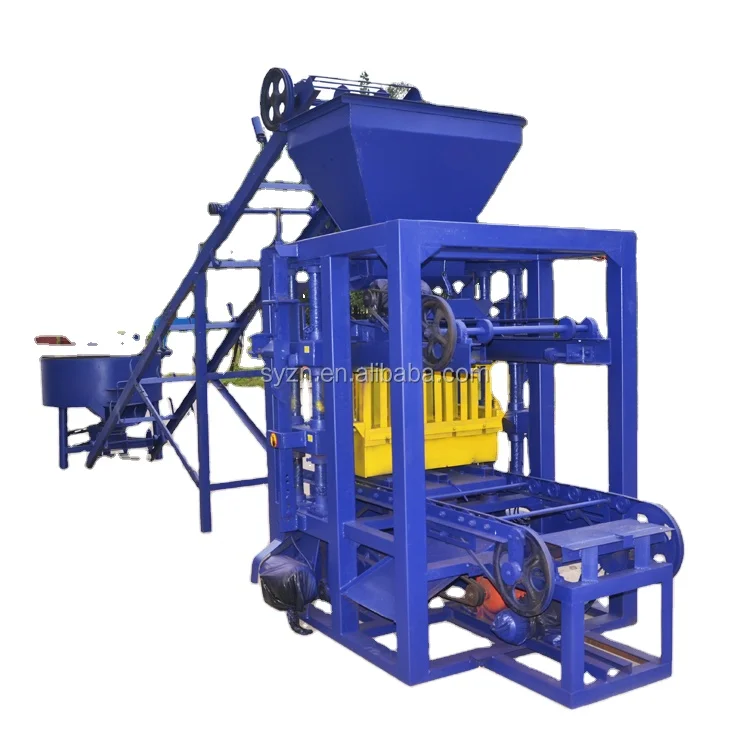
Line station matching — the QTJ4-26 is configured so mixer throughput, pallet feed and press cycle are timed to one another, preventing the bottleneck that leaves output stacking up by hand.
Technical Specifications
| Parameter | Value |
|---|---|
| Model | QTJ4-26 |
| Product Type | Semi-Automatic Concrete Block Making Machine |
| Overall Dimensions (L×W×H) | 2060×1730×2580 mm |
| Molding Cycle | 26 s |
| Vibration Frequency | 4200 r/min |
| Exciting Force | 35.5 kN |
| Total Power | 14.25 kW |
| Mixer Model | JQ350 |
| Pallet Size | 850×450×20 mm |
| Net Weight | 1800 kg |
| Applied Products | Hollow block (8 inch, 6 inch), solid brick |
| Raw Materials | Crushed stone, sand, cement, dust, fly ash |
| Automation Level | Semi-automatic (mould movement automatic, pallet handling manual) |
| Output Capacity — Hollow Block 390×190×190 mm | 480 pcs/h, 3800 pcs/8h |
| Output Capacity — Hollow Block 400×150×200 mm | 600 pcs/h, 4800 pcs/8h |
| Output Capacity — Solid Brick 240×115×53 mm | 2100 pcs/h, 17000 pcs/8h |
| Voltage & Frequency | (basis to be confirmed) |
| Control System | (basis to be confirmed) |
| Hydraulic Pressure | (basis to be confirmed) |
Application Suitability
| Application | Material or Output |
|---|---|
| Small to medium block production plants | Hollow blocks and solid bricks from crushed stone, sand and cement |
| On-site construction block production | 8-inch and 6-inch hollow blocks produced directly at the building site |
| Entrepreneurs setting up a first block plant | Solid brick and hollow block formats using fly ash and local aggregate |
| Contractors producing hollow blocks and solid bricks locally | Continuous daily output across mixed-format runs with manual pallet handling |
What "4800 Blocks per Day" Leaves Out About Line Matching
A press cycle means nothing if the mixer cannot keep up or the pallets are not in position.
When I started out on the assembly floor, the QTJ4-26 was the machine everyone in Shandong knew. I watched buyers take delivery of the press alone, plug it in, then spend the rest of the week wondering why output never matched the brochure figure. The bottleneck was never the press — it was the gap between stations. A concrete block making machine production line only works when every station is timed against the 26-second cycle, and that calculation has to happen before the order is placed, not after the container arrives [NEED_CITE: common causes of output shortfall in small block plants].
Mixer Sizing Against Press Hunger
The JQ350 mixer paired with this press is not an arbitrary catalogue choice. It is selected so the batch volume and mixing time keep pace with the 26-second molding cycle across all three listed formats. If the mixer delivers slower than the press consumes, every cycle begins with a partial charge and block density drops. The concrete block making machine production line depends on that first station delivering full, consistent batches on schedule.
Pallet Size and Curing Area Alignment
The 850×450×20 mm pallet is not a stand-alone spec — it must fit the buyer’s existing curing racks, forklift tine spacing and stacking area. A pallet chosen without this context forces the buyer to replace handling equipment or rebuild curing racks after the line is already running. We confirm pallet dimensions against the buyer’s actual site conditions before production begins, not after.
What the Specs Actually Mean on the Floor
The 4200 r/min vibration frequency and 35.5 kN exciting force work together under the mould table to compact the mix into uniform density. Higher frequency with low force leaves the core porous; high force with low frequency cracks the shell before it sets. The QTJ4-26 balances these two values for the hollow block and solid brick formats listed. The total power draw of 14.25 kW covers press, mixer and vibration, so the electrical supply must account for starting current on all three loads simultaneously [NEED_CITE: motor starting current requirements for vibration block presses]. The semi-automatic layout means pallet feed and removal are manual, which keeps the initial investment contained but requires the operator to maintain rhythm with the 26-second cycle. Mould movement is handled automatically, so format changeover relies on mechanical positioning rather than manual lifting.
The Cost of Skipping Line-Level Planning
When the mixer, press and pallet handling are sourced from separate suppliers, nobody owns the cycle time match. The mixer seller quotes batch output in isolation. The press seller quotes cycle speed in isolation. The buyer is left standing between them when output falls short and no one accepts responsibility. I have seen this scenario repeat across installations in Africa where site conditions left no room for rework [NEED_CITE: challenges of on-site block production in remote locations]. The rework cost on a compact line like this is rarely in the machine itself — it is in the wasted pallets, the scrapped blocks and the weeks of lost production.
Why a Line-First Approach Works Here
Block machinery is the single focus of this supply, so the press, mould, pallet and handling are specified as one system rather than assembled from separate quotes. Configuration is set against the buyer’s actual mix design and local aggregate, not a default catalogue page. Mould design covers the formats the buyer’s market actually sells, with custom drawings where standard sizes do not fit. The automation level is selectable, so a buyer starting with semi-automatic pallet handling can move toward higher automation later without replacing the press. Installation and commissioning include operator training so the 26-second cycle rhythm is established on day one.
Documentation & Verification
- Line layout drawing showing station spacing and pallet flow path for the QTJ4-26
- Capacity calculation sheet stating the block format assumed for each output figure
- Pallet specification matched to the buyer’s curing rack and forklift dimensions
- Factory test record showing achieved cycle time per format before dispatch
- Voltage and control language confirmation document signed before production
- Operation and maintenance manual covering mould change and wear part replacement
Installation, Commissioning & Support
- Foundation pad sized to the 2060×1730 mm footprint with vibration isolation provisions
- Dedicated electrical circuit for 14.25 kW total draw with confirmed voltage and frequency
- Mixer and press shipped in dismantled state with reassembly sequence documented
- First-run parameter setting covering vibration timing and mould travel limits
- Operator training on 26-second cycle rhythm and manual pallet handling pace
- Wear parts list covering vibration springs, mould liners and mixer blades
What to Prepare Before Your Inquiry
Send the target block format and daily output figure so the line can be sized from the press outward. Confirm local voltage and frequency, the pallet size your curing area accepts, and whether you already have a mixer or stacker that needs to be matched into the concrete block making machine production line.
Frequently Asked Questions
Q: How is daily output calculated for each block format, and what does the 8-hour figure assume?
A: Each output figure is based on a specific block format running through the full 26-second cycle continuously. The 8-hour number assumes uninterrupted press operation with pallets fed and blocks removed at cycle pace, mixer batches delivered on time, and no mould changes during the shift. Actual daily totals will vary with operator rhythm and format mix.
Q: Which supporting equipment is included in the line quotation?
A: The JQ350 mixer is specified as part of the package alongside the press. Pallet feed and block removal at the press are manual in this semi-automatic configuration. Stacking, curing rack handling and cubing stations are added based on the buyer’s automation preference and confirmed separately during line layout planning.
Q: Can the pallet size be changed to match my existing curing area and forklift?
A: The standard 850×450×20 mm pallet can be adjusted to match the buyer’s curing rack spacing and forklift tine width. This confirmation happens during line layout so the mould, press table and pallet are all sized together before production starts.
Q: How do line station cycle times match so the press is never left waiting?
A: Mixer batch volume and mixing duration are set against the 26-second press cycle. Pallet feed rate is confirmed so a fresh pallet is in position before each cycle begins. If any station runs slower, the entire line slows to that pace, which is why every station is calculated together.
Q: What happens if I want to add a new block format later?
A: A new mould can be designed and supplied for any format the press table accommodates. The cycle time for the new format is calculated and tested at the factory before the mould ships. Line stations may need adjustment if the new format requires a different pallet or longer curing time.