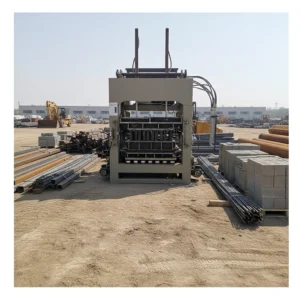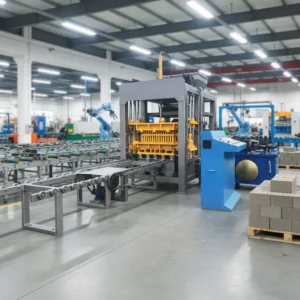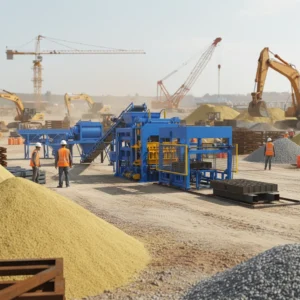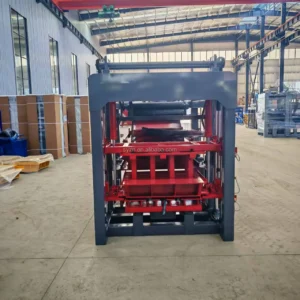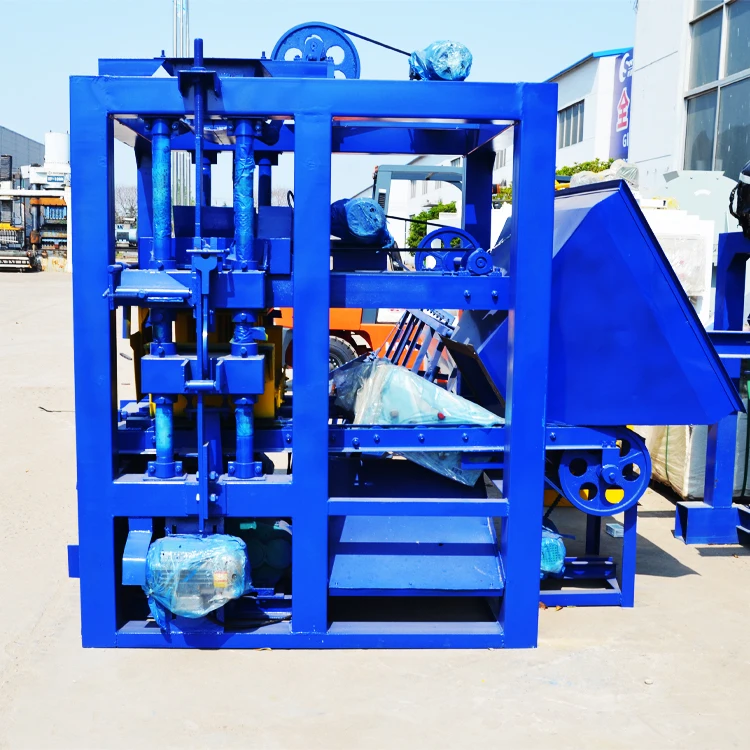
Matched Line Layout — Every station from the JQ350 mixer through pallet feed to the QTJ4-26 press is timed so the 26-second moulding cycle never waits on upstream or downstream equipment.
Technical Specifications
| Parameter | Value |
|---|---|
| Model | QTJ4-26 |
| Product Type | Semi-Automatic Concrete Block Making Machine |
| Overall Dimensions (L×W×H) | 2060×1730×2580 mm |
| Molding Cycle | 26 s |
| Vibration Frequency | 4200 r/min |
| Vibration Force (Exciting Power) | 35.5 kN |
| Total Power | 14.25 kW |
| Mixer Model | JQ350 |
| Pallet Size | 850×450×20 mm |
| Net Weight | 1800 kg |
| Guide System | Four guide pillars |
| Mould Movement | Automatic |
| Vibration Type | Dual vibrating motors under mould, direct vertical vibration combined with upper mould pressing |
| Output Capacity — Hollow Block 390×190×190 mm | 4 pcs/mould, 480 pcs/h, 3800 pcs/8 hr |
| Output Capacity — Hollow Block 400×150×200 mm | 5 pcs/mould, 600 pcs/h, 4800 pcs/8 hr |
| Output Capacity — Solid Brick 240×115×53 mm | 18 pcs/mould, 2100 pcs/h, 17000 pcs/8 hr |
| Automation Level | Semi-automatic (automatic mould movement, manual pallet handling) |
| Hydraulic Pressure | (basis to be confirmed) |
| Voltage & Frequency | (basis to be confirmed) |
| Control System | (basis to be confirmed) |
Application Suitability
| Application | Material or Output |
|---|---|
| Hollow block (8 inch and 6 inch) manufacturing | Crushed stone, sand, cement, fly ash, stone dust |
| Solid brick production | Cement, sand, crushed stone, stone dust |
| Small to medium-scale block plant setup | Paired with JQ350 mixer for continuous feed |
| On-site production for housing projects | 3800 to 17000 pcs per 8-hour shift depending on block format |
| Format expansion for existing producers | Mould change across hollow block and solid brick formats |
Why "Pieces per Hour" Means Nothing Without the Rest of the Line
A block press rated at 600 pieces per hour is only as fast as the slowest station feeding or clearing it.
I have watched a semi-automatic block machine sit idle for twelve seconds every cycle because the operator was still walking the pallet back from the curing yard. The press was fine. The line was not. When buyers focus on press cycle time alone and treat the block production line as a single-machine purchase, the gap between quoted capacity and actual daily output widens fast. A turnkey block making machine conversation has to start with the mixer batch time, the pallet travel distance, and the curing rack layout — not just the vibration force on the press table. [NEED_CITE: common causes of block plant throughput shortfall]
How the Stations Connect Around the QTJ4-26
The QTJ4-26 completes a moulding cycle every 26 seconds. That means the JQ350 mixer must deliver a fresh batch to the hopper within that same window, or the press idles. We size the mixer drum volume and discharge rate against the press consumption rate per cycle so material arrives before the hopper runs dry. This is the first bottleneck we eliminate when laying out a block production line.
Pallet Flow and What It Means for Your Curing Yard
With a pallet size of 850×450×20 mm, each cycle consumes one pallet. Over an eight-hour shift producing hollow blocks, that is several hundred pallets moving between the press, the curing area, and back. The pallet return loop must be planned so the operator is not walking further than necessary. If your existing forklift and curing racks were built around a different pallet dimension, the entire handling rhythm breaks down before the first block is made. [NEED_CITE: pallet handling impact on block plant output]
Reading the Specs That Actually Matter
The vibration system uses dual motors under the mould delivering 35.5 kN at 4200 r/min, combined with upper mould pressing. This vertical vibration plus top pressure is what determines whether a hollow block comes out with uniform wall density or cracks at the web junction. For solid brick, the same force compresses a finer mix into a denser unit. The four-pillar guide system keeps the mould aligned during travel, which matters when you switch between the 8-inch hollow block mould and the solid brick mould — misalignment causes uneven block height and rejected output.
The 14.25 kW total power draw tells you what electrical supply you need at the panel. Confirm your site voltage and frequency before the machine enters production, because rewiring a motor after arrival adds weeks to commissioning. [NEED_CITE: voltage and frequency standards by export market]
The Cost of Treating Supporting Equipment as Optional
When a buyer purchases the press alone and sources the mixer, pallets, and handling gear separately, the stations rarely match. A mixer with too small a drum forces the press to wait. Pallets that warp under moisture cause blocks to stick and break during demoulding. A curing rack spacing that does not fit the 850×450 mm pallet means double-handling every single block. These are not equipment failures — they are line integration failures, and they show up as lost output on the very first production day. [NEED_CITE: block production line integration failures]
Why Line-Level Specification Changes the Outcome
Every configuration we send out pairs the QTJ4-26 with a JQ350 mixer matched to the press cycle, so raw material supply does not become the constraint. Pallet material and thickness are selected based on your curing environment and the forklift you already operate, not pulled from a default list. The line layout document states the block format behind each capacity figure, so your business plan matches what the plant actually produces. Mould drawings are confirmed against the formats your market sells before production begins. Voltage, frequency, and control language are locked in during the order stage, not discovered when the container opens. [NEED_CITE: CE machinery directive requirements for industrial equipment]
Documentation & Verification
- Line layout showing mixer, press, and pallet flow with capacity stated per block format
- Pallet specification sheet confirming 850×450×20 mm size, material, and load rating
- Mould drawing and format list covering hollow block and solid brick dimensions
- Factory test record on your specified block format before dispatch
- Voltage, frequency, and control language confirmation signed before production
Installation, Commissioning & Support
- Foundation pad sized to the 2060×1730 mm footprint with anchor bolt plan provided
- Dedicated circuit rated for 14.25 kW total draw confirmed before energization
- Mixer and press aligned on-site so discharge feeds the hopper without spillage
- First-run parameter setting for vibration time and mould travel on your chosen format
- Operator training covering mould change procedure and daily greasing points
- Wear parts list with reorder codes for vibration motor mounts and guide pillar bushings
Before You Request a Quote
To size the supporting equipment around this block production line, we need to know the block formats you sell and the daily volume your market absorbs. Share your site voltage and frequency, your curing area dimensions, and the pallet size your current forklift handles. If you are adding this turnkey block making machine to an existing plant, tell us which upstream and downstream stations are already in place so we match the gaps rather than duplicate them.
Frequently Asked Questions
Q: How is daily output calculated and which block format does each capacity figure assume?
A: Every output figure on this page is tied to a specific mould and block dimension. The 4800 pieces per 8-hour shift, for example, assumes the 400×150×200 mm hollow block at five per mould. A different format changes the pieces-per-mould count and the cycle count, so your actual daily tonnage depends on which block your market buys.
Q: What supporting equipment keeps the QTJ4-26 running at its stated cycle time?
A: The JQ350 mixer is matched to the 26-second press cycle so material arrives before the hopper empties. You also need pallets at 850×450×20 mm, a clear pallet return path, and a curing rack layout that accepts this pallet size without double-handling.
Q: How do I confirm voltage, frequency, and control language before the machine ships?
A: We lock in your site voltage, frequency, and preferred control display language during the order confirmation stage. This is written into the production documents so the electrical panel and motor wiring match your local supply before the machine leaves the factory.
Q: What pallet size and material should I choose for my curing setup?
A: The standard pallet for this line is 850×450×20 mm. The material — wood, bamboo, or composite — depends on your curing humidity and the forklift tine spacing you already use. We confirm pallet spec against your curing area layout before the order is finalized.
Q: How is mixer capacity matched to the press so the line runs without bottlenecks?
A: The JQ350 mixer batch volume and discharge rate are calculated against the QTJ4-26 consumption per 26-second cycle. This ensures fresh mix reaches the hopper before the press completes its current mould, removing the most common upstream bottleneck in small-to-medium block lines.