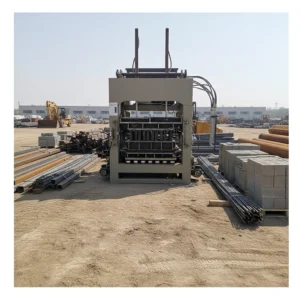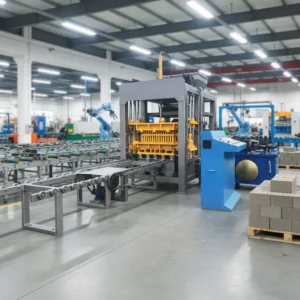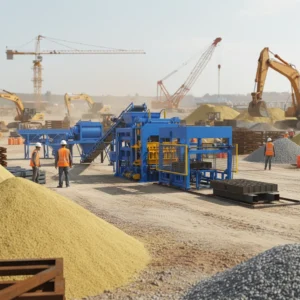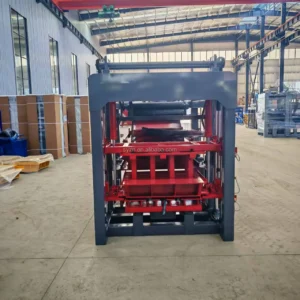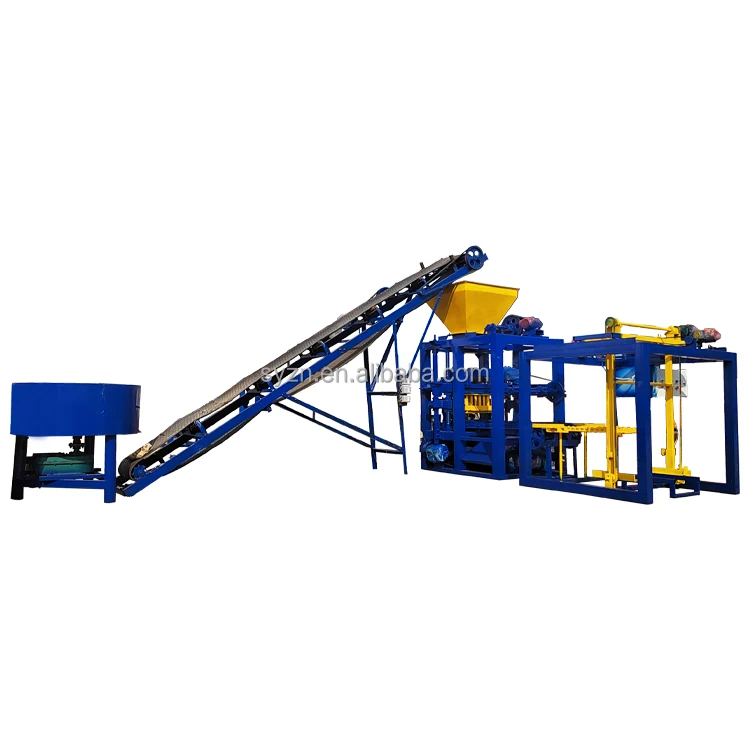
Matched Line Configuration — mixer, conveyor, and pallet flow are specified around the QTJ4-24 press cycle so the machine is never left waiting for material or empty pallets.
Technical Specifications
| Parameter | Value |
|---|---|
| Product Type | Semi-Automatic Concrete Block Making Machine |
| Model | QTJ4-24 |
| Machine Configuration | Stationary table vibration, semi-automatic |
| Main Machine Power | 11.95 kW |
| Overall Dimensions (L×W×H) | 3600 mm × 1700 mm × 2560 mm |
| Net Weight | 3.5 T |
| Pallet Size | 900 mm × 450 mm |
| Molding Cycle | 24–26 s |
| Mould Formats & Pieces per Mould | 400×200×200 mm (4 pcs/mould); 390×240×190 mm (3 pcs/mould); 390×120×190 mm (6 pcs/mould); 240×115×53 mm (21 pcs/mould) |
| Output per Cycle | 4 / 3 / 6 / 21 pcs depending on mould format (basis to be confirmed for daily shift hours) |
| Vibration Type | Table vibration feeding, fluctuation vibration molding |
| Feeding Method | Manual feeding, two feed ways available |
| Control System | Electrical control cabinet with mechanical interworking, knife switch operation |
| Recommended Mixer | J350 or JQ500 vertical mixer |
| Recommended Conveyor | 6 m or 8 m belt conveyor |
| Wire Specification | General power 3×16 mm² / Main machine 3×6 mm² / Mixer 3×4 mm² / Conveyor 3×2.5 mm² |
| Lubrication | J350 reducer 10 kg 35–40# / JQ500 reducer 15 kg 35–40# |
| Assembly State | On-site installation on precast concrete ground; leveling and alignment required |
| Warranty | 1 year for whole machine (excluding spare parts) |
| Voltage & Frequency | To be confirmed before commissioning |
| Certification | CE declaration where applicable |
Application Suitability
| Application | Material or Output |
|---|---|
| Hollow block production | Crushed stone, sand, cement, and water mix for 400×200×200 mm cavity blocks |
| Multi-cellular brick production | Lightweight aggregate and cement blends for partition wall units |
| Paving brick production | Dense aggregate mix for interlocking and solid paving formats |
| Standard solid brick production | Fly ash or sand-cement mix for 240×115×53 mm solid bricks |
| Small-scale block plants | Workshop-level output with manual pallet handling and natural curing |
| On-site contractor production | Temporary block yards at construction projects with limited footprint |
What "Cycles per Hour" Does Not Tell You About Line Throughput
A press rate means nothing when the mixer or conveyor cannot keep the hopper full.
I once watched a plant owner commission a QTJ4-24 block machine production line that ran beautifully for the first twenty minutes. Then the mixer emptied, the belt conveyor had nothing to carry, and the press sat idle while workers shoveled material by hand. The cycle time on paper said one thing; the actual pallets coming off the line said another. That mismatch happens when quotations list the press alone and leave feeding, pallet handling, and curing as someone else’s problem [NEED_CITE: common causes of block line throughput shortfall].
The QTJ4-24 block machine production line addresses this by specifying the J350 or JQ500 vertical mixer and a 6 m or 8 m belt conveyor as part of the same package. The mixer batch size and conveyor length are chosen so that material arrives at the press hopper in time for the next 24–26 second cycle, rather than the operator watching an empty feed tray.
Coordinating Mixer Batch Size with Press Cycle Demand
The J350 and JQ500 vertical mixers each hold a different batch volume, and the choice depends on how many pallets per hour the QTJ4-24 block machine production line will actually run. A J350 suits shorter shifts or single-format production where the mixer can finish a batch before the press needs the next one. The JQ500 gives more headroom when running larger hollow block formats that consume mix faster per mould fill. Either way, the mixer sits upstream of the belt conveyor, and the conveyor length — 6 m or 8 m — is matched to the physical distance between the mixing station and the press hopper so material does not sit in transit longer than necessary.
Pallet Flow from Press to Curing and Back Again
Each pallet leaving the QTJ4-24 carries a wet block load that must travel to a curing area, dry, and return empty to the press infeed. The 900 mm × 450 mm pallet size determines how many pallets fit on a standard curing rack, which in turn determines how much floor space the curing yard occupies. If the pallets do not match the racks already on site, or the forklift tines are too wide for the pallet width, the whole downstream flow stalls. Confirming pallet dimensions against existing curing infrastructure is therefore part of the line specification, not an afterthought [NEED_CITE: pallet and curing rack compatibility in block production].
Reading the Specs That Actually Shape Output
The 11.95 kW main machine power drives both the table vibration and the fluctuation vibration molding action. Table vibration feeds material into the mould cavity, while fluctuation vibration compacts it — together they determine block density and edge quality. The four mould formats each produce a different piece count per cycle, so stating output as a single number without naming the format is misleading. The 24–26 second cycle applies across formats, but the total blocks per shift depends on which mould is loaded and how many cycles the operator can sustain given pallet supply and material feed. The electrical control cabinet with mechanical interworking prevents the press from firing out of sequence, reducing damage from operator error across the line.
The Cost of Treating the Press as a Standalone Purchase
When the mixer, conveyor, and pallet system are sourced separately, nobody is responsible for the rhythm between stations. The press waits for material. Pallets pile up at the outfeed because nobody planned the curing rack capacity. Workers end up stacking wet blocks by hand, which damages edges and slows the entire shift. These problems do not show up in a press-only quotation, but they appear on the first day of production and they do not go away without re-engineering the line layout [NEED_CITE: hidden costs of unmatched block line equipment].
Why Specify the Whole Line from One Source
Block machinery is the single focus here, which means the QTJ4-24, its moulds, pallets, and supporting conveyors are specified as one matched system rather than assembled from separate suppliers. The line configuration is set against the buyer’s actual mix design, local aggregate, and target block format — not pulled from a catalogue default. Mould design covers the formats the buyer’s market actually sells, including custom drawings when standard formats do not fit. Automation level is selectable, so a buyer can start semi-automatic and add pallet feeding or stacking later. Installation and commissioning support includes operator training so the crew understands the sequence from mixer through to curing.
Documentation & Verification
- Line layout drawing showing station spacing, conveyor routing, and pallet flow path
- Capacity calculation stated per block format with shift-hour assumption
- Machine specification sheet with voltage and control language confirmation
- Mould drawing and format list covering all four standard cavity options
- Factory test record on buyer’s target block format before dispatch
- Operation and maintenance manual with wear parts and mould replacement list
Installation, Commissioning & Support
- Precast concrete ground required; leveling and alignment of the 3600 mm × 1700 mm base frame on site
- Dedicated circuit sized for 11.95 kW main machine plus mixer and conveyor loads
- Machine shipped in assembly state requiring on-site erection and station-by-station connection
- Voltage and frequency confirmed in writing before production begins to avoid commissioning delays
- Operator training covers the mechanical interworking control sequence and mould change procedure
- Wear parts list provided with lubrication schedule for J350/JQ500 reducer oil at specified intervals
What to Include in Your Inquiry
To size the QTJ4-24 block machine production line correctly, the most useful information you can provide includes the target block format and daily output requirement, the raw materials available locally and their grading, the dimensions of your curing area and the forklift you plan to use for pallet handling, and your site voltage and frequency. If you already have a mixer or conveyor in place, share those specifications so the line layout can integrate rather than duplicate.
Frequently Asked Questions
Q: How is daily output calculated per block format on this line?
A: Output depends on the mould loaded — 4 pieces for 400×200×200 mm hollow blocks, 21 pieces for 240×115×53 mm solid bricks — multiplied by the number of complete 24–26 second cycles sustained per shift. The calculation must state which format and how many shift hours are assumed, because a single cycles-per-hour figure without that context does not reflect real throughput.
Q: Can the QTJ4-24 line integrate with my existing mixer and conveyor?
A: Yes, if the existing mixer batch volume and the conveyor length and speed can keep the press hopper supplied within the 24–26 second cycle. Share the mixer model and conveyor dimensions so the line layout can be adjusted. If the existing equipment cannot match the cycle rhythm, the J350 or JQ500 mixer with a 6 m or 8 m belt conveyor is recommended as a matched alternative.
Q: What voltage and frequency does the line require?
A: Voltage and frequency are not fixed defaults and must be confirmed for your site before production begins. The wire specification calls for 3×16 mm² general power and 3×6 mm² for the main machine. The control panel labeling language should also be specified at the inquiry stage so operators can read the cabinet on day one.
Q: How do the two conveyor layout options affect my site footprint?
A: The 6 m belt conveyor suits a compact in-line layout where the mixer sits directly behind the press. The 8 m option allows a perpendicular or offset arrangement when site width is restricted or the curing yard sits to one side. The choice affects material travel distance and pallet return path, both of which influence how many pallets you need in circulation.
Q: What supporting equipment is included versus supplied separately?
A: The quotation covers the QTJ4-24 press, selected mould, recommended mixer, and belt conveyor as the core QTJ4-24 block machine production line. Pallets, curing racks, stacking equipment, and cubing systems are specified based on your curing area and output volume. Clarifying what is already on site avoids duplicate purchases and ensures pallet flow matches the press cycle.