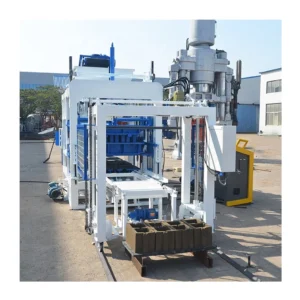
Press-to-Curing Match — The QTF3-20 semi-automatic line is specified as a connected system from mixer through curing rack, not quoted as a standalone press.
Technical Specifications
| Parameter | Value |
|---|---|
| Model | QTF3-20 |
| Product Type | Semi-Automatic Concrete Block Making Machine |
| Automation Level | Semi-automatic |
| Hydraulic System | Yes, hydraulic press combined with vibration |
| Vibration Force | (basis not stated in source) |
| Hydraulic Pressure | (basis not stated in source) |
| Pallet Size | (basis to be confirmed) |
| Mould Format Examples | 200×100×60mm paving block / 400×200×200mm hollow block / 225×112.5×60mm interlocking block |
| Output Capacity (Paving Block) | 2700 pcs/hour based on 200×100×60mm, 15 pcs/mould |
| Output Capacity (Hollow Block) | 540 pcs/hour based on 400×200×200mm, 3 pcs/mould |
| Output Capacity (Interlocking) | 1440 pcs/hour based on 225×112.5×60mm, 8 pcs/mould |
| Control System | (basis to be confirmed) |
| Voltage & Frequency | Customizable to local supply |
| Warranty | 1 year (excluding wearing parts) |
Application Suitability
| Application | Material or Output |
|---|---|
| Color paving block production | Cement, crushed stone, and pigment for 200×100×60mm format |
| Hollow block manufacturing | Concrete with local aggregate for 400×200×200mm standard blocks |
| Interlocking brick laying | Sand-cement mix for 225×112.5×60mm interlocking format |
| Curbstone and solid block runs | Dense aggregate blends for load-bearing and boundary elements |
What "Cycle Time" Leaves Out of the Quotation
A press running at full speed means nothing if the mixer or pallet feeder cannot keep up.
When buyers compare semi-automatic concrete block making machine production line proposals, most quotations list the press cycle time in isolation. The mixer takes a set number of seconds per batch, the pallet feeder advances at its own pace, and manual stacking introduces variable delays between every press stroke. If these stations are not balanced against each other, the press sits idle for a large portion of the shift. I have watched plants where the press was technically capable of high output, yet daily numbers fell far short because the raw material infeed bottlenecked the entire rhythm. [NEED_CITE: balancing station cycle times in block production lines]
How Stations Connect Around the Press
A semi-automatic concrete block making machine production line is only as fast as its slowest station. The QTF3-20 press occupies the center, but material must arrive mixed, pallets must be fed, and finished blocks must be cleared before the next cycle begins. Each supporting station — mixer, pallet feeder, and stacking area — must complete its task within the press cycle window so the press is never left waiting. When we map the line layout, we calculate the time budget for each station and flag any mismatch before the equipment is built.
Where the Pallet Loop Breaks Down
Pallets circulate from the press to the curing area and back. If the curing rack capacity or the forklift schedule cannot return empty pallets fast enough, the press pauses. On a semi-automatic setup, this loop is often manual, which means the pallet quantity, the distance to the curing yard, and the number of workers assigned to pallet return all directly affect output. [NEED_CITE: pallet circulation planning in semi-automatic block plants] Getting the pallet count wrong is one of the most common reasons a plant underperforms in its first month.
Reading the Specs That Actually Shape Output
Hydraulic pressure and vibration force work together to compact the concrete mix into the mould cavity. Higher vibration alone cannot achieve target density if the hydraulic pressure is insufficient to hold the material during compaction, and vice versa. The pallet size determines how many blocks are formed per cycle — the QTF3-20 produces 15 paving blocks, 3 hollow blocks, or 8 interlocking bricks per mould stroke, all tied to the pallet dimensions chosen. Voltage and frequency must match the local grid before the motor is wound; arriving with the wrong voltage delays commissioning by weeks. The semi-automatic configuration leaves room to add batching or stacking stations later without replacing the press itself.
The Cost of Skipping Line-Level Planning
When the quotation covers only the press and omits pallet handling, stacking, and curing infrastructure, the buyer absorbs hidden costs after arrival. Workers are hired to move blocks by hand, curing racks are improvised, and the forklift fleet turns out to be incompatible with the pallet dimensions chosen at random. The line technically runs, but daily output stays well below what the press could deliver if every station were specified as a matched set. [NEED_CITE: hidden costs of incomplete block line quotations]
Why Source the Full Line from One Supplier
The QTF3-20 press, moulds, pallets, and supporting handling equipment are specified as one matched system rather than assembled from separate vendors. Configuration is set against the buyer’s actual mix design and local aggregate, not pulled from a catalogue default. Mould design covers the formats the local market actually sells, including custom drawings when standard formats do not fit. The semi-automatic platform allows a plant to start with manual pallet handling and add automation stations in phases. Installation support includes operator training on the specific line layout delivered to the site.
Documentation & Verification
- Line layout drawing showing every station from raw material infeed to curing rack with cycle times
- Capacity calculation sheet stating the block format assumed for each output figure
- Mould drawing and format list matching the buyer’s local market requirements
- Hydraulic and electrical schematic with confirmed voltage and control language
- Factory test record on the buyer’s target block format before dispatch
Installation, Commissioning & Support
- Foundation plan showing load points and curing area dimensions for the QTF3-20 pallet size
- Electrical supply requirements confirming voltage, frequency, and dedicated circuit capacity
- Assembly sequence for press, mixer, and pallet feeder with estimated on-site build time
- First-run commissioning with parameter adjustment to the buyer’s local aggregate and mix design
- Operator training covering mould change, daily maintenance, and troubleshooting procedures
- Wear parts list for hydraulic seals, vibration components, and mould liners with reorder references
What to Prepare Before Requesting a Quote
To size a semi-automatic concrete block making machine production line accurately, share the block formats your market sells, the daily volume you need for each format, and the raw materials available locally including aggregate type and moisture content. Confirm the voltage and frequency at your site, the pallet handling method you prefer, and whether you already have a mixer, forklift, or curing area in place. If you have existing equipment upstream or downstream, list the models and their cycle times so the line can be balanced around them.
Frequently Asked Questions
Q: How is daily output calculated when the line includes mixing, pallet feeding, and manual stacking rather than the press alone?
A: Daily output is based on the slowest station in the loop. We calculate the time each station — mixer, pallet feeder, press, and stacking — takes per cycle, then use the longest single-station time to project realistic hourly and shift output for each block format.
Q: Which supporting stations are included in the quotation and which are optional?
A: The quotation specifies exactly which stations are included: press, moulds, pallets, mixer, pallet feeder, and stacking arrangement. Any station marked optional is listed separately so you can decide based on your existing equipment and budget.
Q: Can the semi-automatic line be upgraded to automatic pallet feeding and stacking later without replacing the QTF3-20 press?
A: Yes. The QTF3-20 semi-automatic platform is designed to accept automatic pallet feeders and stacking systems as add-on stations. The press mounting points and control interfaces allow these upgrades without replacing the main machine.
Q: How is pallet size chosen to match the curing area and the forklift the buyer already owns?
A: Pallet dimensions are selected based on the curing rack spacing you have available and the fork width of your existing forklift. We confirm both before production so pallets integrate with your current handling infrastructure without modification.
Q: What voltage and frequency is the motor wound for, and is the control language confirmed before shipment?
A: Voltage, frequency, and control panel language are confirmed in writing before production begins. The motor is wound to your local grid specification and the control interface is set to your preferred operating language to avoid delays during commissioning.