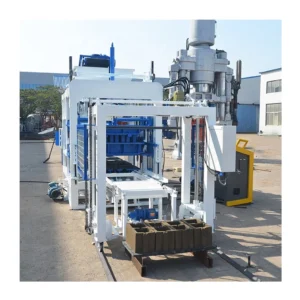
Matched Line Throughput — Every station from mixer to curing rack is paced to the 15-20 s moulding cycle of the QT4-16 press so no upstream or downstream bottleneck leaves the machine idle.
Technical Specifications
| Parameter | Value |
|---|---|
| Model | QT4-16 |
| Product Type | Hydraulic Concrete Block Making Machine |
| Overall Dimensions (L×W×H) | 7400×1950×2800 mm |
| Rated Pressure | 21 MPa |
| Main Vibration Form | Platform Vibration |
| Vibration Frequency | 2800-4500 r/min |
| Vibration Force | 40 kN |
| Pallet Size | 900×550 mm |
| Molding Cycle | 15-20 s (basis not stated in source — confirm block format / material / thickness) |
| Total Mass | 5 T |
| Demolding Method | Hydraulic |
| Required Factory Area | 600 m² |
| Applied Products | Hollow/solid blocks, pavers, interlocking blocks, curbstone |
| Raw Material Compatibility | Crushed stone, sand, cement, fly ash, gravel, slag |
| Control System | PLC with man-machine interface, fault diagnosis, remote control |
| Oil Hydraulic System | International standard |
| Key Features | Platform vibration, hydraulic demolding, configurable automation level |
Application Suitability
| Application | Material or Output |
|---|---|
| Hollow block production plants | Crushed stone, sand, cement, and fly ash mixes |
| On-site contractor block making | Locally sourced gravel and slag aggregates |
| Paver and interlocking brick yards | Colored concrete mixes and fine aggregates |
| Curbstone and kerb production | Dense concrete mixes requiring high hydraulic pressure |
| Building material distributor lines | Multiple block formats from a single press platform |
What the Quoted Cycle Time Actually Means for Your Line
A hydraulic block making machine production line only produces at its rated pace when every supporting station keeps the press fed and clears finished pallets without delay.
Quotations often highlight the fastest possible moulding cycle but leave out the block format that figure assumes. A buyer expecting a certain daily volume may find the actual output falls far short because the line was never configured around the specific hollow or solid block the plant actually sells. The mixer, pallet feeder, and stacking stations must all be matched to that cycle time. [NEED_CITE: standard practices for block plant capacity calculation]
How the Press Fits Into the Complete Production Flow
The QT4-16 press sits at the centre of the hydraulic block making machine production line, receiving batched material from the mixer and pressing it onto pallets that arrive via the pallet feeder. Each station upstream must deliver material within the moulding window, and each station downstream must remove and rack finished pallets before the next cycle begins. Platform vibration at 2800-4500 r/min compacts the mix during the 15-20 s cycle, after which hydraulic demolding lifts the mould and releases the loaded pallet to the transfer system.
Where Cycle Mismatches Create Idle Time
If the mixer takes longer to batch than the press takes to mould, the hydraulic block making machine production line loses cycles every round. I have seen lines where an undersized mixer upstream meant the press sat idle for a significant portion of each shift, cutting actual output well below what the spec sheet suggested. The same applies downstream — if pallet handling or curing rack capacity cannot absorb finished blocks fast enough, the press waits. Every station must be specified against the same cycle assumption. [NEED_CITE: line balancing principles in block manufacturing]
Reading the Specs That Determine Line Performance
The 21 MPa rated pressure and 40 kN vibration force work together to compact the concrete mix into a dense block; if either is insufficient for the buyer’s aggregate, block strength drops. The 900×550 mm pallet size dictates the spacing of curing racks and the fork pocket dimensions of the forklift already in the yard — ordering pallets without checking these downstream assets causes delays at commissioning. The PLC control system coordinates press timing with the mixer discharge and pallet feed sequence, and its fault diagnosis function helps operators trace which station is causing a line stoppage rather than guessing.
The Hidden Cost of Unspecified Supporting Equipment
When a quotation lists the press alone without detailing the mixer capacity, pallet feeder speed, or stacking method, the buyer often discovers after delivery that freshly pressed blocks must be moved by hand. This cancels the cycle time advantage the press was supposed to deliver and forces the plant to hire extra labour just to keep the machine running. Pallet handling, stacking, and curing are not optional extras — they are stations that must be specified before the line is built. [NEED_CITE: common omissions in block machinery quotations]
Why Specifying the Whole Line Matters Here
Block machinery is the single focus of this operation, so the press, mould, pallet, and handling equipment are specified as one matched system rather than assembled from separate suppliers. The configuration is set against the buyer’s actual mix design and local aggregate, not a catalogue default. Mould design covers the formats the buyer’s market sells, with custom drawings available. Automation level is selectable, allowing a plant to start semi-automatic and add stacking or cubing later. Installation includes operator training so the crew understands how each station connects.
Documentation & Verification
- Line layout drawing showing station positions and material flow path
- Capacity calculation sheet stating the block format assumed for cycle time
- Hydraulic and electrical schematic with station interlock points
- Pallet specification matched to curing rack spacing and forklift type
- Factory test record run on the buyer’s target block format before dispatch
- Voltage, frequency, and PLC display language confirmation form
Installation, Commissioning & Support
- Foundation plan based on the 7400×1950 mm footprint and 5 T total mass
- Dedicated power circuit sized for the hydraulic system and vibration motor
- Machine arrives dismantled for container loading with reassembly on site
- First-run commissioning with cycle time verified per block format
- Operator training covering PLC fault diagnosis and mould change procedure
- Wear parts and mould list with reorder part numbers supplied at handover
Before You Request a Quote
Tell us which block format you sell most — hollow, solid, paver, or interlocking — along with the daily volume your market demands. Include your local aggregate type, available curing area dimensions, existing forklift specifications, and site voltage and frequency. If you already operate a mixer or other upstream equipment, share its model and batch capacity so the line can be balanced around it.
Frequently Asked Questions
Q: How do I verify daily output for the block format I actually produce?
A: Request a capacity calculation that states the specific block format, moulding cycle, and number of blocks per pallet used in the estimate. A generic cycles-per-hour figure without a named format is not enough to plan production or compare quotations from different suppliers.
Q: How does pallet size affect the rest of the line?
A: The 900×550 mm pallet determines curing rack slot spacing, rack capacity per square metre of yard, and whether your existing forklift can handle loaded pallets. Specifying pallets without checking these downstream assets leads to costly rework before the line can run.
Q: Which supporting stations are included and which must I supply?
A: Confirm whether the quotation covers the mixer, pallet feeder, stacker, and curing rack handling, or only the press itself. Any station left out becomes your responsibility to source and integrate, which can delay commissioning significantly.
Q: How does the PLC prevent stations from idling?
A: The PLC coordinates mixer discharge timing, pallet feed intervals, and press cycle start so each station triggers the next. Fault diagnosis traces which station caused a stoppage, letting operators resolve the bottleneck instead of restarting blindly.
Q: What raw material feed setup keeps pace with the press cycle?
A: The mixer must batch and discharge within the moulding window so the press never waits for material. Share your aggregate types and cement ratio so the feed configuration is sized to match the QT4-16 cycle time.