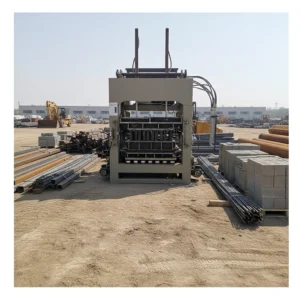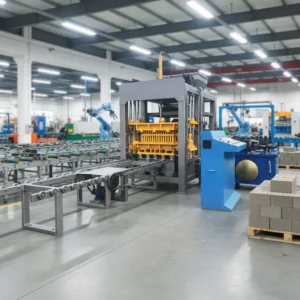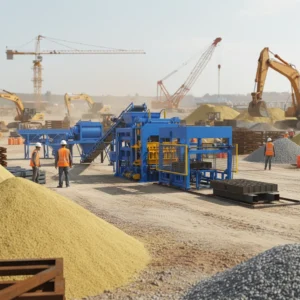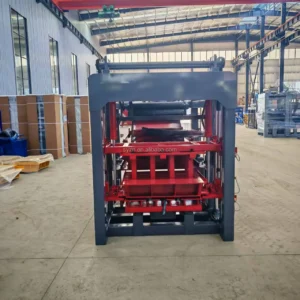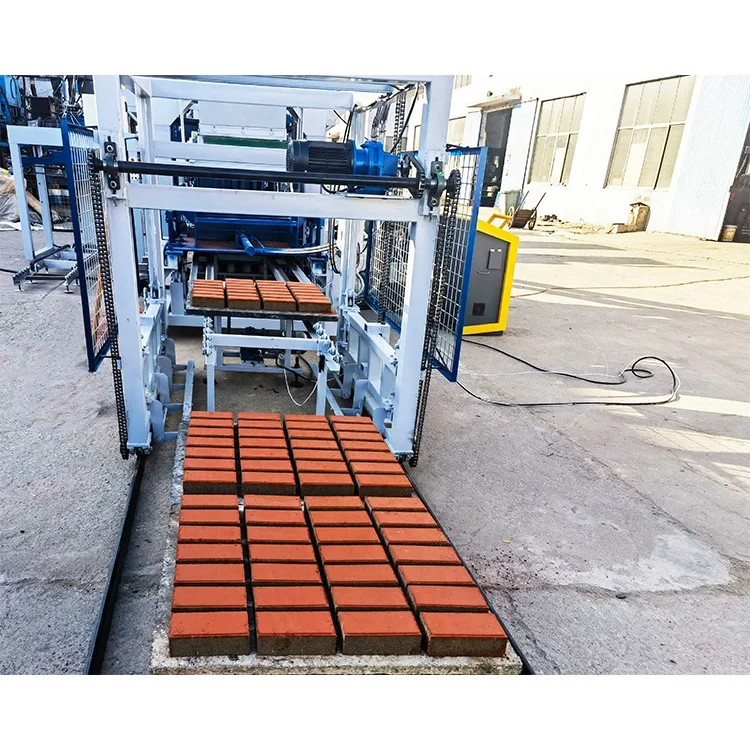
Matched Line Integration — The QT8-15 hydraulic block machine is sized so that raw material feeding, mixing, pallet circulation, and stacking stations all align with its 15–20 second molding cycle, preventing the press from standing idle.
Technical Specifications
| Parameter | Value |
|---|---|
| Model | QT8-15 |
| Product Type | Hydraulic Concrete Block Making Machine |
| Overall Dimensions (L×W×H) | 8300 × 1860 × 3000 mm |
| Rated Pressure | 21 MPa |
| Main Vibration Form | Platform Vibration |
| Vibration Frequency | 2800–4500 r/min |
| Vibration Force | 45 kN |
| Pallet Size | 950 × 900 mm |
| Molding Cycle | 15–20 s |
| Overall Power | 55.5 kW |
| Total Mass | 8 T |
| Demolding Method | Hydraulic |
| Factory Area | 300 m² |
| Applied Products | Concrete hollow/solid blocks, pavers, interlocking blocks, curbstone, colored pavers |
| Raw Material | Crushed stone, sand, cement, dust, fly ash, gravel, slag |
| Control System | (basis to be confirmed) |
| Voltage & Frequency | (basis to be confirmed) |
| Automation Level | (basis to be confirmed) |
| Output Capacity | (basis to be confirmed) |
Application Suitability
| Application | Material or Output |
|---|---|
| Hollow block production plants | Crushed stone, sand, cement, fly ash |
| Solid block manufacturing | Gravel, slag, cement blends |
| Paver and colored paver lines | Fine aggregate with pigment additives |
| Interlocking brick and curbstone | Coarse aggregate with hydraulic compaction |
| On-site project production | Locally sourced sand and stone with cement |
Why "15–20 Second Cycle" Means Nothing Without Line Matching
A fast press cycle only matters when every upstream and downstream station can keep pace.
I have seen too many buyers return from trade shows with a single-press quotation in hand, only to discover on site that the mixer discharges slower than the press demands. One project ran a QT8-15 block machine production line where the pallet feeder lagged behind the molding cycle, leaving the press waiting for several seconds each round. Over a shift, that idle gap accumulates into a meaningful loss of output. When we build a concrete block making line supporting equipment proposal, the first calculation is always station-to-station timing — not the press figure in isolation [NEED_CITE: typical block line bottleneck analysis].
How Each Station Synchronises with the Press
The mixer must deliver a fresh batch to the hopper before the press completes its current cycle. With a 15–20 second molding window, the QT8-15 block machine production line requires a mixer whose discharge rate matches or slightly exceeds the press consumption rate. Undersized mixers force the press to idle; oversized mixers waste power and let concrete set in the hopper.
The pallet feeder advances a clean, cured pallet into position within the same window. If the pallet return conveyor is too slow, the press waits for the next pallet instead of starting the next cycle. We specify pallet conveyor speed and buffer count so that at least one pallet is always queued.
Pallet Circulation and Curing Area Handshake
Pallet dimensions of 950 × 900 mm were not chosen arbitrarily. They must match the curing rack spacing and the forklift tine width already in use at the buyer’s yard. A mismatch means blocks are handled twice — once off the pallet, once onto the rack — adding labour and breakage risk. We confirm rack pitch and forklift specs before finalising the pallet order, because replacing hundreds of pallets after arrival is neither cheap nor fast [NEED_CITE: pallet sizing and curing rack compatibility in block plants].
The stacking station at the line exit must lift and cube wet blocks without exceeding the green strength the QT8-15 delivers at 21 MPa hydraulic pressure. If the stacker gripper closes too hard, corner cracks appear before curing even begins.
Reading the Numbers Behind Block Density
The 21 MPa rated pressure and 45 kN platform vibration work together: hydraulic pressure compacts the mix from above while vibration settles particles from below. Higher vibration frequency (2800–4500 r/min) is useful for fine-sand pavers, while lower frequency with sustained pressure suits coarse-aggregate hollow blocks. The operator adjusts both through the control panel to match the local mix.
At 55.5 kW overall power, the line covers press, mixer, and feeder under one electrical feed. Buyers in regions with unstable grids should confirm whether the local transformer can handle the starting surge of all motors firing within seconds of each other. The 8 T total mass of the press section demands a reinforced concrete slab; a compacted gravel base will settle unevenly and throw the vibration table out of level.
The Cost of Skipping the Line View
When a buyer purchases the press alone and sources the mixer and pallet system locally, timing mismatches surface during commissioning. The mixer may be rated in litres per batch without a stated discharge rate, leaving the press starved. Pallets bought from a local welder may be slightly narrower than 950 mm, causing the feeder guide rails to jam. These issues are solvable, but they cost weeks of on-site rework that a matched-line quotation would have avoided [NEED_CITE: hidden integration costs in block production lines].
Why Source the Full Line Together
Block machinery as a single focus means the QT8-15 press, moulds, pallets, and handling equipment are specified as one system rather than assembled from separate suppliers. Configuration is set against the buyer’s actual mix design and local aggregate, not a catalogue default. Mould design covers the formats the buyer’s market sells, with custom drawings available. Automation level is selectable — a buyer can start semi-automatic and add automatic stacking later. Installation includes operator training so the crew understands cycle matching from day one.
Documentation & Verification
- Line layout drawing showing station spacing and pallet flow path for the QT8-15
- Capacity calculation stating the block format assumed for the 15–20 s cycle
- Pallet specification matched to buyer’s curing rack and forklift dimensions
- Hydraulic and electrical schematic covering the full 55.5 kW power envelope
- Factory test record on the buyer’s target block format before dispatch
- Voltage, frequency, and PLC display language confirmation sheet
Installation, Commissioning & Support
- Reinforced concrete slab required to support the 8 T press mass and vibration load
- Dedicated 55.5 kW circuit with soft-start or VFD to limit inrush current on the QT8-15
- Machine shipped in modular sections to fit standard container; on-site reassembly supervised
- First-run parameter setting for vibration frequency and hydraulic pressure matched to local mix
- Operator training on pallet feeder timing and mould change procedure
- Wear parts and mould list provided for first reorder planning
What to Share Before Requesting a Quotation
Send us your target block formats, daily output goal, and the raw materials available locally. Include your curing area dimensions and the forklift model already on site so pallet sizing is accurate. Confirm local voltage, frequency, and preferred control language. If you already operate a mixer or conveyor upstream, share its make and discharge rate so the concrete block making line supporting equipment proposal accounts for existing gear.
Frequently Asked Questions
Q: How is daily output calculated for the QT8-15 across different block formats?
A: Output depends on the block format assumed in the molding cycle. A hollow block takes longer to fill and compact than a thin paver, so cycles per hour differ. We provide a capacity table listing each format separately rather than a single headline number, so buyers can plan against the format they actually sell.
Q: Do the mixer and pallet feeder keep pace with the 15–20 second press cycle?
A: In a matched line they do. We calculate mixer discharge rate and pallet conveyor speed against the press cycle before the quotation is issued. If the buyer sources these stations separately, we recommend minimum throughput values to avoid idle time on the QT8-15.
Q: What pallet size and material are specified for my curing area?
A: The standard pallet is 950 × 900 mm, but material — wood, bamboo, or composite — is chosen based on curing temperature, humidity, and the forklift tine width at your yard. We confirm these details before production to avoid costly pallet replacement after delivery.
Q: How are raw material feeding and batching integrated with the press control?
A: The batching station feeds the mixer on a timed cycle that mirrors the press demand. When the press completes a mold, the mixer discharges a fresh batch into the hopper. This synchronisation is documented in the line layout so the buyer’s electrician can wire the interlocks correctly.
Q: What is the factory footprint and utility requirement for the complete line?
A: The QT8-15 press alone requires roughly 300 m² including material storage and curing rack access. Utilities include a 55.5 kW electrical supply, water for mixing, and compressed air for certain mould release systems. We provide a detailed layout showing each station’s position and utility connection point.