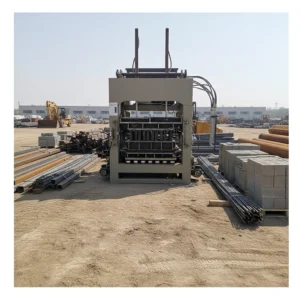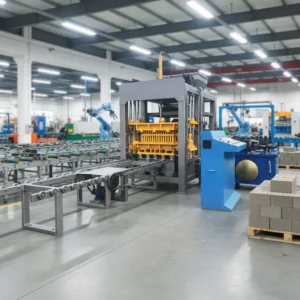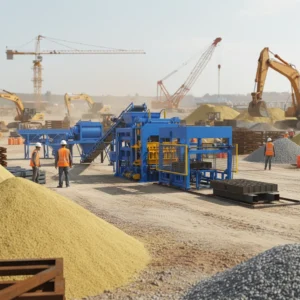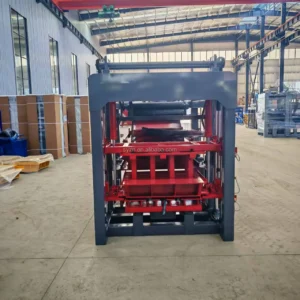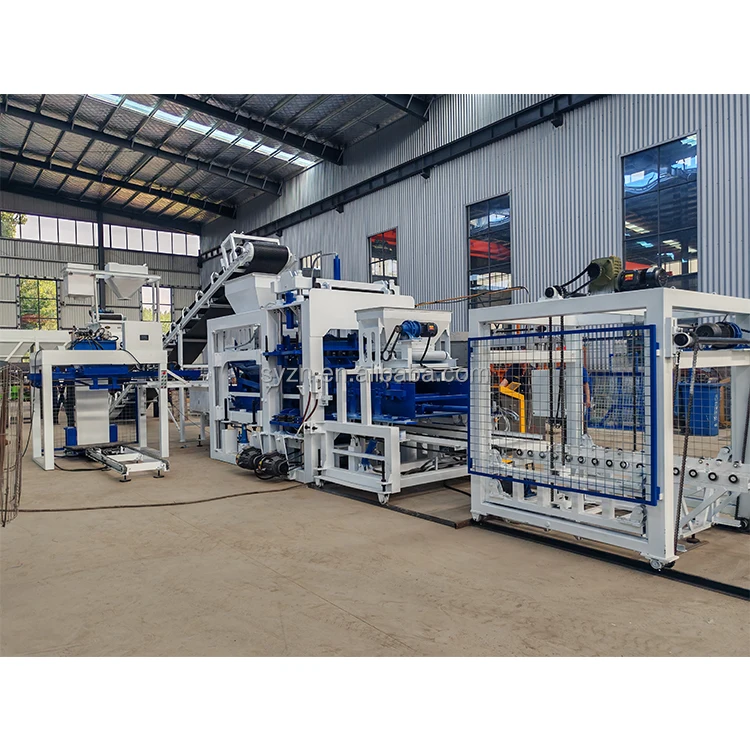
Matched Line Balance — the QT8-15 press, pallets, mixer and stacker are specified as one timed system so no station idles while another catches up.
Technical Specifications
| Parameter | Value |
|---|---|
| Model | QT8-15 |
| Product Type | Hydraulic Concrete Block Making Machine |
| Overall Dimensions (L×W×H) | 8300 × 1860 × 3000 mm |
| Rated Pressure | 21 MPa |
| Main Vibration Form | Platform Vibration |
| Vibration Frequency | 2800–4500 r/min |
| Vibration Force | 45 kN |
| Pallet Size | 950 × 900 mm |
| Molding Cycle | 15–20 s (basis to be confirmed by block format and material) |
| Overall Power | 55.5 kW |
| Total Mass | 8 T |
| Demolding Method | Hydraulic |
| Factory Area | 300 m² |
| Applied Products | Hollow blocks, solid blocks, pavers, interlocking blocks, curbstone, colored pavers |
| Raw Materials | Crushed stone, sand, cement, fly ash, gravel, slag |
| Control System | (source value — verify against manufacturer catalog) |
| Automation Level | (source value — verify against manufacturer catalog) |
| Voltage & Frequency | (source value — verify against manufacturer catalog) |
Application Suitability
| Application | Material or Output |
|---|---|
| Hollow block production for building walls | Crushed stone, sand, cement, fly ash |
| Solid block manufacturing for load-bearing structures | Gravel, sand, cement, slag |
| Paving block and colored paver runs for walkways and yards | Fine aggregate, cement, pigment |
| Interlocking block and curbstone forming for road edges | Coarse aggregate, sand, cement |
| On-site block production for housing projects | Locally sourced aggregate and cement |
Why the Mixer and Pallet Return Decide Your Real Output
A press cycle is only as fast as the slowest station feeding or clearing it.
I worked on a block production line equipment project in the Middle East where the QT8-15 press sat idle for seconds every cycle because the upstream mixer could not discharge fast enough and the pallet return conveyor was undersized. The press was rated for a 15–20 s molding cycle, but the actual line rhythm stretched well beyond that. Daily output dropped noticeably below what the press alone could deliver. When you evaluate supporting block machine equipment, the press specification is only one node. The mixer batch time, pallet feed speed, stacking station throughput, and curing rack handling must all be reconciled to the same cycle [NEED_CITE: line balancing principles for concrete block production].
Upstream Feeding and Mixing Must Match the Press Rhythm
Raw material feeding and mixing sit ahead of the QT8-15 in the block production line equipment chain. If the mixer discharges a batch every 25 seconds but the press demands a fresh mix every 15–20 seconds, the press waits. We size the mixer capacity and discharge gate to complete one batch within the press molding cycle, including a margin for pallet positioning. The raw material feed configuration — whether a simple hopper with belt conveyor or a multi-bin batching system — is chosen to keep the mixer hopper replenished without interruption.
Downstream Pallet Handling and Stacking Close the Loop
Once the QT8-15 presses and demolds a block, the loaded pallet must exit the press station and an empty pallet must return before the next cycle begins. If the pallet return conveyor is too slow or the stacking station cannot lift and place pallets onto curing racks at the line’s pace, the press stalls. The supporting block machine equipment around the press — pallet feeder, wet-side stacker, curing rack shuttle, and dry-side cubing system — is specified so each station’s throughput matches or slightly exceeds the press cycle. This is where block production line equipment planning either succeeds or quietly loses output every shift [NEED_CITE: pallet circulation requirements in block plants].
Reading the Core Specs for Line Planning
The QT8-15 runs platform vibration at 2800–4500 r/min alongside 21 MPa hydraulic pressure. These two values work together: vibration settles the mix into the mould cavity while hydraulic pressure compresses it to target density. If the buyer’s local aggregate is angular or poorly graded, the vibration frequency range must be adjustable to compensate — a fixed-frequency machine may produce blocks with inconsistent strength when the mix changes. The 45 kN vibration force must be evaluated against the mould cavity volume and the block format being produced.
The 950 × 900 mm pallet size is a fixed constraint for the entire line. Curing rack spacing, forklift tine width, and stacking station dimensions all derive from this pallet footprint. Before the line is finalized, the buyer’s existing curing area and material handling equipment must be checked against this pallet size.
At 55.5 kW overall power, the electrical supply at the press station must support the peak draw during vibration startup. The 8 T total mass requires a reinforced concrete foundation sized to absorb vibration without transmitting it to adjacent stations. The 15–20 s molding cycle is the reference point every other station in the block production line equipment layout is timed against [NEED_CITE: foundation design for vibrating block presses].
What Happens When Stations Are Not Balanced
When the mixer, pallet return, or stacking station is specified independently from the press, the line develops a hidden bottleneck. The press completes its cycle and then waits — sometimes only a few seconds per cycle, but those seconds accumulate across thousands of cycles per shift. I have seen block plants where the supporting block machine equipment was added piecemeal, and the result was a press that never reached its rated output. Pallet damage also increases when pallets pile up at a slow stacking station instead of flowing smoothly to the curing area. Voltage and control language mismatches compound the problem: if the PLC display is in a language the operator cannot read, parameter adjustments during commissioning take far longer than necessary [NEED_CITE: common commissioning delays in exported block machinery].
Why Source the Full Line from One Supplier
Block machinery is our single focus, so the QT8-15 press, moulds, pallets, and handling equipment are specified as one matched system rather than assembled from separate vendors. Each line configuration is set against the buyer’s actual mix design, local aggregate, and target block format — not pulled from a catalogue default. Mould design covers the formats the buyer’s market actually sells, including custom drawings when standard moulds do not match. The automation level is selectable: a buyer can start with semi-automatic pallet handling and upgrade to automatic stacking and cubing later. Installation support includes operator training so the line runs correctly from the first shift.
Documentation & Verification
- Line layout drawing with capacity calculation stated per block format for every station
- Machine specification sheet confirming QT8-15 pressure, vibration, and power values
- Pallet specification sheet cross-checked against buyer’s curing racks and forklift
- Hydraulic and electrical schematic for on-site maintenance reference
- Voltage, frequency, and PLC display language confirmation signed before production
- Factory test record showing press cycle with buyer’s chosen mould installed
Installation, Commissioning & Support
- Foundation pad poured to support 8 T mass and absorb platform vibration at full frequency
- Dedicated 55.5 kW circuit with correct voltage and frequency confirmed before energizing
- Machine arrives dismantled for container loading; reassembly supervised on site
- First run supervised with mould change drill and cycle timing verified per format
- Operator training covers PLC navigation, pressure adjustment, and daily lubrication points
- Wear parts and mould list supplied so first replacements are in stock before production starts
What We Need to Size Your Line
To configure the QT8-15 within a balanced block production line equipment layout, share your target block format and dimensions, required daily output, and the local aggregate and cement you plan to use. We also need your site’s voltage and frequency, the control display language your operators require, and the dimensions of your existing curing area and forklift specifications so the 950 × 900 mm pallet integrates without modification.
Frequently Asked Questions
Q: How do I verify the real daily output of the full line, not just the press cycle?
A: Ask for a line layout that states throughput per station based on a specific block format. The QT8-15 molding cycle of 15–20 s must be reconciled with mixer batch time, pallet return speed, and stacking rate. If any station is slower, the real output drops below the press rating.
Q: How do I ensure the mixer and pallet return match the 15–20 s press cycle?
A: The mixer must discharge one full batch within the press cycle time, and the pallet conveyor must return an empty pallet before the press is ready for the next press. We calculate these timings during line layout and specify supporting block machine equipment accordingly.
Q: Is the 950 × 900 mm pallet compatible with my existing curing racks and forklift?
A: Check your curing rack shelf spacing and forklift tine width against these pallet dimensions before the line is finalized. If your existing equipment was sized for a different pallet, the curing area layout or forklift may need adjustment to avoid handling delays.
Q: What electrical details should be confirmed before the line ships?
A: Voltage, frequency, and PLC display language must be confirmed in writing before production. A mismatch in any of these delays commissioning because the QT8-15 electrical panel and control interface must match the site supply and operator language.
Q: Which supporting stations are included and which are optional?
A: Raw material feeding, mixing, pallet feeding, stacking, curing rack handling, and cubing can all be included in the block production line equipment quotation. Each station is optional depending on your automation level choice, and the line layout clearly marks what is included.