
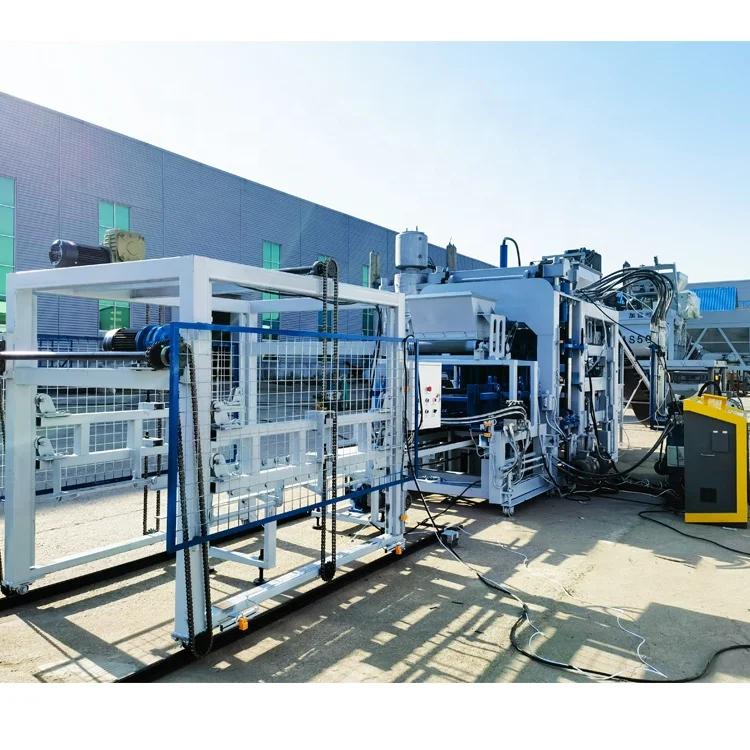
Integrated Line Synchronization — Every station from the JS750 mixer through the pallet feeder to the block conveyor is timed against the QT8-15 press cycle, preventing the bottleneck that turns a rated machine into an underperforming asset.
Technical Specifications
| Parameter | Value |
|---|---|
| Model | QT8-15 |
| Product Type | Automatic Hydraulic Concrete Block Making Machine |
| Overall Dimensions | 8300 × 1860 × 3000 mm |
| Molding Cycle | 15–20 s (basis not stated in source — confirm block format, material, and thickness) |
| Vibration Force | 55 kN |
| Total Power | 37.2 kW |
| Mixer Model | JS750 |
| Pallet Size | 1020 × 900 mm |
| Total Weight | 8 T |
| Control System | PLC control system |
| Hydraulic Station | Included |
| Applied Products | Paver, solid block, hollow block, curbstone (basis not stated in source — confirm format and mix) |
| Raw Materials | Crushed stone, sand, cement, dust, fly ash |
| Included Equipment | Block making machine, hydraulic station, PLC control unit, block mould, material feeder, pallet feeder, block conveyor, brick conveyor, block sweeper, spare parts and tools |
Application Suitability
| Application | Material or Output |
|---|---|
| Hollow block production for residential and commercial walls | Crushed stone, sand, cement, fly ash blends |
| Solid block manufacturing for load-bearing structures | Dense aggregate mixes with cement binder |
| Paver production for walkways, driveways, and plazas | Fine aggregate and cement with pigment options |
| Curbstone forming for road and infrastructure projects | High-strength concrete mixes with coarse aggregate |
| On-site block production for construction contractors | Locally sourced sand, stone dust, and cement |
What "15–20 Seconds per Cycle" Leaves Out About Your automatic hydraulic block making machine production line
A cycle time is only as honest as the slowest station feeding or clearing the press.
When a quotation lists a molding cycle without naming the block format, thickness, and mix design behind that number, buyers routinely discover on site that the actual output reaches a fraction of the calculated figure. The press may be ready every 15 seconds, but if the JS750 mixer cannot deliver a fresh batch in time, or the pallet feeder cannot index a new board fast enough, the machine stands idle. I have watched complete lines lose entire shifts of capacity because one upstream conveyor was specified half a meter too short, causing a material gap every third cycle [NEED_CITE: common causes of cycle time mismatch in concrete block lines]. The only way to prevent this is to map every station’s individual timing against the press before the line ships.
Matching Mixer Output to Press Demand Across the Line
The JS750 mixer must deliver enough homogeneous concrete to fill the mould box on every stroke of the QT8-15. If the mixer batch volume is too small relative to the mould cavity, the press draws an incomplete charge and the resulting blocks fall short on weight and strength. If the mixer discharge is too slow, the material feeder starves and the PLC holds the press in a wait state. Sizing the mixer to the press is the first synchronization point in any automatic hydraulic block making machine production line, and it must be recalculated whenever the buyer changes block format or mix proportions.
Pallet Feeder and Conveyor Sequencing Under PLC Control
The PLC control unit coordinates pallet indexing, mould filling, vibration, demoulding, and block discharge as a single sequence. Each step sends a confirmation signal before the next step begins. If the pallet feeder uses a slower chain drive than the conveyor can accept, finished blocks queue on the press table and the cycle pauses. Configuring the PLC timers to the actual mechanical speed of each station — rather than to catalogue defaults — is what keeps the automatic hydraulic block making machine production line running at its intended rhythm without operator intervention [NEED_CITE: PLC programming standards for synchronized material handling].
Reading the Specifications That Actually Determine Line Throughput
Vibration force at 55 kN works in tandem with hydraulic pressure to compact the concrete mix inside the mould. Higher vibration amplitude densifies the block faster, shortening the time needed to reach target strength, but only when the mix moisture and aggregate grading allow proper particle rearrangement. The 1020 × 900 mm pallet size determines how many blocks are formed per cycle and must align with the curing rack spacing and the forklift fork width already present in the buyer’s yard. Total connected load of 37.2 kW means the site electrical supply must provide adequate capacity on a dedicated circuit, with voltage and frequency confirmed before the control panel is wired. The 8300 × 1860 × 3000 mm footprint of the press alone does not include the mixer, conveyor runs, or stacking area, so the full line layout must be drawn against the buyer’s available floor space and ceiling height before foundation work begins.
The Hidden Cost of Treating the Press as a Standalone Purchase
Buying the QT8-15 without specifying the pallet feeder, conveyors, and mixer as one package seems like a way to control capital outlay, but the savings disappear the moment the line starts. A press waiting for pallets produces zero blocks, yet still draws power and occupies labor. I have seen plants add a feeder months later only to find the PLC firmware version on the original panel cannot communicate with the new station’s sensors, forcing a control replacement that costs more than the feeder itself [NEED_CITE: risks of retrofitting automation stations on existing PLC platforms]. Specifying the entire automatic hydraulic block making machine production line together eliminates this mismatch and keeps the warranty under one responsibility.
Why Sourcing the Complete Line From One Supplier Matters Here
Block machinery is the single focus at Shiyue, so the QT8-15, its moulds, pallets, and handling equipment are specified as one matched system rather than assembled from separate vendors. The configuration is set against the buyer’s actual mix design, local aggregate availability, and target block format instead of a catalogue default. Mould design covers every format the buyer’s market demands, with custom drawings accepted for non-standard shapes. Automation level is selectable, meaning a buyer can begin with manual pallet handling and add automatic stacking later without replacing the press. Installation support includes on-site commissioning and operator training, ensuring the line runs at matched cycle times from the first production day.
Documentation & Verification
- Line layout drawing showing station spacing and conveyor lengths matched to the QT8-15 cycle
- Capacity calculation sheet stating the exact block format behind the 15–20 s molding figure
- Pallet specification confirming 1020 × 900 mm size, material grade, and forklift compatibility
- Voltage, frequency, and PLC display language confirmation signed before panel wiring
- Factory test record with all stations running together at synchronized speeds before crating
Installation, Commissioning & Support
- Foundation plan accounting for the 8 T machine weight and dynamic vibration loads
- Dedicated 37.2 kW power circuit with voltage and frequency matched to site supply
- Partial dismantling for container loading with reassembly sequence documented
- PLC parameter tuning on site to match actual conveyor and feeder motor speeds
- Operator training covering mould change, pallet loading, and daily greasing points
- Wear parts list identifying hydraulic seals, vibration springs, and mould liners
Preparing Your Inquiry for the QT8-15 Line
To size the automatic hydraulic block making machine production line correctly, share the block formats you intend to produce, including dimensions and target daily volume for each. Specify the local aggregate types and cement grade available, along with the curing yard area and forklift fleet already on site. Confirm the site voltage, frequency, and preferred PLC display language so the control panel is wired and programmed before dispatch.
Frequently Asked Questions
Q: How do you calculate realistic daily output when the press cycle must match mixer, feeder, and conveyor speeds?
A: We start with the block format dimensions and the confirmed mix design, then calculate the mould fill volume per cycle. The JS750 mixer batch time and the pallet feeder index speed are each measured against the 15–20 s press cycle. The slowest station sets the actual line rhythm, and the capacity sheet states output based on that governing station, not on the press alone.
Q: What pallet size and material work with my existing curing racks and forklift fleet?
A: The standard 1020 × 900 mm pallet is sized to fit common rack spacing and standard forklift fork widths. If your racks or handling equipment differ, we adjust the pallet specification during the layout phase so boards move from press to curing area without manual repositioning or damage.
Q: How do you confirm voltage, frequency, and PLC language before the line ships?
A: A voltage and control confirmation document is signed during the quotation stage. The PLC display language, button labels, and electrical schematic are all matched to your site supply and operator preference before the panel is wired, preventing commissioning delays after arrival.
Q: Which stations in the line are most likely to become bottlenecks, and how do you prevent them?
A: The mixer discharge rate and the pallet feeder index speed are the two stations most likely to slow the press. We calculate each station’s cycle independently, then adjust conveyor lengths and motor speeds so every confirmation signal arrives before the PLC timer expires.
Q: Can I start with semi-automatic pallet handling and upgrade to automatic stacking later?
A: The QT8-15 PLC architecture supports staged automation. The panel is pre-wired with reserved I/O channels for a future stacker and cubing station, so adding them later requires connecting sensors and actuators rather than replacing the entire control system.



