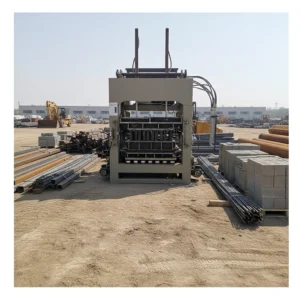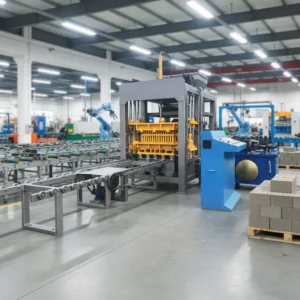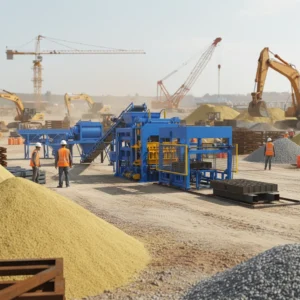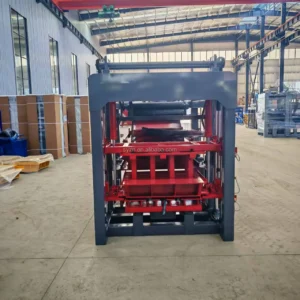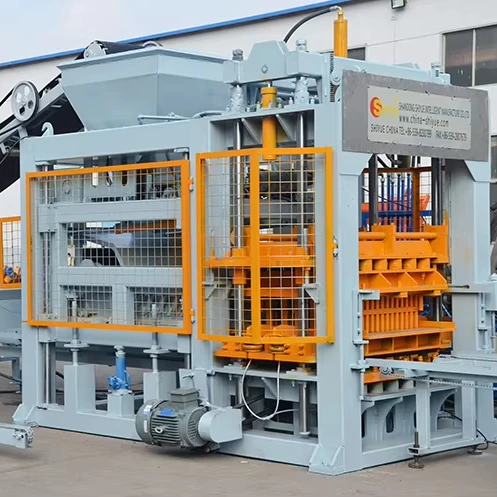
Single-Focus Block Line Integration — Every station from raw material feeding through stacking is specified to match the QT8-15 cycle time, preventing the press from waiting on upstream or downstream bottlenecks.
Technical Specifications
| Parameter | Value |
|---|---|
| Model | QT8-15 |
| Product Type | Automatic Concrete Block Making Machine |
| Overall Dimensions (L×W×H) | 8300 × 1860 × 3000 mm |
| Rated Hydraulic Pressure | 21 MPa |
| Vibration Form | Platform Vibration |
| Vibration Frequency | 2800–4500 RPM |
| Pallet Size | 950 × 900 mm |
| Molding Cycle | 15–25 s (basis not stated in source — confirm block format / material / thickness) |
| Overall Power | 46 kW |
| Control System | PLC with Touch Screen HMI |
| Hydraulic System | Independent Integrated Station |
| Block Comprehensive Strength | Up to 15 MPa (source value — verify against manufacturer catalog) |
| Included Support Equipment | JS750 Mixer, 8 m Belt Conveyor, Automatic Stacker |
| Automation Level | Manual and Automatic Mode Selectable |
Application Suitability
| Application | Material or Output |
|---|---|
| Hollow Block Production | Crushed stone, cement, sand, and water mixed for structural masonry units |
| Solid Block Manufacturing | Dense aggregate blends for load-bearing concrete blocks |
| Paving Block Formation | Fine aggregate and pigment mixes for interlocking or rectangular pavers |
| Construction Site Supply | On-site or local plant production for housing project contractors |
| Format Expansion | Existing plants adding kerbstone or porous brick formats with mould changes |
What the Quoted Capacity Figure Leaves Out of Your Line Design
The press cycle time only matters if the mixer, conveyor, pallet feeder, and stacker can all keep pace without interruption.
When an automatic block making machine production line is quoted based on a single cycle number, the actual daily output on the floor often falls short. The press finishes its cycle, then sits idle waiting for the mixer to deliver the next batch or for the pallet feeder to position the next board. In my years configuring lines across Shandong workshops and export sites, I have watched buyers invest heavily in a fast press only to discover that the belt conveyor or stacker was never matched to that speed. The result is a line where every station operates on a different rhythm, and the real throughput is governed by the slowest link. [NEED_CITE: line balancing principles for concrete block production]
Matching Station Rhythms Across the Full Line
The QT8-15 is positioned within this automatic block making machine production line as the central press, but its 15–25 second molding cycle must be supported by every surrounding station. The JS750 mixer and 8-meter belt conveyor handle material delivery, and their batch size and travel speed determine whether fresh concrete arrives at the hopper before the press demands it. If the mixer finishes a batch in ninety seconds but the press consumes that batch in four cycles, the material buffer must bridge the gap. This is the kind of timing calculation that separates a line drawing from a functioning production floor.
Pallet Flow and Stacking as Part of the Cycle
The 950 × 900 mm pallet size is not arbitrary — it must align with the curing racks and forklifts the buyer already operates. The automatic stacker handles two pallets per cycle, building layers from three to six high depending on block height. If the stacking station cannot clear pallets fast enough, they back up into the press zone and force the operator into manual mode. Planning the pallet return loop from curing area back to the feeder is a detail that defines whether the automatic block making machine production line runs continuously through a shift or stalls every forty minutes. [NEED_CITE: pallet circulation requirements in block plants]
Reading the Specifications Against Your Site Reality
The 21 MPa rated hydraulic pressure and platform vibration at 2800–4500 RPM work together to compact the mix into a dense block. However, the block comprehensive strength of up to 15 MPa assumes a mix design and aggregate that may differ from what is locally available. A volcanic ash or slag-based mix requires different vibration duration and pressure hold time than a standard sand-and-gravel blend. The PLC touch screen allows operators to adjust feeding times and vibration parameters per format, but the starting values must be set against the buyer’s actual material, not a catalogue default. The independent hydraulic station sits isolated from the main vibration and dust, which protects pressure consistency across long production runs.
The Cost of Treating the Press as a Standalone Purchase
When the automatic stacker, pallet feeder, or belt conveyor is treated as an optional add-on rather than a core station, the buyer is left moving output by hand between the press and the curing area. This creates a hidden labour cost that never appeared in the original quotation. Mould changes also become a bottleneck if the line was not designed with format switching in mind — a shift spent reconfiguring the press cancels out the flexibility the buyer paid for. Voltage and PLC display language, if not confirmed before production, delay commissioning by weeks after the equipment arrives on site. [NEED_CITE: common commissioning delays in exported block machinery]
Why Line-Level Configuration Matters Here
The QT8-15 and its supporting equipment are specified as one matched system rather than assembled from separate suppliers, so the mixer output, conveyor speed, and stacker capacity are calculated against the press cycle. Mould design covers the formats the buyer’s market actually sells, with custom drawings available for non-standard shapes. Automation level is selectable, allowing a buyer to begin with semi-automatic pallet handling and add the full stacker later. Installation includes operator training on the PLC interface and hydraulic station, and wear parts lists are provided with the first shipment so replacements are on hand before the first mould or seal needs changing.
Documentation & Verification
- Line layout with capacity calculation stated per block format, not a single catalogue output figure
- Pallet specification sheet confirming 950 × 900 mm dimensions and load rating for your curing racks
- Voltage, frequency, and PLC display language confirmation document signed before production begins
- Factory test record run on your specified mix design and target block format before dispatch
- Mould drawing and format list showing cycle time assumptions for each block type included
Installation, Commissioning & Support
- Foundation plan based on the 8300 × 1860 mm footprint and vibration isolation requirements
- Dedicated power circuit sized for 46 kW total load with correct voltage and frequency for your site
- Dismantling and container loading plan for shipment with reassembly sequence documented
- PLC parameter setup against your local aggregate and chosen block format during commissioning
- Operator training on mould change procedure, hydraulic pressure adjustment, and stacker operation
- Wear parts and hydraulic seal list supplied with shipment for first replacement cycle
Preparing a Line Inquiry That Gets an Accurate Proposal
A useful inquiry starts with the target block formats, the daily output required for each, and the local raw materials available — including aggregate type, cement grade, and any industrial by-products like fly ash or slag. Site conditions matter: the curing area dimensions, existing forklift capacity, and local voltage and frequency all shape the line configuration. If you have an existing mixer or pallet fleet, share those specifications so the new stations can be matched to what is already on the floor.
Frequently Asked Questions
Q: How is line capacity calculated and which block format does each output figure assume?
A: The molding cycle of 15–25 seconds is a range that depends on block format, material, and thickness. A valid capacity calculation must state which specific block — such as a 400×200×200 mm hollow block — was used as the basis. Without that assumption, the number is not comparable to your production targets.
Q: How do I match the mixer and conveyor so the press is not left waiting between cycles?
A: The JS750 mixer batch volume and the 8-meter belt conveyor speed must deliver material to the press hopper within the molding cycle window. If the mixer produces one batch every ninety seconds, the line design must ensure the press consumes that batch over the same period to avoid idle time or material overflow.
Q: What pallet size does the line assume and how does it connect to my curing area?
A: The line uses 950 × 900 mm pallets. This size must match your existing curing rack slots and forklift fork width. The automatic stacker builds pallets three to six layers high, so the curing area must accept stacks of that height with adequate clearance.
Q: Which automation stations are included and which are optional?
A: The standard line includes the JS750 mixer, belt conveyor, pallet feeder, host press, block conveyor, and automatic stacker. Additional stations such as raw material batching silos, cement screws, or cubing systems beyond the stacker are configured based on the buyer’s automation level and plant layout requirements.
Q: How are voltage and PLC language confirmed before shipment?
A: A confirmation document specifying local voltage, frequency, and the PLC touch screen display language is signed before production begins. This prevents commissioning delays caused by incompatible power supply or an interface the operators cannot read on arrival.