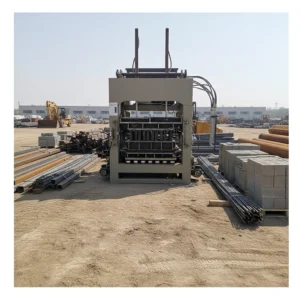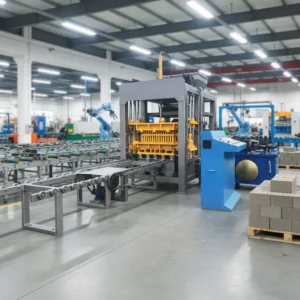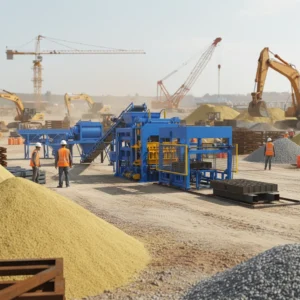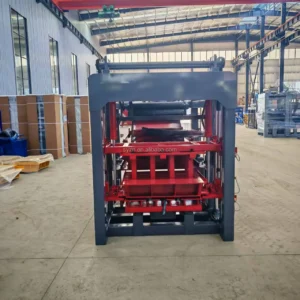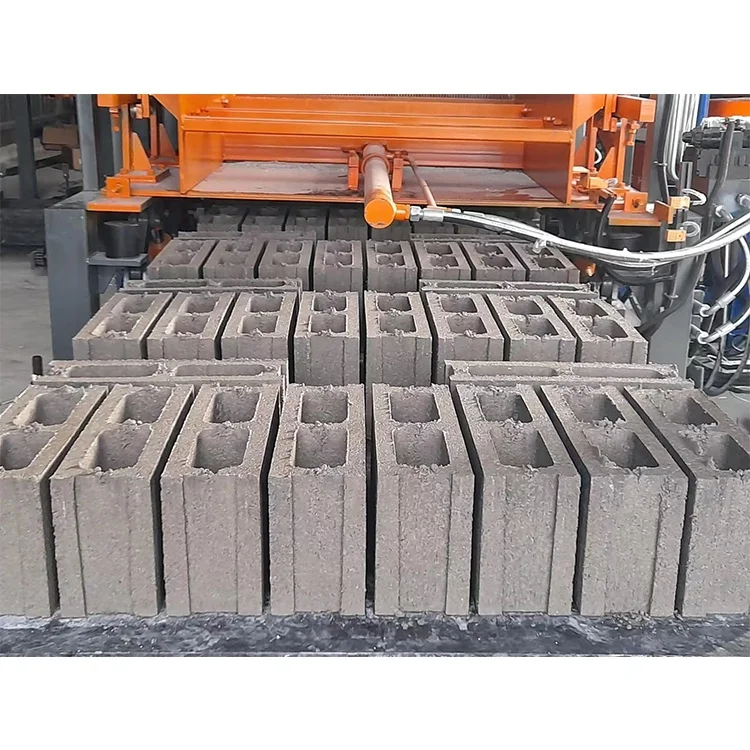
Matched Line Configuration — the QT7-15 block making machine is specified with upstream feeding, pallet circulation and downstream stacking so the press cycle is never interrupted by station mismatch.
Technical Specifications
| Parameter | Value |
|---|---|
| Product Type | Hydraulic Concrete Block Making Machine |
| Model | QT7-15 |
| Pallet Size | 1150x700mm |
| Molding Cycle | 15-20s |
| Overall Power | 45KW |
| Vibration Force | 100KN |
| Vibration Frequency | 0-60HZ |
| Vibration Form | Platform Vibration |
| Demolding Method | Hydraulic |
| Control System | PLC (Programmable Logic Controller) with touch screen interface |
| Total Mass | 8T |
| Component Configuration | Pallet feed machine, block making machine, storage hopper, conveyor, hydraulic unit, PLC control cabinet |
| Mould Change System | Quick replacement for multi-format production |
| Output Capacity | 1260-1680 pcs/h (basis: 400x200x200mm hollow block, 7 pcs/mould, 15-20s cycle) |
| Output Capacity | 1440-1920 pcs/h (basis: 400x150x200mm hollow block, 8 pcs/mould, 15-20s cycle) |
| Output Capacity | 3888-4860 pcs/h (basis: 200x100x60mm rectangular paving brick, 27 pcs/mould, 20-25s cycle) |
Application Suitability
| Application | Material or Output |
|---|---|
| Hollow block production | Crushed stone, sand, cement and fly ash mix for 400x200x200mm and 400x150x200mm formats |
| Paving brick and interlocking brick production | Fine aggregate and cement mix for 200x100x60mm rectangular format |
| Multi-format concrete product manufacturing | Variable mix designs across hollow, solid and paver formats via mould change |
| On-site block production for housing projects | Local aggregate and cement adapted to project-specific strength requirements |
| Block and paver production plants | Full-line setup from raw material batching to cured product stacking |
What "1680 Blocks per Hour" Leaves Out About Your Block Production Line Equipment
A quoted cycle rate means nothing if the mixer cannot feed the hopper fast enough or the pallet return loop falls behind the press.
Many quotations list a single hourly figure without stating the block format or the supporting stations required to sustain that rate. I have seen a Middle East plant install a fast-cycling press only to discover the pan mixer batch time was nearly double the press cycle, leaving the host machine idle for half the shift. The real daily throughput dropped to a fraction of the brochure number. When evaluating block production line equipment, the question is not how fast the press cycles in isolation but whether every station from the storage hopper to the pallet return can keep pace [NEED_CITE: cycle time matching across block line stations].
How the Upstream Feed and Pallet Loop Sustain Press Output
The QT7-15 presses a mould every 15 to 20 seconds, which means the storage hopper must deliver a fresh charge of mixed material and the pallet feed machine must present a clean pallet within that same window. The conveyor and storage hopper in this line are sized so that material arrives before the press completes its compaction stroke, eliminating the dead time that turns a 15-second cycle into a 30-second reality. The pallet feed mechanism is matched to the 1150x700mm pallet dimension, ensuring smooth entry without manual alignment.
Where Downstream Handling Determines Actual Throughput
Once a wet block leaves the press, it sits on a pallet that must travel to the curing area before the pallet can return. If the block production line equipment quotation stops at the press output, the buyer is left stacking pallets by hand or improvising a transfer system that was never designed for the line’s pace. This configuration includes the pallet return loop as part of the system, so the press never waits for an empty pallet. The PLC control cabinet monitors station status across the line, alerting operators when a downstream station is falling behind before it causes a full stop [NEED_CITE: pallet circulation requirements for continuous block pressing].
Reading the Specs That Actually Shape Daily Output
The 100KN vibration force and hydraulic demolding method work together to compact the mix into a dense block within the 15-20 second window. Platform vibration at 0-60Hz allows the operator to adjust frequency depending on whether the mould is producing a thick-walled hollow block or a thin paving brick, each requiring different energy transfer to achieve target density. The 45KW overall power rating covers the press, hydraulic unit, conveyor and pallet feed as a combined load, which matters when sizing the site’s electrical supply and dedicated circuit breaker. Quick mould replacement lets a plant switch from 400x200x200mm hollow blocks to 200x100x60mm paving bricks without losing a full shift to changeover, keeping the line productive across multiple product formats in a single working day.
The Cost of Treating the Press as a Standalone Purchase
When a buyer sources the press from one supplier and the mixer, conveyor and pallet system from others, the interface points become the buyer’s problem. Belt speeds do not match hopper fill times. Pallet dimensions drift from the feed mechanism tolerance. The PLC on the press cannot communicate with a third-party stacker, so fault diagnosis is limited to one station at a time. These mismatches surface after installation, when re-engineering the line costs more than specifying it as a single system would have [NEED_CITE: integration challenges in multi-supplier block plants].
Why Specifying the Full Line Matters Here
The pallet feed machine, storage hopper, conveyor, hydraulic unit and PLC control cabinet are configured as one system around the QT7-15 press, not assembled from separate catalogue pages. Each station’s cycle time is checked against the 15-25 second press window so no single point bottlenecks the output. The pallet size is confirmed against the buyer’s existing curing rack dimensions and forklift capacity before production begins, preventing a mismatch that would force manual handling. Voltage, frequency and PLC display language are locked in before the machine enters assembly, so commissioning starts on day one rather than waiting for a language pack or transformer. Factory testing runs the full line with the buyer’s target block format, producing a test record that documents actual cycle times rather than theoretical rates.
Documentation & Verification
- Line layout drawing showing station positions and pallet circulation path for the QT7-15 configuration
- Capacity calculation document stating the block format and cycle time assumed for each output figure
- Pallet specification sheet confirming 1150x700mm size, material grade and load rating
- Hydraulic and electrical schematic covering the press, conveyor and pallet feed as one circuit
- Voltage, frequency and PLC touch screen language confirmation recorded before assembly begins
- Factory test record documenting actual press cycle and line throughput on the target block format
Installation, Commissioning & Support
- Foundation plan specifying load points for the 8T machine mass and vibrating platform isolation
- Electrical supply requirement for the 45KW overall power draw with dedicated circuit and earth bonding
- PLC touch screen configured to operator language before arrival so first-day training proceeds without delay
- Mould installation and cycle parameter setup for each block format included in commissioning scope
- Quick mould change procedure trained on site so format switching stays within a single shift
- Wear parts list covering hydraulic seals, vibration springs and mould liners with recommended stock levels
Preparing Your Inquiry for a Matched Line
To configure a turnkey block making plant around the QT7-15, share the block formats you need to produce, the daily volume target for each format, and the raw materials available locally including aggregate type and cement grade. Confirm the voltage and frequency at your site, the language your operators need on the PLC touch screen, and whether you have existing curing racks or forklifts that the pallet size must accommodate.
Frequently Asked Questions
Q: How is the daily output calculated, and which block format does each capacity figure assume?
A: Each output figure is tied to a specific block format, mould cavity count and cycle time. For example, 1260-1680 pieces per hour assumes a 400x200x200mm hollow block with 7 cavities per mould and a 15-20 second cycle. Daily output is then derived from the number of effective working hours, allowing for pallet return time and mould change intervals.
Q: Which line stations are included in the quotation, and where does the buyer’s scope end?
A: The quotation covers the pallet feed machine, block making machine, storage hopper, conveyor, hydraulic unit and PLC control cabinet as one coordinated system. The buyer’s scope typically begins at the raw material stockpile and extends to the curing area, unless additional batching or stacking equipment is added to the configuration.
Q: How are pallet size and material selected to match the curing area and forklift already on site?
A: The 1150x700mm pallet dimension is confirmed against the buyer’s curing rack spacing and forklift fork width before production. Material grade and thickness are chosen based on the wet block weight per pallet, ensuring the pallet survives repeated cycling without warping under the vibration and hydraulic pressure of the press.
Q: How do upstream mixing and downstream stacking cycle times align with the press to prevent bottlenecks?
A: The storage hopper and conveyor are sized to deliver a fresh material charge within the 15-20 second press cycle, while the pallet return loop is timed so an empty pallet is available before the press completes demolding. The PLC monitors each station and flags slowdowns before they cause the press to idle.