
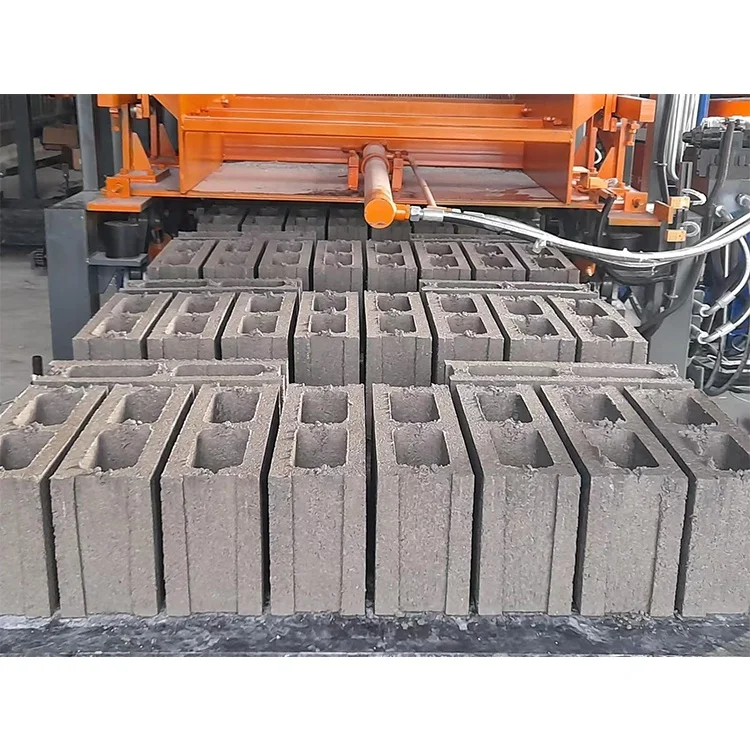
Integrated Line Synchronization — The QT7-15 block machine production line is specified so that every station from pallet feeding to stacking shares a matched cycle, preventing the press from outpacing downstream handling.
Technical Specifications
| Parameter | Value |
|---|---|
| Model | QT7-15 |
| Product Type | Hydraulic Block Making Machine |
| Pallet Size | 1150 × 700 mm |
| Molding Cycle | 15–20 s (basis not stated in source) |
| Overall Power | 45 kW (rated or peak not specified) |
| Vibration Force | 100 kN |
| Vibration Frequency | 0–60 Hz |
| Vibration Form | Platform Vibration |
| Demolding Method | Hydraulic |
| Total Mass | 8 T |
| Control System | PLC with touch screen interface |
| Automation Level | Automatic |
| Output — 400×200×200 mm Hollow Block | 1260–1680 pcs/h (7 pcs/mould) |
| Output — 400×150×200 mm Hollow Block | 1440–1920 pcs/h (8 pcs/mould) |
| Output — 200×100×60 mm Rectangular Brick | 3888–4860 pcs/h (27 pcs/mould) |
| Remote Diagnostics | Supported |
| Assembly State | Complete line: pallet feed, press, hopper, conveyor, hydraulic unit, PLC cabinet |
Application Suitability
| Application | Material or Output |
|---|---|
| Hollow block production | 400×200×200 mm and 400×150×200 mm, crushed stone and cement |
| Rectangular paving brick | 200×100×60 mm, fine aggregate and cement |
| Multi-cellular brick formats | Standard and custom mould profiles |
| On-site contractor block making | Full line footprint planned before foundation pour |
What a Block Machine Production Line Quote Often Omits
A press rated for 15-second cycles is only as fast as the slowest station feeding or clearing it.
I have seen plants where the block machine production line press ran flawlessly while finished blocks piled up on pallets because the stacking station could not keep pace. The buyer had been quoted a cycle time in isolation — no mention of pallet travel distance, curing rack capacity, or forklift turnaround. By the time the backlog reached the press, operators were manually clearing output and the theoretical daily tonnage was never reached [NEED_CITE: line-wide cycle matching in concrete block plants].
Matching Every Station to the Press Rhythm
The QT7-15 block machine production line treats the press, pallet feeder, storage hopper, belt conveyor, and hydraulic power unit as one timed system. Each station is configured so material arrives and pallets cycle at a rate the 15–20 second moulding window demands. When the pallet feed machine lags even a few seconds per cycle, the press sits idle and daily output drops noticeably below the quoted figure.
Where Bottlenecks Hide in a Block Line
Bottlenecks rarely show up on a spec sheet. A pallet that is too heavy for the chosen forklift slows curing rack turnover. A conveyor that feeds aggregate faster than the mixer can blend causes the storage hopper to overflow, forcing the PLC to pause the press. These mismatches surface only when the entire turnkey block making system runs under load [NEED_CITE: typical bottlenecks in automated concrete product lines].
Reading the Specs That Actually Matter on Site
The 100 kN vibration force, combined with adjustable frequency from 0–60 Hz, determines how densely the concrete matrix compacts before hydraulic demolding locks the shape. Pair that with platform vibration rather than mould-only vibration, and the entire pallet surface receives uniform energy — critical when producing 400×200×200 mm hollow blocks where thin walls are prone to cracking if density varies across the face. The 1150 × 700 mm pallet size was chosen to accommodate seven hollow blocks per mould while still fitting standard curing racks and mid-range forklifts. Overall power of 45 kW covers the full line draw, so the buyer can size the transformer and dedicated circuit before the container arrives. PLC control with a touch screen interface stores process data per batch, giving the operator a record to trace any strength inconsistency back to a specific mix or parameter set.
The Cost of Overlooking Line-Wide Integration
When a buyer sources the press from one supplier and pallet handling from another, responsibility for cycle synchronization falls on the plant owner. I have watched operators stand between two machines pressing emergency stops because the pallet feed and the stacker disagreed on timing. The result is unplanned downtime, damaged pallets, and a curing yard full of blocks that never reached design strength because they were moved too early [NEED_CITE: pallet handling failures in block production].
Why Source the Full Line from One Configuration
Block machinery is the single focus here, so the QT7-15 press, mould, pallet, and handling equipment are specified as one matched system rather than assembled from separate suppliers. The configuration is set against your actual mix design and local aggregate, not a catalogue default. Pallet size and material are validated against your existing curing area and forklift capacity before the quotation is finalized. Voltage, frequency, and PLC display language are confirmed in writing so commissioning is not delayed by a mismatched control panel. Mould design covers the formats your market actually sells, including custom drawings when standard profiles do not fit.
Documentation & Verification
- Line layout and capacity calculation stating the exact block format assumed for each figure
- Machine specification sheet with hydraulic and electrical schematics
- Pallet specification matched to your curing rack dimensions and forklift rating
- Voltage, frequency, and PLC language confirmation signed before production
- Factory test record demonstrating every station running as a synchronized system
- Packing photographs taken before the container doors close
Installation, Commissioning & Support
- Foundation plan sized for the 8 T total mass and vibration isolation requirements of the press
- Dedicated circuit rated for the 45 kW overall power draw with correct voltage and frequency
- Dismantled-for-shipment reassembly sequence supervised on site by a line engineer
- PLC parameter sets loaded per block format, with process data storage verified at startup
- Operator training covering mould change, pallet feed adjustment, and remote fault diagnosis
- Wear parts and hydraulic seal list matched to your first replacement cycle
Preparing a Useful Inquiry
Share the block formats you intend to produce, your target daily output per format, and the raw materials available locally. Include your workshop dimensions and ceiling height so the line layout accounts for curing rack clearance. State your local voltage and frequency, preferred PLC language, and whether existing forklifts or conveyors must interface with the new equipment.
Frequently Asked Questions
Q: How is line-wide cycle time balanced so stations do not bottleneck each other?
A: Every station — pallet feed, press, conveyor, and stacking — is configured against the 15–20 second moulding cycle. Belt speeds, pallet travel distances, and hydraulic actuation times are set so no station waits on another. The capacity calculation document shows the assumed block format and the cycle contribution of each station.
Q: What supporting equipment is included versus sourced separately?
A: The quotation covers the pallet feed machine, storage hopper, belt conveyor, hydraulic unit, and PLC cabinet alongside the press. Curing racks, forklifts, and raw material silos are typically buyer-supplied. The line layout drawing marks the exact boundary so nothing is assumed.
Q: How is the 1150 × 700 mm pallet validated for my site?
A: Pallet dimensions are checked against your curing rack spacing and forklift fork width before production. If your existing racks use a different size, the pallet specification is adjusted so blocks move from press to rack without manual rehandling.
Q: Can automation be expanded after initial installation?
A: Yes. The PLC architecture supports adding automatic stacking and cubing modules later. The control cabinet is pre-wired with reserved I/O points so upgrades connect without replacing the main controller.
Q: What documentation proves the line was tested as a matched system?
A: A factory test record is provided showing the complete line running through multiple cycles with your chosen mould installed. The record includes cycle times per station, block dimensions measured at demolding, and any parameter adjustments made during the test.



