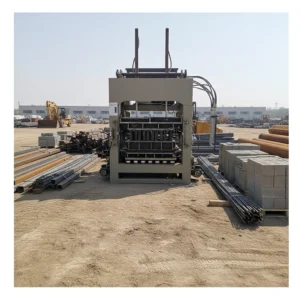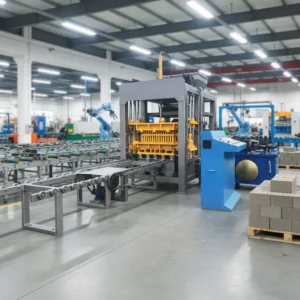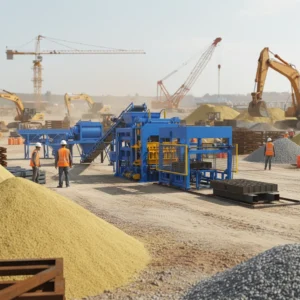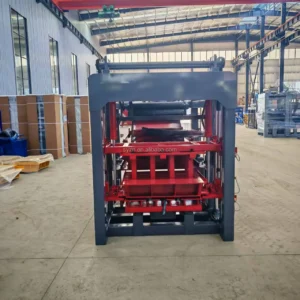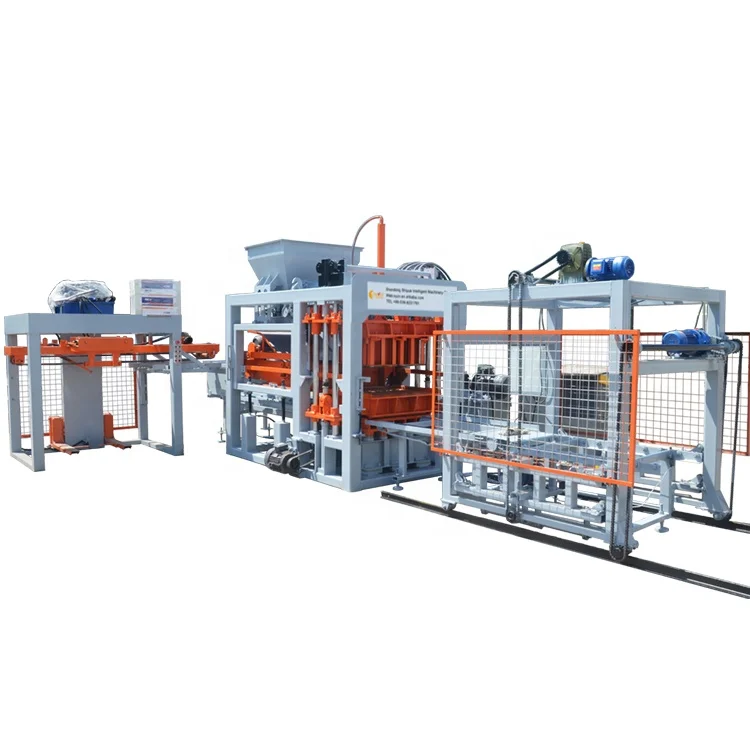
Matched System Configuration — The QT6-15 block making machine production line is specified as an integrated system where mixing capacity, pallet circulation speed, and stacking rhythm are calculated against the 15-20 second press cycle, preventing the bottleneck that occurs when the press sits idle waiting for upstream stations.
Technical Specifications
| Parameter | Value |
|---|---|
| Product Type | Hydraulic Concrete Block Making Machine |
| Model | QT6-15 |
| Overall Dimensions (L×W×H) | 8200×1700×2950 mm |
| Total Mass | 7 T |
| Overall Power | 37 kW |
| Vibration Frequency | 0-60 Hz |
| Vibration Force | 45 kN |
| Vibration Form | Platform Vibration |
| Moulding Mode | Load automatically, vibration moulding |
| Pallet Size | 880×850 mm |
| Molding Cycle | 15-20 s |
| Demolding Method | Hydraulic |
| Factory Area Required | 1200 m² |
| Control System | PLC controlled with touch screen and fault diagnosis system |
| Hydraulic System | Independent integrated type hydraulic station |
| Output Capacity (Hollow block 400×200×200 mm) | 1080-1440 pcs/hour, 8640-11520 pcs/8hr |
| Output Capacity (Hollow block 400×150×200 mm) | 1440-1920 pcs/hour, 11520-15360 pcs/8hr |
| Output Capacity (Solid brick 240×115×53 mm) | 5760-7680 pcs/hour, 46080-61440 pcs/8hr |
| Output Capacity (Rectangular brick 200×100×60 mm) | 2160-2880 pcs/hour (basis: 20-25s cycle), 17280-23040 pcs/8hr |
| Output Capacity (Zigzag brick 225×112.5×60 mm) | 2160-2880 pcs/hour (basis: 20-25s cycle), 17280-23040 pcs/8hr |
| Voltage & Frequency | Configurable (basis to be confirmed) |
| Language Options | Configurable (basis to be confirmed) |
| Warranty | 1 year for the whole machine (excluding spare parts) |
Application Suitability
| Application | Material or Output |
|---|---|
| Hollow Block Production | Waste ash, slag, and various aggregate mixes for structural walls |
| Solid Brick Manufacturing | Cement, sand, and crushed stone for load-bearing construction |
| Paving Brick Production | High-density concrete mixes for rectangular and interlocking formats |
| Multicellular Bricks | Lightweight aggregates for insulation and partition walls |
What the "Cycle Time" Figure Leaves Out in a Turnkey Block Plant
A 15-second molding cycle means nothing if the mixer takes 45 seconds to deliver the next batch.
When configuring a block making machine production line, I have seen buyers focus entirely on the press specifications while ignoring the material flow. The QT6-15 can cycle every 15-20 seconds, but if the upstream batching and mixing stations are not timed to deliver wet mix at that same rhythm, the press spends half its shift waiting. This idle time is rarely factored into the quoted daily capacity, leading to significant shortfalls once the line is running [NEED_CITE: impact of upstream bottlenecks on block plant throughput].
Synchronizing the Material Feed with the Press Rhythm
The core of a successful block making machine production line is the synchronization between the mixer discharge and the press hopper. For the QT6-15, the automatic loading system requires a consistent supply of material to maintain the 15-20 second cycle. If the mixer is undersized, the press stops. We calculate the mixer batch size and discharge time to ensure the press hopper is never empty, effectively treating the mixer and the press as a single continuous unit rather than separate machines.
Pallet Circulation as the Line’s Pulse
The 880×850 mm pallets are the physical link between the press, the curing area, and the stacker. In a complete turnkey block plant, the speed at which pallets return from the curing racks to the press determines the maximum sustainable output. If the pallet return conveyor is too slow or the curing rack handling system is not matched to the press output, the entire line backs up. We specify the pallet circulation system to match the peak cycle rate of the QT6-15, ensuring that a finished block is always moving off the press and a fresh pallet is always arriving.
Interpreting Vibration and Hydraulic Force for Local Aggregates
The QT6-15 generates 45 kN of vibration force at 0-60 Hz, combined with hydraulic pressure to compact the mix. However, these numbers must be interpreted against the specific aggregate available at the site. A mix with high slag content requires different vibration frequency settings than one using sharp river sand to achieve the same block density. The PLC control system allows operators to store these specific parameters for different block formats, ensuring that the switch from hollow blocks to paving bricks maintains consistent strength without manual trial and error [NEED_CITE: relationship between vibration frequency and aggregate type in concrete block production].
The Hidden Cost of Mismatched Downstream Handling
A common failure in block plant planning is underestimating the labor required for stacking and curing. If the quotation for the block making machine production line ends at the press output, the buyer is left to manually move thousands of blocks per hour. This not only increases labor costs but also risks damaging green blocks before they have cured. By including automatic stacking and curing rack handling in the initial line design, the physical strain on workers is removed, and the curing process becomes a controlled part of the production flow rather than a bottleneck.
Why Configure the Line Here
- System Integration: We specify the QT6-15 not as a standalone unit but as the center of a line where the mixer, pallet feeder, and stacker are sized to the same cycle time.
- Format-Specific Capacity: Our proposals state the daily output for the specific block format the buyer intends to produce, based on the 15-20 second cycle, rather than a generic maximum.
- Site-Matched Pallets: The 880×850 mm pallet specification is verified against the buyer’s existing forklift dimensions and curing area layout to prevent handling incompatibilities.
- Local Material Adaptation: The vibration and hydraulic parameters are set based on the buyer’s local aggregate samples, ensuring the 45 kN force produces the required block strength.
- Automation Scalability: The line design allows for semi-automatic pallet handling initially, with provisions for upgrading to fully automatic stacking and cubing as production volume grows.
Documentation & Verification
- Line layout drawing showing material flow from mixer to curing rack
- Capacity calculation sheet stating the block format and cycle time basis
- Pallet specification matching the 880×850 mm size and load rating
- Hydraulic and electrical schematics for the independent integrated station
- Factory test record verifying cycle times for the ordered block formats
- Voltage and PLC language confirmation form signed before production
Installation, Commissioning & Support
- Foundation plan detailing load points for the 7 T machine mass and 8200 mm length
- Power supply requirements for the 37 kW total load with dedicated circuit recommendations
- Assembly guidance for the independent hydraulic station to isolate vibration during operation
- PLC parameter setting for the specific block formats ordered, including the 15-20 s cycle
- Operator training on the touch screen interface and fault diagnosis system
- Wear parts list for the mould and hydraulic seals with recommended replacement intervals
Starting the Line Configuration
To provide an accurate proposal for a QT6-15 block making machine production line, we need the specific block formats you intend to produce and the daily volume target. Please also provide details on your local raw materials (aggregate type and source) and the available voltage and frequency at the site. This information allows us to size the mixer and pallet handling system correctly so the press is never left waiting.
Frequently Asked Questions
Q: How is daily output calculated when the line includes mixing and stacking?
A: Daily output is calculated by taking the press cycle time (15-20 seconds for the QT6-15) and factoring in the time required for the mixer to replenish the hopper and the pallet system to circulate. We do not quote the theoretical maximum of the press alone; we quote the sustained output of the complete block making machine production line, assuming all upstream and downstream stations are synchronized.
Q: How do upstream stations need to be timed so the press is not left waiting?
A: The mixer discharge time must be shorter than the press molding cycle. For the QT6-15, we specify a mixer that can deliver a full batch of wet concrete in under 15 seconds. Similarly, the pallet feeder must place a new pallet on the press table immediately after the previous one is stripped, ensuring the 15-20 second rhythm is maintained without idle gaps.
Q: What pallet size is specified and how does it match my facility?
A: The QT6-15 uses 880×850 mm pallets. Before finalizing the order, we verify this size against your existing curing racks and forklift tines. If your facility uses a different standard, we adjust the pallet specification and the associated handling conveyors to ensure compatibility with your site’s material handling equipment.
Q: Can I start with semi-automatic handling and upgrade later?
A: Yes. The block making machine production line can be configured with manual or semi-automatic pallet handling and stacking initially. The electrical and mechanical interfaces on the QT6-15 allow for the addition of automatic stackers and cubing systems later without requiring major modifications to the press itself.