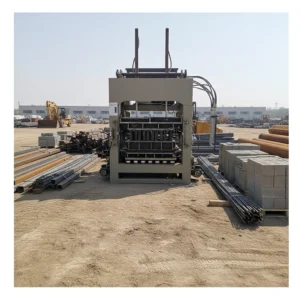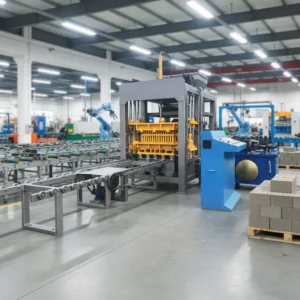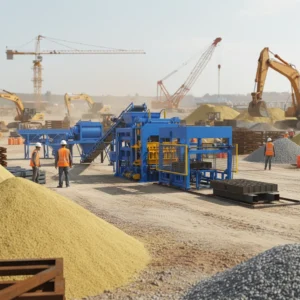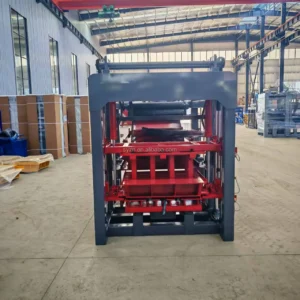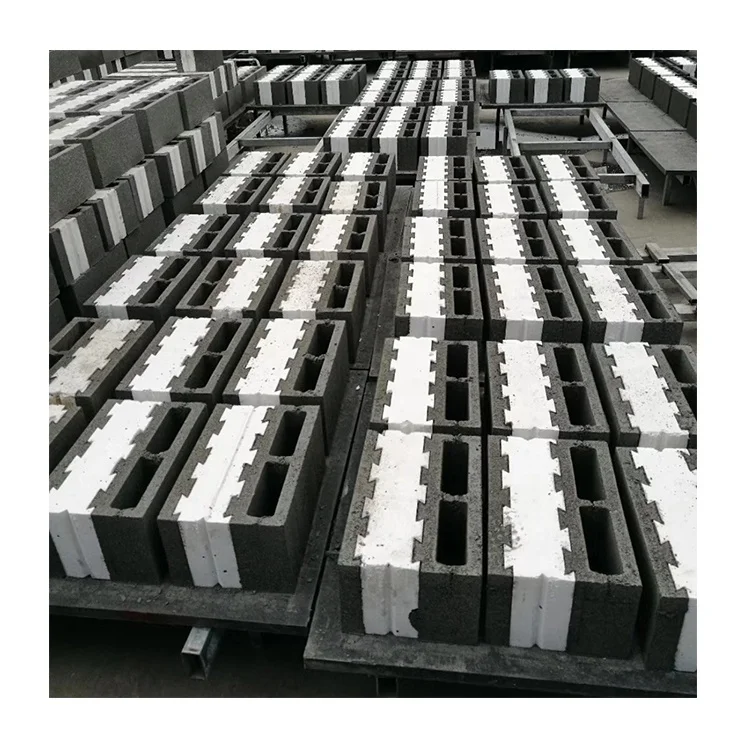
Line-Balanced Throughput — hydraulic station, pallet feeder, and press cycle times are specified as one system so no station governs the line speed
Technical Specifications
| Parameter | Value |
|---|---|
| Model | QT6-15 |
| Product Type | Concrete Block Making Machine |
| Overall Dimensions (L×W×H) | 7400 × 1900 × 2660 mm |
| Molding Cycle | 15–25 s |
| Vibration Frequency | 4600 r/min |
| Exciting Force | 40–50 kN |
| Rated Power | 31.25 kW |
| Mixer Model | JQ350 |
| Pallet Size | 850 × 550 × 25 mm |
| Net Weight | 7 T |
| Control System | PLC control system |
| Output Capacity (400×200×200 mm hollow block) | 9,600–13,440 pcs per 8-hour shift |
| Output Capacity (400×150×200 mm hollow block) | 14,400–19,200 pcs per 8-hour shift |
| Output Capacity (240×115×53 mm solid brick) | 16,200–19,440 pcs per 8-hour shift |
| Included Equipment | Block making machine, hydraulic station, PLC control system, pallet feeder, brick conveyor, block sweeper, manual hydraulic trolley |
| Automation Level | Semi-automatic (pallet feeder included; stacking method not stated) |
| Standards | CE |
Application Suitability
| Application | Material or Output |
|---|---|
| Hollow block production for load-bearing and partition walls | Crushed stone, sand, cement, fly ash |
| Solid brick manufacturing for masonry and structural work | Sand, cement, dust, crushed stone |
| Paver and curbstone production for external works and landscaping | Aggregates, cement, sand |
| On-site production by housing and development contractors | Locally sourced raw materials including fly ash |
| Format expansion for existing concrete product plants | Multiple mould options on one press platform |
What "9,600 Blocks per Shift" Actually Means for Your Line
Capacity is only as honest as the block format it assumes.
A quoted figure of 12,000 pieces per hour means nothing until you know which block size was in the mould. I have watched plant managers in the Gulf region run a press flat-out against a pallet return system that could not keep pace — blocks piled up on the vibrating table, and half the shift was lost clearing jams. The QT6-15 block making machine production line addresses this by including the pallet feeder and brick conveyor in the base configuration, so the upstream and downstream stations are matched to the press cycle from the start [NEED_CITE: common causes of block line bottlenecks at the pallet return stage].
Every Station on the QT6-15 Line Speaks the Same Speed
The molding cycle of 15–25 seconds sets the rhythm, but it only matters if the JQ350 mixer delivers fresh material in time and the pallet feeder returns clean pallets before the next press stroke. This QT6-15 block making machine production line ships with those stations already sized to the press throughput. You are not buying a press and hoping the rest catches up.
The Mixer-to-Press Handoff That Stops Starvation
A JQ350 mixer paired to the QT6-15 is chosen so the batch volume covers the press consumption at the shortest cycle time. When the mixer undershoots, the press waits, and the vibration motor runs idle against an empty mould — a wear pattern that shows up on hydraulic seals long before the buyer notices [NEED_CITE: press idle-vibration effects on hydraulic component life].
Reading the Numbers Behind the Block Density
The 4600 r/min vibration frequency and 40–50 kN exciting force work together with the hydraulic station to compact the mix into a dense, consistent block. Higher vibration alone will not produce strength if the hydraulic pressure is insufficient to hold the material under the mould head during compaction. The pallet size of 850 × 550 × 25 mm determines not only how many blocks fit per cycle but also what curing rack spacing and forklift tine width the buyer needs on site. Mould change time governs whether a plant can realistically produce two formats in one shift, or whether the second format always gets pushed to tomorrow. The semi-automatic configuration includes the pallet feeder, meaning the operator does not manually place pallets, but stacking after the block sweeper remains a manual task unless additional automation is added.
When the Pallet Conveyor Is Faster Than the Operator
I once saw a line in the Middle East where the press output outpaced the curing area. Wet blocks sat on pallets at the end of the conveyor with nowhere to go, because the buyer had not planned rack space for the actual daily volume. A pallet size of 850 × 550 mm means each pallet occupies a specific curing footprint — multiply that by shift output and the required square metres become clear very quickly [NEED_CITE: curing area sizing for concrete block plants].
Why the Line Layout Matters More Than the Press Alone
Shiyue specifies the machine, mould, pallet, and handling equipment as one matched system rather than assembling from separate suppliers. Configuration is set against the buyer’s actual mix design, local aggregate, and target block format — not a catalogue default. Mould design and supply covers the formats the buyer’s market sells, including custom drawings. Automation level is selectable, so a buyer can start semi-automatic and upgrade later. Installation and commissioning support includes operator training on the full line, not just the press [NEED_CITE: importance of matched system specification in block machinery procurement].
Documentation & Verification
- Line layout and capacity calculation stating the block format assumed for each output figure
- Machine specification sheet covering hydraulic and electrical parameters for the QT6-15
- Mould drawing and format list matching the buyer’s target block dimensions
- Pallet specification confirming 850 × 550 × 25 mm size and material grade
- Voltage and control language confirmation documented before production begins
- Factory test record on the buyer’s block format before dispatch
Installation, Commissioning & Support
- Foundation pad sized to the 7400 × 1900 mm machine footprint with vibration isolation provisions
- Dedicated power circuit rated for the 31.25 kW total load with correct voltage and frequency
- Machine dismantled for container loading and reassembled on site with alignment checks
- PLC control system parameters set and molding cycle tuned to the buyer’s mix during commissioning
- Operator training covering mould change procedure, pallet feeder operation, and daily maintenance routines
- Wear parts and hydraulic seal list provided with the first shipment for early replacements
Before You Send an Inquiry
Share the block formats your market actually buys, the daily volume you need per format, and the raw materials available locally. Confirm your site voltage and frequency, the language your operators need on the PLC display, and whether you already have curing racks and forklifts sized for the 850 × 550 mm pallet.
Frequently Asked Questions
Q: How is the line cycle time balanced across the mixer, press, and pallet feeder?
A: The JQ350 mixer batch volume is calculated against the press consumption rate at the shortest molding cycle. The pallet feeder return speed is set so a clean pallet reaches the press table before the next stroke begins. No station should govern the line speed — balance is checked during factory testing.
Q: What block format does the quoted output figure assume?
A: Each capacity figure states its format explicitly — for example, 9,600–13,440 pieces per 8-hour shift is based on a 400 × 200 × 200 mm hollow block. Output changes with every format because the number of cavities per mould and the molding cycle both shift.
Q: Is stacking and curing rack handling included in the line?
A: The standard configuration includes the pallet feeder, brick conveyor, and block sweeper. Stacking after the sweeper remains manual at this automation level. Automatic stacking and cubing can be added as an upgrade to the QT6-15 block making machine production line.
Q: How does the pallet size affect my existing curing area?
A: The 850 × 550 × 25 mm pallet determines rack spacing and forklift tine requirements. Buyers should verify that their curing racks accommodate this pallet dimension and that their forklift can handle the loaded pallet weight at full shift volume.