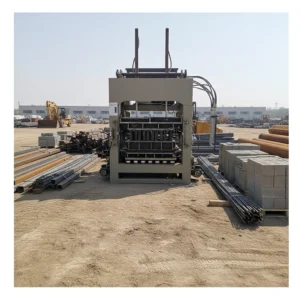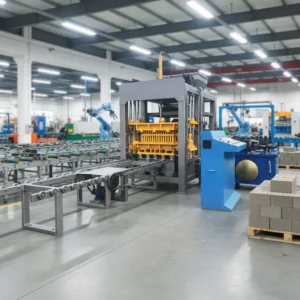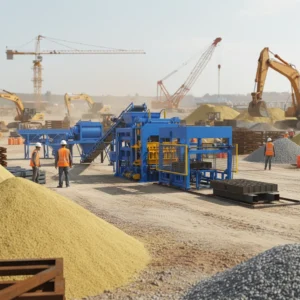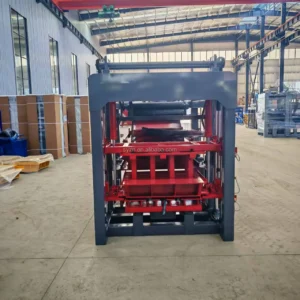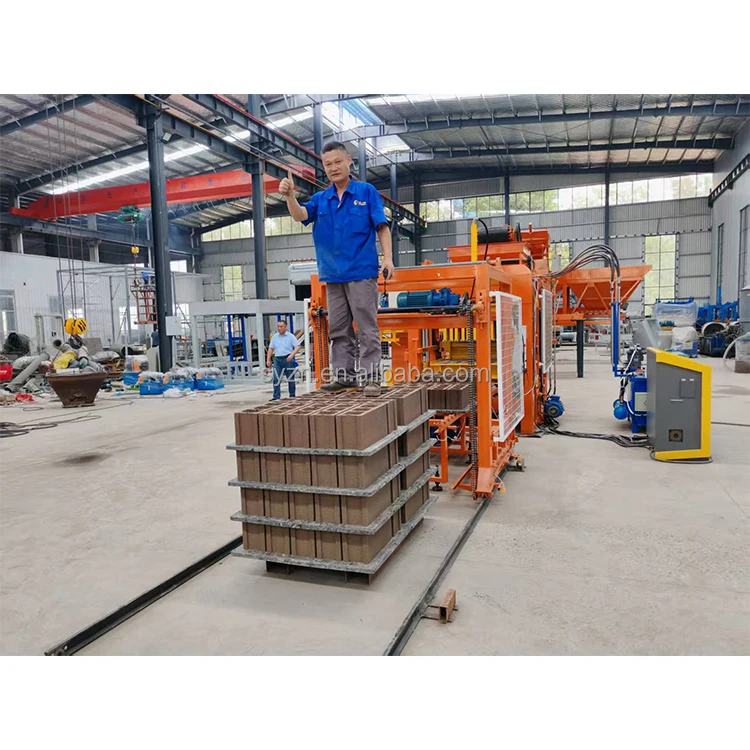
System-Level Line Integration — The QT6-15 is specified as the center of a coordinated block production line where mixing, pallet circulation, stacking, and curing rack handling are timed to the press cycle, preventing bottleneck idle time.
Technical Specifications
| Parameter | Value |
|---|---|
| Model | QT6-15 |
| Product Type | Concrete Block Making Machine |
| Overall Dimensions (L×W×H) | 8200×1700×2950 mm |
| Vibration Frequency | 0-60 Hz |
| Vibration Form | Platform Vibration |
| Moulding Mode | Load automatically, vibration moulding |
| Pallet Size | 880×850 mm |
| Molding Cycle | 15-20 s |
| Overall Power | 37 kW |
| Vibration Force | 45 kN |
| Total Mass | 7 T |
| Demolding Method | Hydraulic |
| Recommended Factory Area | 1200 m² |
| Control System | PLC (Programmable Controller) with touch screen |
| Output Capacity (Hollow block 400×200×200 mm) | 1080-1440 pcs/hour (8640-11520 pcs/8hr) |
| Output Capacity (Hollow block 400×150×200 mm) | 1440-1920 pcs/hour (11520-15360 pcs/8hr) |
| Output Capacity (Solid brick 240×115×53 mm) | 5760-7680 pcs/hour (46080-61440 pcs/8hr) |
| Output Capacity (Rectangular brick 200×100×60 mm) | 2160-2880 pcs/hour, cycle 20-25 s (17280-23040 pcs/8hr) |
| Output Capacity (Zigzag brick 225×112.5×60 mm) | 2160-2880 pcs/hour, cycle 20-25 s (17280-23040 pcs/8hr) |
| Compressive Strength of Blocks | More than 15 MPa |
| Raw Material Adaptability | Waste ash, slag, and various aggregates |
| Hydraulic System | Independent integrated hydraulic station |
| Automation Level | Intelligent electronic control, fault diagnosis system |
| Voltage & Frequency | (basis to be confirmed) |
| Warranty | 1 year for whole machine (excluding spare parts) |
Application Suitability
| Application | Material or Output |
|---|---|
| Hollow block production | Crushed stone, river sand, cement, and waste ash |
| Solid brick manufacturing | Slag, fly ash, and local aggregates |
| Paving brick and rectangular block production | High-density aggregate mixes for 15+ MPa compressive strength |
| Zigzag interlocking brick production | Standard concrete mixes with specific mould tooling |
Why "Rated Capacity" Often Fails on the Factory Floor
The actual daily output of a concrete block making machine production line depends entirely on whether the upstream mixing and downstream pallet handling can match the press cycle without interruption.
Many plant owners base their purchasing decision on the cycles-per-hour figure quoted for a single block format, only to find that real-world throughput drops significantly when switching products or dealing with local material variations. When the mixer takes longer to homogenize a high-clay aggregate, or when manual pallet stacking cannot keep pace with the press ejection, the entire line stalls [NEED_CITE: industrial bottleneck analysis in batch manufacturing]. The QT6-15 is configured so that raw material feeding, block press operation, and pallet circulation are balanced as a single system, not quoted as isolated stations.
Balancing the Mixer Feed with the Press Cycle
The QT6-15 completes a molding cycle in 15 to 20 seconds for standard hollow blocks, which means the upstream mixer must deliver a consistent batch to the hopper within that window. If the raw material contains high moisture or clay content, mixing time increases, and the press sits idle waiting for the next charge. A properly designed concrete block making machine production line accounts for this by sizing the mixer capacity and conveyor speed to the specific aggregate profile of the buyer’s region, ensuring the press operates at its intended rhythm.
Pallet Circulation and Curing Area Coordination
The 880×850 mm pallet size on the QT6-15 is not an arbitrary choice; it must align with the dimensions of the buyer’s existing curing racks and the lift capacity of the forklifts already on site. When pallets are too large for the curing area, blocks must be double-handled, adding labor and breakage risk [NEED_CITE: material handling efficiency standards in precast concrete]. The line design specifies how pallets return from the curing zone to the press feed, closing the loop so that the machine is never starved of pallets during continuous operation.
Decoding the Vibration and Hydraulic Parameters
The platform vibration system operates at an adjustable 0-60 Hz with a maximum vibration force of 45 kN, working in tandem with the hydraulic demolding system to compact the mix. Higher vibration frequency reduces the cycle time for smaller formats like solid bricks, while larger hollow blocks require sustained hydraulic pressure to achieve the specified 15 MPa compressive strength. The independent integrated hydraulic station is isolated from the main machine vibration and dust, which extends the service life of the seals and valves compared to systems mounted directly on the press frame.
The Cost of Mismatched Line Components
When a buyer sources the block press from one supplier and the pallet handling or stacking system from another, the interfaces rarely align without costly modification. A mismatched stacker may drop pallets at a speed that cracks the green blocks, or a pallet return conveyor may run faster than the press can accept, causing jams [NEED_CITE: equipment integration failures in automated manufacturing]. These issues do not appear in a single-machine quotation but manifest as daily downtime and increased scrap rates once the plant is running.
Line Integration and Configuration Discipline
- Single-System Specification: The machine, mould, pallet, and handling equipment are specified as one matched system, eliminating interface gaps between separate suppliers.
- Material-Specific Tuning: The configuration is set against the buyer’s actual mix design and local aggregate, not a generic catalogue default that assumes ideal sand.
- Automation Scalability: The line can start with semi-automatic pallet handling and be upgraded to fully automatic stacking and cubing as production volume grows.
- Format-Matched Mould Supply: Moulds are designed for the specific block formats the buyer’s market demands, with custom drawings available for non-standard profiles.
Documentation & Verification
- Line layout and capacity calculation stating the specific block format assumed for each output figure.
- Machine specification sheet covering the QT6-15 press and all supporting stations.
- Hydraulic and electrical schematics for the full production line, not the press alone.
- Voltage, frequency, and PLC display language confirmation document before production begins.
- Factory test record demonstrating cycle times on the buyer’s target block format.
Installation, Commissioning & Support
- Foundation plan detailing load points for the 7-ton press and 8200 mm overall length.
- Power supply requirements for the 37 kW overall load, including dedicated circuit specifications.
- On-site assembly guidance for the dismantled press and pallet circulation system.
- PLC touch screen parameter setting for the buyer’s specific block format and cycle time.
- Operator training covering mould change procedures and fault diagnosis system use.
- Wear parts and mould list with recommended replacement intervals for hydraulic seals.
Sizing the Line to Your Project
To configure a balanced line around the QT6-15, we need to understand the specific block formats you intend to produce and the daily volume required for your market. Please provide details on your local raw material availability, particularly the type and grading of aggregate, along with your site’s curing area dimensions and existing forklift specifications. Finally, confirm your local voltage and frequency standards so that the electrical and control systems are configured correctly before the equipment leaves the factory.
Frequently Asked Questions
Q: How is the output capacity verified and which block format does each figure assume?
A: Every output figure is tied to a specific block format and dimensions, such as the 400×200×200 mm hollow block. We do not quote a single "maximum capacity" without stating the product being made, as cycle times and mould configurations vary significantly between solid bricks and paving blocks.
Q: How do the line stations connect and where must cycle times match so the press is not left waiting?
A: The mixer discharge, press molding cycle, and pallet return conveyor are timed so that a fresh pallet and material charge are available the moment the press completes a cycle. If any station is slower, it becomes the bottleneck, which is why we calculate the line balance based on your specific target format.
Q: How is the machine configured against the buyer’s actual mix design and local aggregate?
A: We review your local sand, stone, and cement types to adjust the vibration frequency and hydraulic pressure settings. A mix with high clay content, for example, requires different compaction parameters than clean washed river sand to achieve the required block strength.
Q: What supporting equipment is included in the quotation for the complete line?
A: The quotation covers raw material feeding, the mixer, pallet feeding system, the QT6-15 press, and the stacking or curing rack handling equipment. We specify each station so that the buyer receives a complete production line, not just a standalone block press.