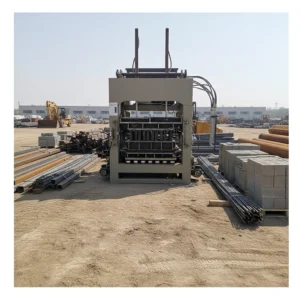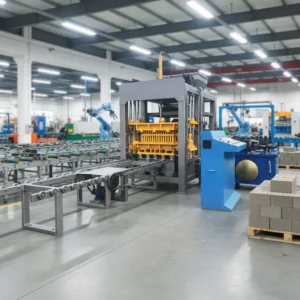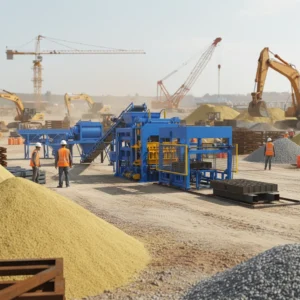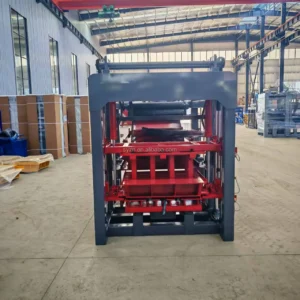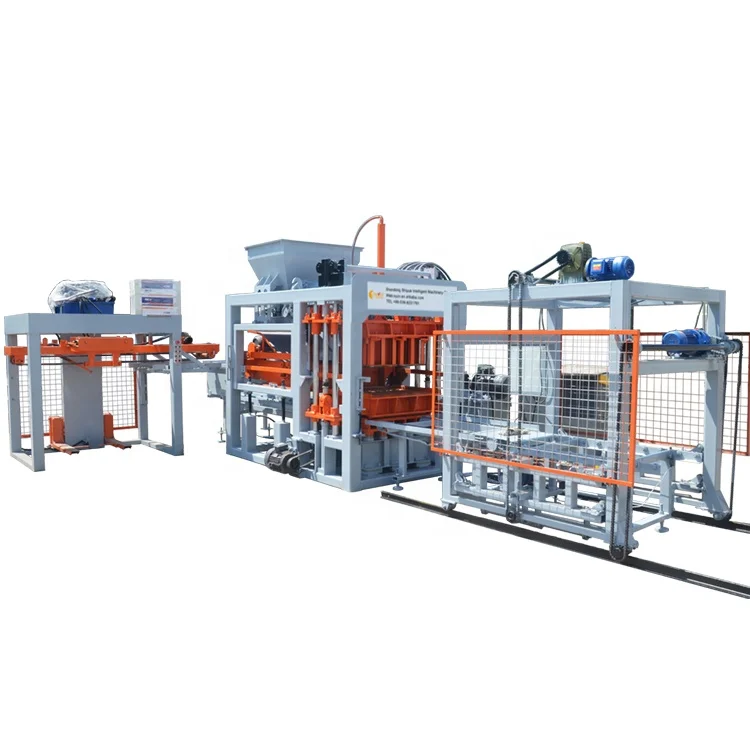
Matched line rhythm — the QT6-15 block making machine production line is sized so pallet return, mixing output, and stacking cadence all align with the press cycle, eliminating idle time between stations.
Technical Specifications
| Parameter | Value |
|---|---|
| Model | QT6-15 |
| Product Type | Hydraulic Concrete Block Making Machine |
| Overall Dimensions (L×W×H) | 8200×1700×2950 mm |
| Vibration Form | Platform Vibration |
| Vibration Frequency | 0-60 Hz (adjustable) |
| Vibration Force | 45 kN |
| Moulding Mode | Automatic loading, vibration moulding |
| Demolding Method | Hydraulic |
| Molding Cycle | 15-20 s (hollow block / solid brick); 20-25 s (paving brick) |
| Pallet Size | 880×850 mm |
| Overall Power | 37 kW |
| Total Mass | 7 T |
| Control System | PLC with touch screen HMI, fault diagnosis system |
| Block Compressive Strength | >15 MPa |
| Output — Hollow Block 400×200×200 mm | 6 pcs/mould, 1080-1440 pcs/h, 8640-11520 pcs/8h (basis: 15-20s cycle) |
| Output — Hollow Block 400×150×200 mm | 8 pcs/mould, 1440-1920 pcs/h, 11520-15360 pcs/8h (basis: 15-20s cycle) |
| Output — Solid Brick 240×115×53 mm | 32 pcs/mould, 5760-7680 pcs/h, 46080-61440 pcs/8h (basis: 15-20s cycle) |
| Output — Rectangular Paver 200×100×60 mm | 21 pcs/mould, 2160-2880 pcs/h, 17280-23040 pcs/8h (basis: 20-25s cycle) |
| Output — Zigzag Paver 225×112.5×60 mm | 15 pcs/mould, 2160-2880 pcs/h, 17280-23040 pcs/8h (basis: 20-25s cycle) |
| Recommended Factory Area | 1200 m² |
| Warranty | 1 year for whole machine (excluding spare parts) |
Application Suitability
| Application | Material or Output |
|---|---|
| Hollow concrete block production for load-bearing walls | Crushed stone, cement, sand, water with industrial by-products such as fly ash or slag |
| Solid brick manufacturing for masonry infill | Cement-aggregate mix proportioned for >15 MPa compressive strength |
| Rectangular and zigzag paving brick production | Fine aggregate and cement blends with pigment dosing for coloured pavers |
| On-site block production for housing projects | Locally sourced aggregate matched to available gradations |
| Expanded format range for building material distributors | Multiple mould sets on one press platform with matched pallet handling |
Why "Cycles per Hour" Means Nothing Without the Rest of the Line
A press only runs as fast as the slowest station feeding or clearing it.
Many quotations for a QT6-15 block making machine production line quote a cycle time and multiply it into an hourly figure, yet the pallet return conveyor, the mixer discharge rate, or the stacking station operates on a different rhythm entirely. The result is a press that idles for several seconds every cycle while waiting for a pallet or a batch of fresh mix. [NEED_CITE:] When I was doing line layouts, one project had the mixer delivering batch volumes that matched the press demand on paper, but the belt conveyor between them was too slow to refill the hopper before the next cycle started — the press lost seconds every round, and the daily shortfall added up to pallets of missed output.
Matching Every Station to the Press Cadence
The QT6-15 block making machine production line treats the press as the pacing element and sizes every upstream and downstream station around its 15-25 second moulding window. The raw material feeder and mixer must deliver a fresh batch to the hopper before the current cycle completes, while the pallet feeder positions the next board before the mould lifts. When each station’s cycle is mapped against the press timing, the line holds continuous rhythm without the operator needing to intervene.
Pallet Return and Curing Rack Sizing
Pallets leaving the press carry wet blocks to the curing area and must return clean and dry before re-entering the feed conveyor. The 880×850 mm pallet dimension is fixed early so that the return conveyor length, curing rack spacing, and forklift tine width are all confirmed before the line layout is drawn. A pallet that doesn’t match the existing rack system forces the buyer into unplanned infrastructure changes on arrival. [NEED_CITE:]
Reading the Specifications That Matter for Line Balance
Vibration force at 45 kN and adjustable frequency from 0-60 Hz define how densely the mix is compacted in the mould, but the hydraulic station must maintain stable pressure independently of the vibration impulse to hold the mould halves closed during compaction. The independent hydraulic station is isolated from main frame vibration and dust ingress, which preserves valve response over long shifts. The PLC with touch screen HMI manages action interlocks and runs a built-in fault diagnosis routine, so when a sensor on the pallet feeder or the hopper gate falls out of sync, the control flags the specific station rather than stopping the press with a generic alarm. The 37 kW total power draw must be accounted for in the site’s electrical planning — a dedicated circuit with the correct breaker rating prevents nuisance trips when the vibration motor and hydraulic pump start simultaneously.
The Cost of Skipping the Line-Wide Calculation
When a line is assembled from separate quotations without a single capacity document tying every station together, mismatches surface only after installation. A stacking station that can’t clear blocks fast enough backs up the pallet return, which starves the pallet feeder, which stalls the press. [NEED_CITE:] These compounding delays are invisible in a press-only quotation but show up as a daily production figure well below what the cycle time promised. I once saw a plant where the curing rack spacing was built for a different pallet size — the entire rack system had to be re-welded before the line could run a second shift.
Why Specifying the Full Line Here Changes the Outcome
Block machinery is the single focus of this facility, so the QT6-15 is never quoted as a standalone press — the pallet, mould, hydraulic station, and handling equipment are specified as one matched system. The configuration is set against the buyer’s actual mix design and local aggregate rather than a catalogue default, which means vibration frequency and hydraulic pressure are tuned before the machine leaves the factory. Mould design covers every format the buyer’s market sells, including custom drawings for non-standard block dimensions. The automation level is selectable, so a plant can open with semi-automatic pallet handling and add automatic stacking later without replacing the press. Installation support includes line-wide commissioning where every station’s timing is verified under production conditions, not just the press running empty on the factory floor.
Documentation & Verification
- Line layout drawing with capacity calculation stated per block format and cycle time assumption
- Pallet specification sheet cross-referenced to buyer’s curing rack dimensions and forklift capacity
- Voltage, frequency, and PLC display language confirmed in writing before production release
- Hydraulic and electrical schematic for local maintenance support after commissioning
- Factory test record documenting press and station timing under matched cycle conditions
Installation, Commissioning & Support
- Foundation must support 7 T total mass across the 8200×1700 mm footprint with vibration isolation pads
- Dedicated electrical circuit rated for 37 kW overall power with correct breaker sizing for simultaneous motor starts
- Line stations arrive dismantled and are reassembled on-site with pallet conveyor alignment verified against press datum
- PLC touch screen HMI configured to operator language and fault diagnosis parameters set before first production run
- Wear parts list covering hydraulic seals, vibration springs, and mould liners with supply lead times confirmed
- Recommended 1200 m² factory area allows curing rack placement and pallet return loop without congestion
What to Prepare Before Requesting a Line Quotation
To size every station correctly, share the target block formats with dimensions, the daily output you need per format, and the raw materials available locally including aggregate gradation. Your existing curing area dimensions and forklift specifications determine pallet sizing and rack layout. Confirm the site voltage, frequency, and the language your operators will need on the PLC display so the control system ships configured from day one.
Frequently Asked Questions
Q: How is daily output calculated when multiple block formats run on the same line?
A: Each format has its own mould cavity count and cycle time — for example, the 400×200×200 mm hollow block runs at 6 pcs/mould on a 15-20 second cycle, giving 8640-11520 pcs per 8-hour shift. The capacity document states the assumed format for every figure so you can plan production around the formats you actually sell rather than a single headline number.
Q: What happens if the mixer can’t keep up with the QT6-15 feed rate?
A: The press will idle between cycles waiting for fresh mix in the hopper, and the hourly output drops below the rated figure. Upstream equipment — batcher, mixer, and belt conveyor — must be sized to deliver a complete batch within the moulding window so the press never pauses. This is calculated during the line layout stage before any equipment ships.
Q: How do we confirm pallet and curing rack compatibility before installation?
A: The 880×850 mm pallet size is locked into the line layout early, and the curing rack dimensions, spacing, and forklift capacity are checked against it. If your existing racks or forklifts don’t match, the pallet specification or rack design is adjusted before manufacturing starts so nothing needs modification on site.
Q: What electrical and control details need confirming before production?
A: Voltage, frequency, and PLC display language must be confirmed in writing before the machine enters production. The 37 kW power requirement and the simultaneous starting load of the vibration motor and hydraulic pump are factored into the electrical schematic so your local electrician can prepare the correct supply and protection before the line arrives.
Q: Which spare parts should we order with the initial shipment?
A: The wear parts list identifies hydraulic seals, vibration components, and mould liner elements that see regular wear. Supply lead times for replacements are stated so you can plan reorder points and avoid a production halt while waiting for a component to arrive from overseas.