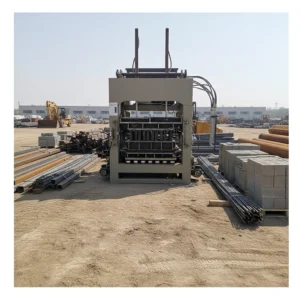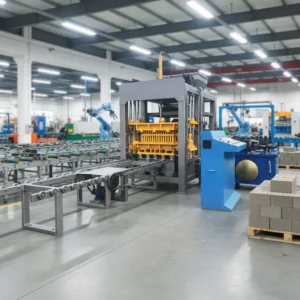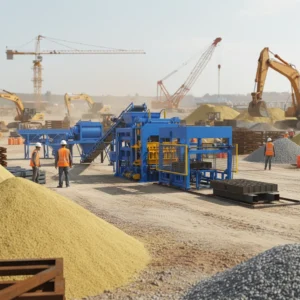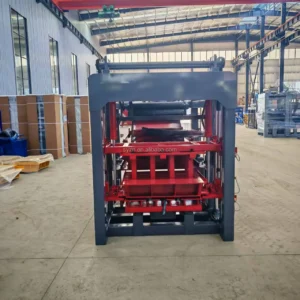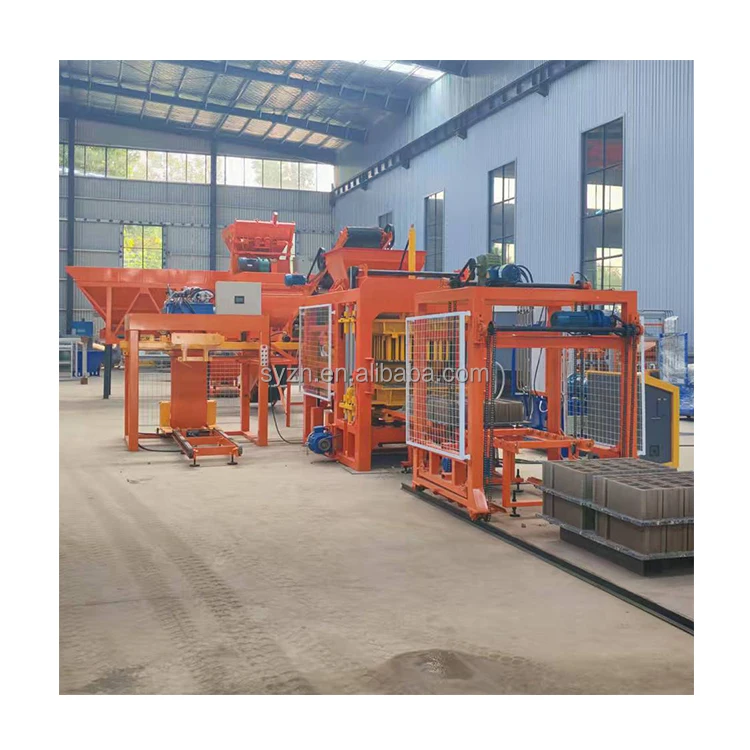
Matched Line Synchronization — QT6-15 configured with supporting stations timed to press cycle, so no pallet waits idle while vibration moulding completes.
Technical Specifications
| Parameter | Value |
|---|---|
| Model | QT6-15 |
| Product Type | Automatic Hydraulic Block Making Machine |
| Overall Dimensions (L×W×H) | 8200×1700×2950 mm |
| Vibration Frequency | 0–60 Hz |
| Vibration Form | Platform Vibration |
| Moulding Mode | Automatic loading, vibration moulding |
| Pallet Size | 880×850 mm |
| Molding Cycle | 15–20 s (blocks), 20–25 s (pavers) |
| Overall Power | 37 kW |
| Vibration Force | 45 kN |
| Total Mass | 7 T |
| Demolding Method | Hydraulic |
| Factory Area Required | 1200 m² |
| Control System | PLC with touch screen HMI, fault diagnosis, action interlock logic |
| Hydraulic System | Independent integrated station, isolated from dust and vibration |
| Output — Hollow Block 400×200×200 mm | 1080–1440 pcs/h, 8640–11520 pcs/8hr (6 pcs/mould, 15–20 s cycle) |
| Output — Hollow Block 400×150×200 mm | 1440–1920 pcs/h, 11520–15360 pcs/8hr (8 pcs/mould, 15–20 s cycle) |
| Output — Solid Brick 240×115×53 mm | 5760–7680 pcs/h, 46080–61440 pcs/8hr (32 pcs/mould, 15–20 s cycle) |
| Output — Rectangular Paver 200×100×60 mm | 2160–2880 pcs/h, 17280–23040 pcs/8hr (21 pcs/mould, 20–25 s cycle) |
| Output — Zigzag Paver 225×112.5×60 mm | 2160–2880 pcs/h, 17280–23040 pcs/8hr (15 pcs/mould, 20–25 s cycle) |
| Block Compressive Strength | >15 MPa (basis not stated in source — verify against mix design) |
| Raw Material Adaptability | Waste ash, slag, various aggregates; cement dosage adjustable |
| Assembly State | Skid-mounted main press, supporting line specified separately |
| Voltage & Frequency | To be confirmed with buyer’s local supply |
| PLC Display Language | To be confirmed with buyer preference |
| Warranty | 1 year on whole machine, excluding wear parts and spare parts |
| Standards | CE declaration where applicable |
Application Suitability
| Application | Material or Output |
|---|---|
| Hollow block production plants | Crushed stone, sand, cement, and waste ash mixes for 400×200×200 mm and 400×150×200 mm formats |
| Solid brick manufacturing | Fine aggregate and cement blends for 240×115×53 mm standard bricks |
| Paving brick production | High-density aggregate mixes for 200×100×60 mm rectangular and 225×112.5×60 mm zigzag pavers |
| On-site construction block making | Local aggregate and cement for housing project contractors producing at the build location |
| Format expansion for existing plants | Multiple mould formats allowing concrete product manufacturers to add hollow, solid, and paver lines |
Why "Cycle Time per Hour" Means Nothing Without the Line Around It
The press never outpaces its slowest supporting station — so the quotation must cover every station, not just the main machine.
Buyers regularly receive proposals that quote a QT6-15 automatic block making machine production line at peak cycle rates without listing the pallet feeder, stacker, or mixer capacity. The press completes a mould every 15 to 20 seconds, but if the pallet return loop takes 25 seconds or the mixer batches once every three minutes, the press stands idle between cycles. I have walked onto sites in the Gulf region where the block machine ran at roughly half its rated output simply because the supporting equipment was never specified to match. The buyer paid for a high-capacity press and received a bottlenecked line. [NEED_CITE: production line synchronization principles in concrete block manufacturing]
How Raw Material Feeding and Mixing Must Track the Press Cycle
The QT6-15 automatic block making machine production line demands a consistent mix supply at intervals matching the moulding cycle. A 15–20 second block cycle means the mixer must discharge a fresh batch before the hopper empties, and the belt feeder must deliver aggregate and cement in proportions that do not fluctuate between batches. If the mixer is undersized or the batching gate response lags, the press operator either waits or runs a starved mix that produces blocks with inconsistent density. Every supporting station upstream of the press must be calculated against the same cycle assumption.
Pallet Feeding, Stacking, and Curing as Part of the Line, Not Afterthoughts
Downstream of the press, the pallet carrying the freshly moulded block must be transferred to the curing rack before the next pallet enters. An automatic stacker that cannot keep pace with the press cycle forces the operator to pull pallets by hand, slowing the entire QT6-15 automatic block making machine production line and introducing handling damage. The pallet size of 880×850 mm must also match the curing rack spacing and the forklift already on site — otherwise the buyer discovers after commissioning that pallets do not fit the existing racking system. [NEED_CITE: pallet handling integration in block production facilities]
Reading the Specs That Actually Determine Daily Output
Platform vibration at 0–60 Hz with 45 kN force determines how densely the mix is compacted into the mould, directly affecting block compressive strength and demolding integrity. The hydraulic demolding system must release the block without cracking, which requires pressure settings matched to the specific mix design and aggregate the buyer sources locally. The 37 kW overall power rating covers both the vibration motor and the hydraulic station, so voltage drop on an undersized supply circuit will reduce vibration force below the rated 45 kN and produce weaker blocks. The PLC touch-screen HMI with fault diagnosis allows the operator to see alarm states across the line rather than diagnosing failures by ear, which matters when the line includes multiple stations running in sequence. Independent hydraulic station isolation from dust and press vibration extends seal life and maintains consistent pressure across long production shifts.
What Happens When Supporting Equipment Is Left Out of Scope
When a quotation covers the press alone, the buyer is left to source pallets, mixers, and stackers from separate suppliers who have no obligation to synchronize cycle times. The result on site is a press that idles between cycles, output stacked manually by workers who damage blocks before curing, and a daily tonnage that never approaches the figure in the proposal. Mould changes take longer when the pallet system was not designed for quick swap, and format flexibility — the reason the buyer chose a multi-mould machine — is lost to changeover downtime. [NEED_CITE: consequences of mismatched line equipment in block production]
Why This Configuration Approach Is Different
The QT6-15 is specified here as the center of a complete production line rather than a standalone press, with every supporting station — feeder, mixer, pallet loop, stacker, curing rack handler — sized to match the 15–20 second moulding cycle. Block machinery is the single focus, so the machine, mould, pallet, and handling equipment are proposed as one matched system instead of assembled from unrelated suppliers. Configuration is set against the buyer’s actual mix design, local aggregate, and target block format, not a catalogue default. Mould design covers the formats the buyer’s market actually sells, including custom drawings when standard cavities do not fit. Automation level is selectable, allowing a buyer to begin with semi-automatic pallet handling and add stacking and cubing later as volume grows.
Documentation & Verification
- Line layout with capacity calculation per block format and assumed cycle time
- Machine specification sheet with hydraulic and electrical schematics
- Mould drawing and format list including custom cavity designs
- Pallet specification confirming 880×850 mm dimensions and material grade
- Factory test record showing cycle times per mould format before dispatch
- Packing photographs and customs documentation support for shipment
Installation, Commissioning & Support
- Foundation plan for 8200×1700 mm footprint with vibration isolation requirements
- 37 kW power connection with dedicated circuit and voltage confirmation before production
- Skid-mounted press arrives assembled; supporting stations connected on site
- PLC display language and fault diagnosis parameters set during commissioning
- Operator training covers mould change procedure and HMI alarm response
- Wear parts list and mould maintenance schedule provided at handover
What to Include in Your Inquiry
Share the block formats your market demands, the daily volume you need per format, and the local aggregate and cement available at your site. Confirm your existing curing area dimensions, forklift capacity, and the voltage and frequency at the plant. If you have upstream or downstream equipment already installed, list the models and cycle times so the line can be configured around them.
Frequently Asked Questions
Q: How is output capacity calculated for each block format, and what cycle time and mould cavity count does it assume?
A: Every capacity figure on this page states the block format, cavity count per mould, and cycle time range used for the calculation. For example, hollow block 400×200×200 mm output is based on 6 cavities per mould and a 15–20 second cycle. Actual daily output depends on supporting station synchronization and shift length, which are confirmed during line layout planning.
Q: Which supporting stations are included in the quotation, and how are their cycle times matched to the QT6-15 press?
A: The proposal covers raw material feeding, mixing, pallet feeding, stacking, and curing rack handling as a complete line. Each station is sized so its cycle time does not exceed the press moulding cycle of 15–20 seconds for blocks or 20–25 seconds for pavers, preventing the press from idling between cycles.
Q: What voltage, frequency, and PLC language options are confirmed before production?
A: Voltage and frequency are confirmed against the buyer’s local supply before the electrical panel is built. PLC display language is set to the operator’s preference. Confirming both before production prevents commissioning delays after the QT6-15 automatic block making machine production line arrives on site.
Q: How is the pallet size 880×850 mm chosen, and is it compatible with existing curing racks and forklifts?
A: The 880×850 mm pallet size is matched to the mould cavity layout on the QT6-15. Before order confirmation, we verify that this pallet dimension fits the buyer’s existing curing rack spacing and forklift fork width, or recommend rack modifications if needed.
Q: What does installation and commissioning cover — does it include operator training and integration with existing equipment?
A: Commissioning includes line assembly, PLC parameter setup, cycle time verification per mould format, and operator training on the HMI and mould change procedure. If upstream or downstream equipment already exists on site, the supporting stations are configured to interface with it during installation.