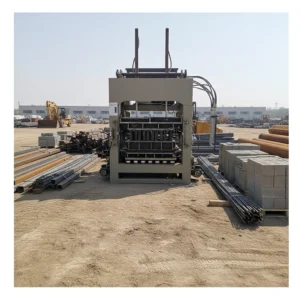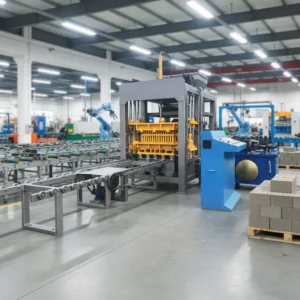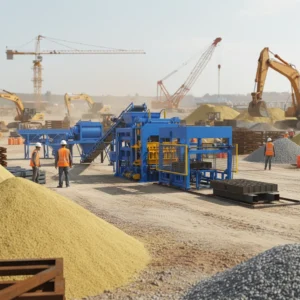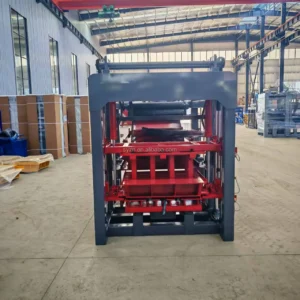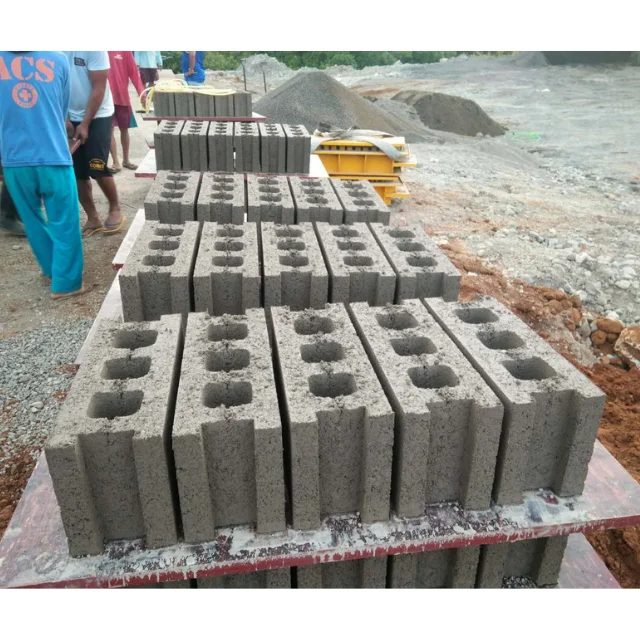
Matched Line Timing — the QT5-15 block production line QT5-15 is configured so pallet circulation, material feeding and stacking match the press cycle, not sold as a standalone unit with mismatched stations.
Technical Specifications
| Parameter | Value |
|---|---|
| Model | QT5-15 |
| Product Type | Hydraulic Hollow Block Making Machine |
| Overall Dimensions (L×W×H) | 7400×1950×2800 mm |
| Total Mass | 5000 kgs |
| Overall Power | 32 kW |
| Vibration Force | 80 kN |
| Vibration Frequency | 0-60 Hz |
| Vibration Form | Platform Vibration |
| Moulding Mode | Automatic loading with vibration moulding |
| Demolding Method | Hydraulic |
| Pallet Size | 1100×550 mm |
| Molding Cycle | 15-20 s (basis not stated in source — confirm block format / material / thickness) |
| Control System | PLC with touch screen interface |
| Hydraulic System | Independent integrated hydraulic station |
| Factory Area Required | 1000 m² |
| Output Capacity — Hollow Block 400×200×200 mm | 900-1200 pcs/h, 7200-9600 pcs/8hr (based on 5 pcs/mould, 15-20s cycle) |
| Output Capacity — Hollow Block 400×150×200 mm | 1080-1440 pcs/h, 8640-11520 pcs/8hr (based on 6 pcs/mould, 15-20s cycle) |
| Output Capacity — Solid Brick 240×115×53 mm | 5760-7680 pcs/h, 46080-61440 pcs/8hr (based on 32 pcs/mould, 15-20s cycle) |
| Output Capacity — Rectangular Paver 200×100×60 mm | 3600-4500 pcs/h, 28800-36000 pcs/8hr (based on 25 pcs/mould, 20-25s cycle) |
| Output Capacity — Zigzag Paver 225×112.5×60 mm | 2304-2880 pcs/h, 18432-23040 pcs/8hr (based on 16 pcs/mould, 20-25s cycle) |
| Block Compressive Strength | >15 MPa |
| Raw Material Compatibility | Fly ash (up to 70%), slag, gangue, sand, crushed stone, cement, water |
| Automation Level | Automatic (pallet feeding, material feeding, vibrating, demoulding) |
| Line Components | Pallet feed machine, block making machine, storage hopper, conveyor, hydraulic unit, PLC control cabinet |
| Warranty | 1 year for whole machine (excluding spare parts) |
Application Suitability
| Application | Material or Output |
|---|---|
| Hollow block production plant | Fly ash, slag, sand and cement mixes forming 400×200×200 mm or 400×150×200 mm blocks |
| Solid brick manufacturing | Dense aggregate and cement producing 240×115×53 mm bricks for load-bearing walls |
| Paving brick and interlocking paver production | Crushed stone and sand forming 200×100×60 mm rectangular or 225×112.5×60 mm zigzag pavers |
| Construction contractor on-site block making | Local aggregate and cement producing hollow blocks for housing project walls |
| Building material manufacturer utilizing industrial residue | Fly ash up to 70% with slag and gangue as primary raw material |
Why a Standalone Press Rating Means Nothing Without the Line Around It
A block production line QT5-15 press rated at 1200 hollow blocks per hour delivers far fewer when upstream mixing cannot feed it or downstream pallet handling cannot clear it.
I have seen a QT5-15-class machine installed in West Africa where the quotation covered the press and nothing else. Fresh blocks piled up on pallets at the discharge end, and the owner hired extra workers just to carry them to the curing area. The press spent part of every shift waiting for empty pallets to return. The daily tally fell well short of what the catalogue promised. [NEED_CITE: typical block plant bottleneck analysis for semi-manual pallet handling]
How the Stations Connect Around the Press
A turnkey block making plant starts long before the press itself. Raw material enters the storage hopper, moves through the conveyor to the mixer, and charges into the mould box on a timed sequence. The pallet feed machine positions an empty pallet under the mould, the press vibrates and demoulds, and the loaded pallet exits to the stacking or curing station. Every transition point is a potential delay if timing is not calculated against the actual molding cycle.
The PLC control cabinet coordinates these transitions in sequence. Each station receives a signal only when the previous station has completed its step, so the press never fires into an empty mould box and no pallet sits uncollected at the discharge end. When you plan a block production line QT5-15 layout, the cycle time of the slowest station sets the ceiling for the entire plant.
Where Pallet Circulation Decides Daily Output
The pallet is the carrier that moves the block through every station. The QT5-15 uses a 1100×550 mm pallet, and that dimension must match the curing racks and the forklift already on site. If the pallet is too wide for the rack slot, blocks stack on the floor. If the forklift cannot lift a full rack of loaded pallets, cured blocks sit in the rack and empty pallets do not return to the feed machine. [NEED_CITE: pallet and curing rack dimensional matching in block plants]
The pallet feed machine holds a stack of empties and releases them one at a time. Its release interval must be shorter than the press cycle so the press never waits. On the return side, cleared pallets must travel back before the feed stack runs out. This closed loop is where most quoted lines fail — the press is specified, but the pallet return path is left to improvisation.
What the Core Parameters Mean for Line Behaviour
The 80 kN vibration force and platform vibration form determine how densely the mix settles into the mould. Denser blocks leave the press with enough green strength to survive pallet transport without crumbling at the edges. If vibration force is too low for the aggregate size in your mix, block edges chip during handling and the stacking station receives damaged product.
The 0-60 Hz adjustable vibration frequency lets the operator tune the press to different formats. A hollow block with thin walls needs higher frequency and shorter duration, while a solid brick or thick paver needs lower frequency with longer vibration to fully compact the charge. The PLC stores these recipes so format changeover does not require manual trial and error.
The independent integrated hydraulic station sits away from the vibration zone and dust path. Hydraulic valves and seals degrade faster when mounted directly on a vibrating frame, especially in a block plant environment where cement dust penetrates every opening. Isolating the hydraulic unit extends service intervals across the full duty cycle of the line.
The 32 kW overall power rating covers the press motor, hydraulic pump and conveyor drives within the line components listed. Your electrical plan must account for the mixer, batching conveyor and any stacking equipment as separate loads on dedicated circuits.
The Hidden Cost of Quoting the Press Alone
When a quotation lists only the press and omits the pallet feed machine, conveyor and stacking station, the buyer assumes these items are either included or trivial to add later. In practice, an undersized mixer starves the press of material, a manual pallet return creates a labour bottleneck, and an unmatched curing rack dimensions forces pallets onto the floor. Each gap appears after commissioning, when changing equipment means halting production. [NEED_CITE: block plant commissioning delays from mismatched line components]
Owners who discover these gaps after arrival end up spending on retrofit equipment, extra labour and lost production days. The total cost of correcting a line mismatch often exceeds what a matched system would have cost from the start.
What Sets This Configuration Apart
Block machinery is the sole focus here, so the QT5-15 press, moulds, pallets and handling equipment are specified as one matched system rather than assembled from separate suppliers. Every station in the block production line QT5-15 layout is sized against the same cycle time calculation.
The configuration is set against the buyer’s actual mix design, local aggregate and target block format — not a catalogue default. Pallet size 1100×550 mm is confirmed against your curing area dimensions and forklift capacity before production begins.
Mould design covers the formats your market actually sells, and the quick replacement mould change system means format flexibility is usable within a shift rather than theoretical. Automation level is selectable, so a buyer can start with the automatic pallet feeding and material feeding included in the QT5-15 line components and add stacking or cubing later as production volume grows.
Installation and commissioning support includes operator training so your team understands not just the press but how every station in the line must be monitored for timing drift.
Documentation & Verification
- Line layout and capacity calculation stating the block format assumed for each output figure
- Machine specification sheet with hydraulic and electrical schematic for your site wiring plan
- Pallet specification confirming 1100×550 mm size matched to your curing rack dimensions
- Factory test record on your target block format and mix before dispatch
- Voltage, frequency and PLC display language confirmation in writing before production
Installation, Commissioning & Support
- The 1000 m² factory area requirement includes space for curing racks and pallet return path
- The 32 kW overall power draw requires a dedicated circuit separate from mixer and conveyor loads
- Machine arrives in dismantled state for container loading with reassembly guided on site
- PLC touch screen commissioning includes timing calibration for each station in the sequence
- Operator training covers mould change procedure and pallet feed machine reload intervals
- Wear parts list includes hydraulic seals and vibration motor bearings with replacement schedule
Before You Request a Quote
Provide the block formats you plan to produce and the daily volume you need for each, so the line layout can be calculated per format rather than as a single aggregate number. Share your local raw material — whether fly ash, sand, crushed stone or slag — along with the mix proportions you intend to use, because vibration settings and mould design depend on aggregate grading. Confirm your site voltage and frequency, the language your operators will need on the PLC display, and the dimensions of any curing racks or forklifts already on site so the pallet specification aligns from day one.
Frequently Asked Questions
Q: How is the output capacity of the full line verified, and which block format does each number assume?
A: Each capacity figure is tied to a specific block format, mould cavity count and cycle time. For example, 900-1200 hollow blocks per hour applies to the 400×200×200 mm format with 5 cavities per mould and a 15-20 second cycle. The line layout document you receive states the assumed format for every output number so you can calculate realistic daily throughput for your actual product mix.
Q: How do upstream mixing and feeding stations match the QT5-15 cycle time so the press is not starved?
A: The storage hopper and conveyor are sized to deliver a full mould charge within the press cycle interval. The PLC coordinates the charge signal so the mixer discharges and the conveyor delivers material before the mould box is ready for the next press. If your mixer batch time exceeds the press cycle, the line capacity calculation will flag this before equipment is built.
Q: What pallet size and material are specified, and how does this align with my existing curing racks and forklift?
A: The standard pallet for the QT5-15 is 1100×550 mm. Before production, your curing rack slot width and forklift load capacity are confirmed so loaded pallets fit your racks and your forklift can move full racks without overloading. If your existing racks require a different dimension, the pallet feed machine is adjusted accordingly.
Q: Which supporting equipment is included in the quotation and which items are optional?
A: The standard line components include the pallet feed machine, block making machine, storage hopper, conveyor, hydraulic unit and PLC control cabinet. Automatic stacking, curing rack handling and cubing systems are available as additions. The quotation lists every included item and every optional station separately so there are no surprises after arrival.
Q: How are voltage, frequency and PLC language confirmed so the line commissions without delay on arrival?
A: Voltage, frequency and PLC display language are confirmed in writing before the machine enters production. The electrical schematic is provided so your electrician can prepare utility connections and dedicated circuits in advance. This prevents the common situation where a machine arrives with a control panel your operators cannot read or a motor rated for a frequency your site does not supply.