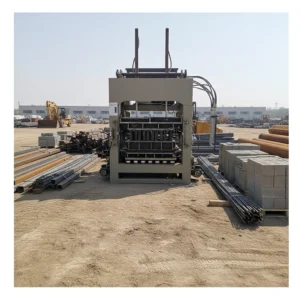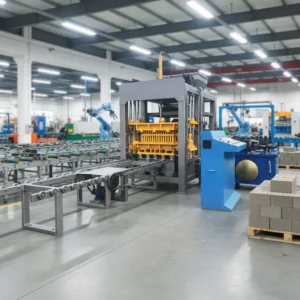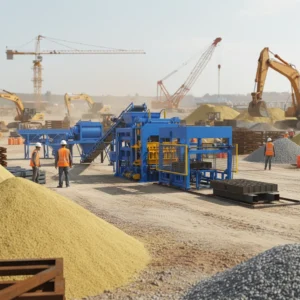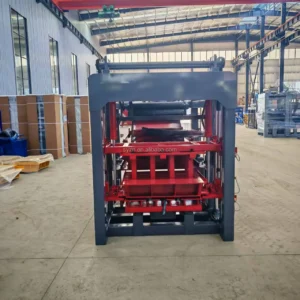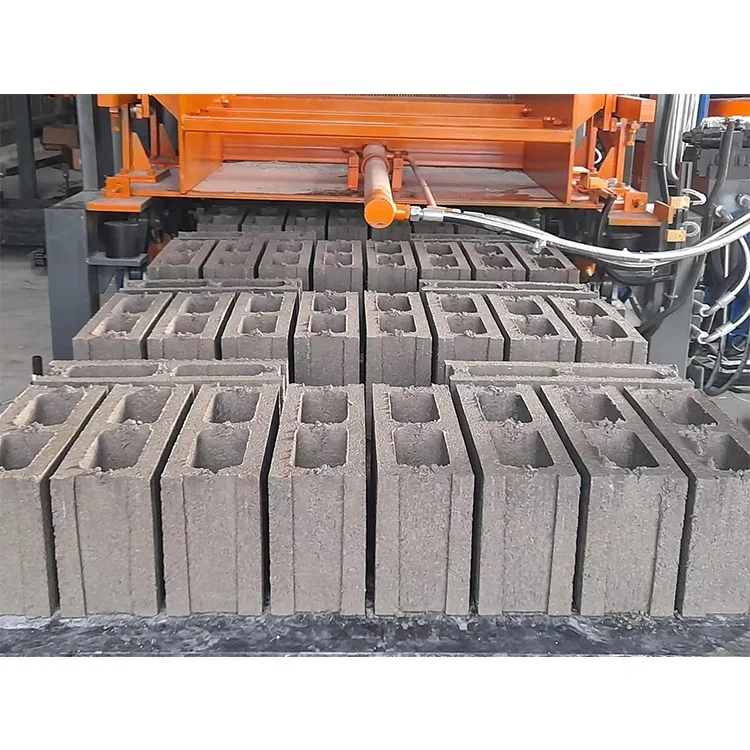
Line-Synchronized Production — every station from pallet feeder to stacker is timed against the QT5-15 press cycle so the machine never idles waiting for the next charge or pallet return.
Technical Specifications
| Parameter | Value |
|---|---|
| Model | QT5-15 |
| Product Type | Fully Automatic Concrete Block Making Machine |
| Overall Dimensions (L×W×H) | 7400×1950×2800 mm |
| Total Mass | 5000 kg |
| Vibration Force | 80 kN |
| Vibration Frequency | 0-60 Hz |
| Vibration Form | Platform Vibration |
| Moulding Mode | Automatic loading, vibration moulding |
| Demolding Method | Hydraulic |
| Hydraulic System | Independent integrated hydraulic station |
| Molding Cycle | 15-20 s |
| Pallet Size | 1100×550 mm |
| Overall Power | 32 kW |
| Control System | PLC with touch screen interface |
| Block Compressive Strength | >15 MPa |
| Recommended Factory Area | 1000 m² |
| Output (Hollow Block 400×200×200 mm) | 900-1200 pcs/h, 7200-9600 pcs/8hr |
| Output (Hollow Block 400×150×200 mm) | 1080-1440 pcs/h, 8640-11520 pcs/8hr |
| Output (Solid Brick 240×115×53 mm) | 5760-7680 pcs/h, 46080-61440 pcs/8hr |
| Output (Rectangular Paver 200×100×60 mm) | 3600-4500 pcs/h (20-25s cycle), 28800-36000 pcs/8hr |
| Output (Zigzag Paver 225×112.5×60 mm) | 2304-2880 pcs/h (20-25s cycle), 18432-23040 pcs/8hr |
| Raw Material Compatibility | Fly ash (up to 70%), slag, gangue, sand, crushed stone, cement, water |
| Mould Change | Quick replacement for multi-format production |
| Line Components | Pallet feed machine, block making machine, storage hopper, conveyor, hydraulic unit, PLC control cabinet |
| Assembly State | Factory assembled, requires on-site installation and commissioning |
| Warranty | 1 year (excluding spare parts) |
Application Suitability
| Application | Material or Output |
|---|---|
| Hollow block production for structural walls | Crushed stone, sand, cement with fly ash or slag blends |
| Solid brick manufacturing for standard masonry | Sand, crushed stone, cement with local aggregate |
| Rectangular and zigzag paver production | Cement-rich mixes with fine aggregate for surface finish |
| Fly ash and industrial residue recycling | Fly ash up to 70%, gangue, slag blended with cement |
| Mid-capacity block plant for contractors | 1000 m² recommended factory area with curing space |
| On-site fixed-plant production for housing projects | Multi-format output from a single pallet size and press |
What Happens When the Press Outruns the Rest of the Line
A fast cycle time on the QT5-15 means nothing if the pallet feeder and return conveyor cannot keep pace.
I have watched a mid-size block plant install a press rated for a 15-second cycle, only to find that the pallet return belt moved too slowly to deliver the next pallet in time. The press sat idle for several seconds between every cycle, cutting real output well below the headline number. That gap compounds across an eight-hour shift into thousands of missing blocks. The QT5-15 block machine production line is designed so the pallet feed machine, conveyor, and hydraulic unit are each timed against the press cycle, with the PLC managing the sequence to prevent that kind of bottleneck [NEED_CITE: typical block plant cycle coordination standards].
How the QT5-15 Block Machine Production Line Coordinates Each Station
The touch screen PLC interface does more than run the press — it sequences pallet feeding, material dosing from the storage hopper, vibration moulding, hydraulic demoulding, and pallet return as one continuous loop. Each station receives its trigger signal from the same controller, so the pallet arrives at the press exactly when the previous block is lifted clear. This coordination is the reason the QT5-15 block machine production line can sustain its stated cycle times across a full shift without manual intervention between stations.
Matching Pallet Dimensions Across the Entire Line
Every piece of handling equipment in the line — the pallet feed machine, the return conveyor, and the curing rack system — is built around the 1100×550 mm pallet size. Confirming this dimension before production starts means the buyer’s existing forklift, curing area, and stacking layout will accept the output without modification. A pallet size confirmed late forces rework on the conveyor width or the curing rack spacing, and that rework is always more expensive at the destination than at the factory [NEED_CITE: pallet dimension compatibility in concrete block plants].
Reading the Specifications That Actually Affect Output
The 80 kN vibration force and independent hydraulic station work together to compact the mix into a dense block. Higher vibration frequency (up to 60 Hz) settles fine particles, while hydraulic pressure locks them in place — the balance between these two determines whether blocks hold above the 15 MPa compressive strength threshold or crack during curing. The 1100×550 mm pallet defines how many blocks fit per cycle: a 400×200×200 mm hollow block fits in a set pattern that yields the rated 900-1200 pieces per hour, while a smaller solid brick fills more positions on the same pallet, reaching 5760-7680 pieces per hour. Quick mould replacement lets the operator switch between these formats without dismantling the press frame, keeping changeover within a fraction of a shift rather than consuming the whole day.
When a Missing Station Stops the Whole Line
A quotation that covers the press and the mixer but leaves out pallet handling and stacking means the buyer is suddenly responsible for moving wet blocks by hand. I once saw a plant where the owner had budgeted for the QT5-15 block machine production line expecting a continuous flow, only to discover the pallet return was not in the scope. Workers carried pallets back one at a time, the press waited, and daily output dropped to roughly half of what the line should have produced [NEED_CITE: scope gaps in block machinery quotations and their operational impact].
Why Sourcing the Line as One Package Matters
Block machinery is our single focus, so the press, moulds, pallets, and handling equipment are specified as a matched system rather than assembled from separate suppliers. Configuration is set against the buyer’s actual mix design and local aggregate — not a catalogue default — which means the vibration force and hydraulic pressure are adjusted to the material that will actually be fed into the hopper. Mould design covers the formats the buyer’s market sells, including custom drawings for non-standard block shapes. Automation level is selectable, so a plant can begin with semi-automatic pallet handling and add stacking later. Installation support includes operator training across every station, not just the press, so the crew understands how pallet feed timing, mixer output, and curing rack rotation all connect to keep the line moving.
Documentation & Verification
- Line layout drawing with cycle time per station so bottlenecks are visible before purchase
- Capacity calculation stated per block format, not a single headline number
- Voltage, frequency, and PLC display language confirmed in writing before production
- Factory test record on the buyer’s target block format before dispatch
- Pallet specification and curing rack layout included with the quotation
- Hydraulic and electrical schematic with station-by-station wiring detail
Installation, Commissioning & Support
- Foundation must support the 5000 kg press mass and the 7400 mm line length within the 1000 m² factory area
- Dedicated power circuit required for the 32 kW overall load with confirmed voltage and frequency
- Line arrives factory assembled in modules; on-site assembly connects conveyor, pallet feeder, and hydraulic station
- Commissioning includes PLC parameter tuning for the buyer’s specific mix and block format
- Operator training covers all stations: mixer dosing, pallet feed, press control, and curing rack handling
- Wear parts list and mould inventory provided for first replacement planning
Before You Send the Inquiry
To size the QT5-15 block machine production line correctly, share the block formats you intend to sell, your daily output target per format, and the local aggregate and fly ash sources available. Confirm your site voltage, frequency, and preferred PLC display language, along with the curing area dimensions and forklift capacity you already have on site. If you are integrating with an existing mixer or conveyor, provide those specifications so the line can be matched without overlap or gap.
Frequently Asked Questions
Q: How do I verify that every station in the line matches the QT5-15 press cycle time?
A: The line layout drawing we provide lists the cycle time for each station — pallet feeder, mixer charge, press, and return conveyor — alongside the press cycle. You can see before purchase whether any station is slower and would create idle time. We adjust conveyor speed and feeder timing during factory testing to close any gap before shipment.
Q: What supporting equipment is included in the quotation versus what is optional?
A: The standard quotation covers the pallet feed machine, storage hopper, conveyor, hydraulic unit, and PLC control cabinet alongside the QT5-15 press. Stacking and curing rack handling are available as additions. We confirm the scope in writing so no station is left undefined before production begins.
Q: How is the pallet size confirmed against my existing curing area and forklift?
A: We confirm the 1100×550 mm pallet dimension against your forklift fork width, curing rack spacing, and floor layout before the line is built. If your existing equipment uses a different size, we discuss whether adjusting the pallet or modifying the handling equipment is the more practical route for your site.
Q: Can the line be configured for my local aggregate and fly ash availability?
A: Yes. We ask for a sample or specification of your local sand, crushed stone, and fly ash before configuration. The vibration force and hydraulic pressure are then set to match that mix, and a factory test on the buyer’s target format validates block strength before the line ships.
Q: Does commissioning cover operator training across all stations, not just the press?
A: Commissioning includes training on the mixer dosing, pallet feed sequence, PLC touch screen operation, hydraulic station maintenance, and curing rack handling. The goal is for the crew to run the full QT5-15 block machine production line independently, not just operate the press while the rest of the stations remain unfamiliar.