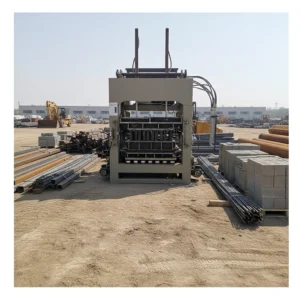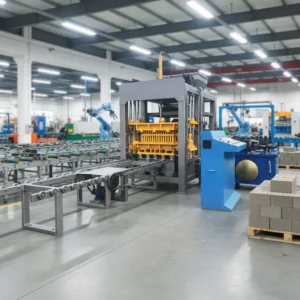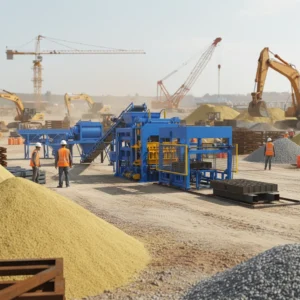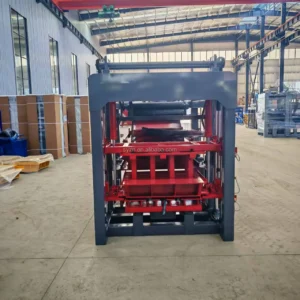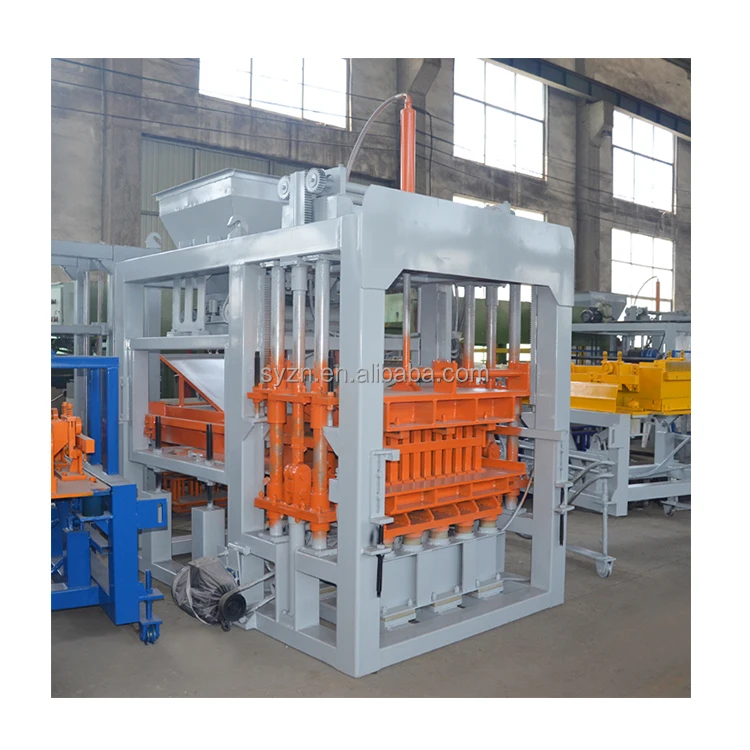
Integrated Block Line Design — the QT5-15 block making machine production line connects material feeding, press cycling and pallet discharge as one matched system, so stations do not leave the press waiting between cycles.
Technical Specifications
| Parameter | Value |
|---|---|
| Model | QT5-15 |
| Product Type | Fully Automatic Hydraulic Block Making Machine |
| Overall Dimensions | 7400 × 1950 × 2800 mm |
| Total Mass | 5000 kg |
| Overall Power | 32 kW |
| Vibration Form | Platform Vibration |
| Vibration Frequency | 0–60 Hz |
| Vibration Force | 80 kN |
| Moulding Mode | Automatic loading with vibration moulding |
| Demolding Method | Hydraulic |
| Pallet Size | 1100 × 550 mm |
| Molding Cycle | 15–20 s (hollow block 400×200×200 mm); 20–25 s (rectangular brick 200×100×60 mm) |
| Output Capacity | 900–1200 pcs/h (basis: 400×200×200 mm hollow block, 5 pcs/mould, 15–20 s cycle) |
| Hydraulic System | Independent integrated hydraulic station |
| Control System | PLC with touch screen interface |
| Automation Level | Fully automatic (pallet feeding, material feeding, vibrating, demolding) |
| Raw Material Compatibility | Fly ash (up to 70%), slag, gangue, sand, crushed stone, cement, water |
| Block Compressive Strength | >15 MPa |
| Factory Area Required | 1000 m² |
| Electrical & Hydraulic Components | Original imported or Chinese well-known brand |
Application Suitability
| Application | Material or Output |
|---|---|
| Hollow block production | Crushed stone, sand, cement blends; fly ash up to 70% |
| Solid brick manufacturing | Gangue, slag and cement mixes for load-bearing units |
| Rectangular and interlocking paver production | Fine aggregate and cement for surface-grade pavers |
| Environmental protection brick | Industrial residue including fly ash, slag and coal gangue |
| On-site contractor block production | Locally sourced aggregate with cement binder |
Why the Upstream Stations Decide the Real Output
A press that cycles in 15 seconds but waits 10 seconds for material is not a 15-second machine. The QT5-15 block making machine production line addresses this by matching the storage hopper discharge rate and conveyor speed to the press cycle, so material arrives at the mould cavity before the next press stroke begins. I have watched plants lose noticeable portions of a shift because the mixer discharged slower than the press could accept — the operator simply stood there watching an empty hopper [NEED_CITE: bottleneck analysis in block plant throughput studies]. When the pallet feeder, material feed system and press share one PLC timing sequence, the gaps disappear from the cycle chart entirely.
Matching Stations Around the Press Cycle
Every station in the QT5-15 block making machine production line is timed against the 15–20 second hollow block cycle. The pallet feed machine places a fresh pallet onto the press table during demolding, so the next press stroke begins without manual intervention. The storage hopper gates open and close on a programmable delay tied to the PLC touch screen, which means the material drop duration adjusts when you switch from a 15-second hollow block cycle to a 25-second paver cycle. This is the difference between a line that runs itself and one that needs an operator watching each station.
What the Integrated Hydraulic Station Prevents
The independent hydraulic station sits away from the main vibration platform and the material dust zone. This separation matters over a long shift. When the hydraulic pump shares the same frame as the 80 kN vibration source, oil temperature climbs and pressure fluctuates, which shows up as inconsistent block density from the first hour to the last [NEED_CITE: hydraulic system isolation in vibrating machinery]. The QT5-15 keeps the hydraulic unit on its own skid, connected by hoses rated for the full system pressure, so demolding force stays constant whether you are running hollow blocks at dawn or pavers in the afternoon heat.
Reading the Specification Sheet Correctly
The vibration frequency range of 0–60 Hz and 80 kN vibration force work together with the hydraulic pressure to compact the mix into the mould cavity. For hollow blocks at 400×200×200 mm, the platform vibration must fluidize the mix enough to fill the thin wall sections before the hydraulic head applies final pressure. The pallet size of 1100×550 mm sets the maximum mould footprint and therefore determines how many block units fit per cycle — this is why the output capacity of 900–1200 pieces per hour is based specifically on a 5-cavity hollow block mould running a 15–20 second cycle. The PLC touch screen stores process data and runs fault diagnostics across the mechanical, electrical, hydraulic and vibrating subsystems, so when a sensor trips the operator sees the exact station and error code rather than a general alarm.
When Line Timing Goes Wrong
I once visited a plant where the owner had purchased a block press separately and added a pallet feeder from a different supplier. The feeder delivered pallets faster than the press could accept them, so pallets jammed at the entry guide every few minutes. The operator spent the shift clearing jams instead of monitoring block quality [NEED_CITE: equipment integration failures in masonry production]. That kind of problem does not show up in a brochure — it only appears on the factory floor when stations were never tested as a group. The consequence is lost production time that no specification sheet warned you about.
Why Source the Full Line Together
The QT5-15 is configured as one system because the pallet feed machine, storage hopper, conveyor, hydraulic unit and PLC cabinet are assembled and tested before shipment. Configuration decisions are made against the buyer’s actual mix design and target block format rather than a catalogue default. Mould drawings are provided for the formats the local market sells, with custom design available from buyer drawings. The automation level is selectable within the line, so a plant can begin with semi-automatic pallet handling and add automatic stacking later. Installation includes on-site commissioning with operator training covering PLC operation, mould change procedure and daily maintenance routines.
Documentation & Verification
- Line layout drawing showing station spacing and pallet flow direction for the QT5-15
- Capacity calculation sheet stating block format and cycle time assumed for each output figure
- Machine specification sheet with hydraulic and electrical schematic included
- Mould drawing and format list covering hollow block, solid brick and paver options
- Factory test record captured on buyer’s confirmed raw material mix before dispatch
- CE declaration documentation where applicable to destination market
Installation, Commissioning & Support
- Factory area of 1000 m² must accommodate press, pallet return path and curing zone
- 32 kW total power requires dedicated circuit with confirmed voltage and frequency before production
- Line arrives as assembled stations; hydraulic and electrical connections completed on-site
- PLC touch screen configured to buyer’s language before commissioning begins
- Operator training covers mould change, PLC fault diagnosis and daily hydraulic checks
- Wear parts list and mould inventory provided with recommended replacement intervals
What to Include in Your Inquiry
Send your target block format with daily output requirement, the raw materials available locally including aggregate type and cement grade, and the factory floor dimensions you have allocated. Confirm your site voltage, frequency and the language your operators need on the PLC display. If you already have a mixer or curing racks in place, share those specifications so the line layout accounts for the existing equipment rather than duplicating it.
Frequently Asked Questions
Q: How is daily output calculated across different block formats, and what cycle time applies to each?
A: The QT5-15 hollow block cycle runs 15–20 seconds with a 5-cavity mould, giving 900–1200 pieces per hour on that format. Rectangular pavers at 200×100×60 mm use a 20–25 second cycle with a 25-cavity mould, yielding 3600–4500 pieces per hour. Each output figure assumes continuous operation with matched upstream and downstream stations.
Q: Which supporting equipment is included in the line quotation?
A: The standard line includes the pallet feed machine, block making machine, storage hopper, conveyor, hydraulic unit and PLC control cabinet. Automatic stacking and curing rack handling are configurable additions. Confirm with the supplier which stations are included so you can plan pallet return and finished block transport accordingly.
Q: How does the PLC control system prevent bottlenecks between stations?
A: The PLC touch screen sequences pallet feeding, material discharge, press cycling and demolding on one shared timer. When you change the block format, the cycle parameters update across all stations simultaneously, so the pallet feeder does not outrun the press and the hopper does not overfill the mould cavity.
Q: What factory area and utility connections are required for the complete QT5-15 line layout?
A: The line requires approximately 1000 m² including space for the press, pallet circulation path and curing area. Electrical supply must match the 32 kW total power draw with confirmed voltage and frequency. The independent hydraulic station needs ventilation and should be positioned away from direct material dust exposure.
Q: How do I confirm voltage, frequency and control language before production?
A: Provide your site electrical specifications and preferred PLC display language during the inquiry stage. The control cabinet is configured and the touch screen loaded with the correct language file before factory testing, so the machine arrives ready for commissioning without electrical modifications on-site.