
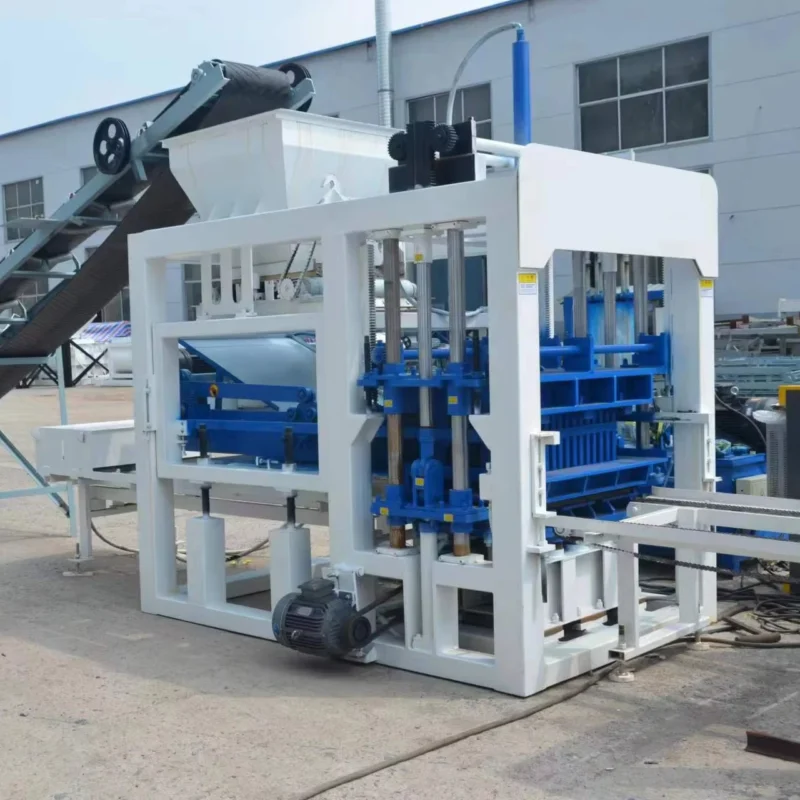
Matched Line Integration — The QT5-15 block production line coordinates batching, mixing, pressing, and stacking as one timed system rather than separate machines forced to share a floor.
Technical Specifications
| Parameter | Value |
|---|---|
| Model | QT5-15 |
| Product Type | Automatic Block Making Machine |
| Dimension of Host Machine | 5870 × 2220 × 2850 mm |
| Weight of Host Machine | 5.5 Tons |
| Molding Area | 1050 × 500 mm |
| Host Machine Power | 31.5 kW |
| Vibration Force | 55 kN |
| Vibration Method | Hydraulic + Platform Vibration |
| Vibration Frequency | 2800–4500 Times/Minute |
| Pallet Size | 1100 × 550 × 25 mm |
| Molding Period | 15 Seconds (basis not stated in source — confirm block format / material / thickness) |
| Control System | Siemens PLC with independently developed control program |
| Motor | Germany SIEMENS brand or CE standard brand |
| Travel Switch | France Schneider / Japan Omron |
| Mould Treatment | Heat treatment and carburizing, hardness 54–58 HRC, lifespan over 100,000 cycles |
| Welding | Carbon dioxide protection welding |
| Voltage | 220/380/415/440V (Customized) |
| Batching Machine (PLD1200) | 1200L hopper, 4 × 2.5 m³ storage, ±2% precision, 4500 kg, 12000 × 2200 × 2500 mm |
| Concrete Mixer (JS500) | 800L charging / 500L discharging, 18.5 kW mixing motor, 2800 kg, 4490 × 3030 × 5280 mm |
| Stacker (SY-4) | 3 kW, mobile pallet stack, suitable for hollow block and pavers, 600 kg |
| Workshop Area | 200 m² (source value — verify against manufacturer catalog) |
| Automation Level | Automatic (full line with batching, mixing, stacking) |
| Standards | CE |
Application Suitability
| Application | Material or Output |
|---|---|
| Hollow block production plants | Crushed stone, sand, cement, and fly ash blends |
| Solid block manufacturing for housing projects | Dense aggregate mixes with standard Portland cement |
| Paving brick production for municipal works | Fine aggregate and pigment-loaded concrete |
| Interlocking brick for retaining walls and slopes | Low-slump concrete with interlocking mould profiles |
| On-site block production for contractors | Locally sourced sand and gravel with cement binder |
What "Cycle Time" Actually Means for Your Daily Output
The 15-second molding period only tells half the story — real output depends entirely on which block format fills that pallet.
I have watched buyers receive a brick machine quoted at impressive cycles per hour, then discover on the first production day that their actual hollow block count falls well short because the quoted cycle assumed a thin paving brick. The pallet spends more time traveling to the stacker and back than the press spends forming. When you are running a 400 × 200 × 200 mm hollow block, the vibration dwell alone stretches well beyond what a flat paver demands [NEED_CITE: block format influence on realistic cycle time]. An automatic block making machine production line must state capacity per format so you can plan shifts, raw material orders, and curing rack space against real numbers.
How Batching, Mixing, and Pressing Stay in Rhythm
A block plant fails at the seams between stations, not inside any single machine. The PLD1200 batching unit delivers four ingredients at ±2% precision into the JS500 mixer, which discharges a 500-liter batch in time to feed the QT5-15 hopper before the press runs dry. If the mixer cycle lags behind the press consumption rate, the host machine idles and your daily tally drops. This automatic block making machine production line is configured so that each upstream station finishes its cycle slightly ahead of the press demand, keeping material flow continuous without overflow.
Pallet Handling and Stacking Close the Loop
The SY-4 stacker collects filled pallets from the press discharge conveyor and builds them into mobile stacks ready for the curing area. Without this station, workers pull wet blocks off the line by hand, pallets pile up on the floor, and the press operator slows the machine to avoid jamming the exit [NEED_CITE: manual pallet handling bottleneck in block plants]. Including stacking inside the line specification means the press runs at its intended pace throughout the shift rather than tapering off as floor space fills.
Reading the Vibration and Pressure Numbers
The 55 kN vibration force works together with hydraulic pressure to compact concrete into the mould cavity. Higher frequency settings in the 2800–4500 range suit finer aggregates and thinner paver formats, while lower frequencies penetrate deeper into tall hollow block cells. The platform vibration method transmits energy through the pallet rather than just the mould walls, producing more uniform density across the block cross-section. Carburizing treatment on the mould steel to 54–58 HRC keeps cavity dimensions stable over extended production runs, preventing the gradual size drift that causes blocks to fail dimensional checks at the construction site.
The Cost of Mismatched Stations
When a buyer sources the press from one supplier and the mixer from another, nobody takes responsibility for the gap between them. A JS500 mixer paired with a larger press would leave the host machine starving for material every few cycles, while an oversized batching unit wastes floor space and capital on capacity the line cannot use [NEED_CITE: station mismatch consequences in block production]. The pallet size also matters — if the 1100 × 550 × 25 mm pallet does not match the curing racks or forklifts already on site, you face a secondary purchase before the first block leaves the plant.
Why Source the Full Line From One Supplier
Block machinery is the single focus here, so the press, mould, pallet, and handling equipment are specified as one matched system rather than assembled from separate vendors. The configuration is set against your actual mix design and local aggregate, not pulled from a catalogue default. Mould design covers the formats your market sells, with custom drawings available when standard profiles do not fit. The automation level is selectable — you can begin semi-automatic and add stacking or cubing modules later. Installation and commissioning include operator training so the line reaches stable production within the first week on site.
Documentation & Verification
- Line layout drawing with capacity calculation stated per block format
- Machine specification sheet covering press, batching, mixer, and stacker
- Hydraulic and electrical schematic for the complete integrated line
- Voltage and PLC display language confirmation sheet before dispatch
- Factory test record demonstrating all stations running as one system
- Mould drawing and format list with pallet dimensions noted
Installation, Commissioning & Support
- Foundation plan sized to the 5870 × 2220 mm host machine footprint and vibration load
- Dedicated power circuit confirmed for 31.5 kW host plus 18.5 kW mixer at your local voltage
- Machine shipped in dismantled modules for container loading, reassembled on site
- Siemens PLC parameters set to your block format during commissioning
- Operator training covers mould change procedure and daily vibration system inspection
- Wear parts list with mould cavity inserts and hydraulic seals identified for first reorder
What We Need to Quote Accurately
Tell us which block formats you plan to produce, the daily volume you need for each, and the raw materials available in your area. Share your workshop dimensions and ceiling height so we can confirm the line layout fits, and let us know the local voltage and frequency so the motors and PLC are configured before shipment. If you already have curing racks or forklifts on site, send the pallet dimensions they accept so the line matches your existing handling equipment.
Frequently Asked Questions
Q: How is daily output calculated and which block format does each figure assume?
A: Output is calculated by multiplying pallets per cycle, cycles per hour, and operating hours, but each number depends on the block format. A hollow block occupies more mould depth and needs longer vibration than a thin paver, so cycle times differ. We provide a capacity table listing realistic daily output for every format you intend to produce, not a single headline number.
Q: How do the batching, mixer, and press cycle times match so the press is not left waiting?
A: The PLD1200 batching unit and JS500 mixer are sized so that a fresh concrete batch is ready before the QT5-15 hopper runs empty. We calculate material consumption per cycle for your block format and set the mixer discharge timing slightly ahead of press demand, preventing idle gaps without overflow.
Q: Is pallet handling, stacking, and curing rack handling included or priced separately?
A: The SY-4 stacker is part of this line configuration, collecting filled pallets at the press discharge and building mobile stacks for curing. Curing rack handling equipment can be added based on your plant layout. We confirm the full scope before quotation so no station is left to manual labor by default.
Q: What voltage, frequency, and PLC language options are confirmed before dispatch?
A: The line supports 220, 380, 415, or 440V at your specified frequency. The Siemens PLC display language is confirmed during the order stage so operators can read alarms and parameters in their working language on day one. We verify these settings in writing before production begins.
Q: How are mould change and format flexibility handled across the full line?
A: Moulds are exchanged on the QT5-15 host machine, and the PLC stores vibration profiles for each format. The pallet size remains constant at 1100 × 550 mm across formats, so the stacker and conveying equipment need no adjustment when you switch from hollow blocks to pavers during the same shift.



