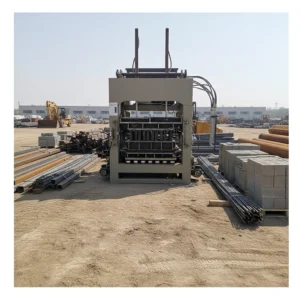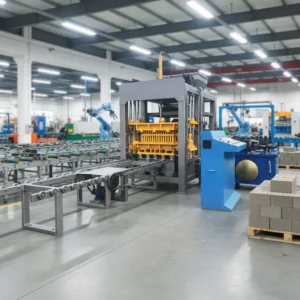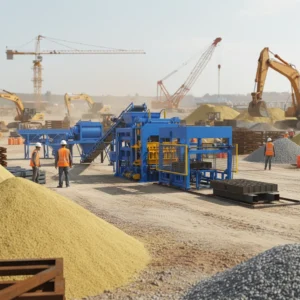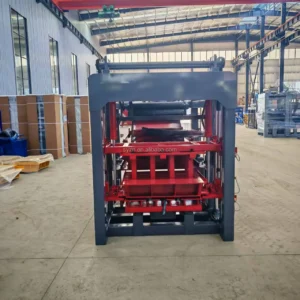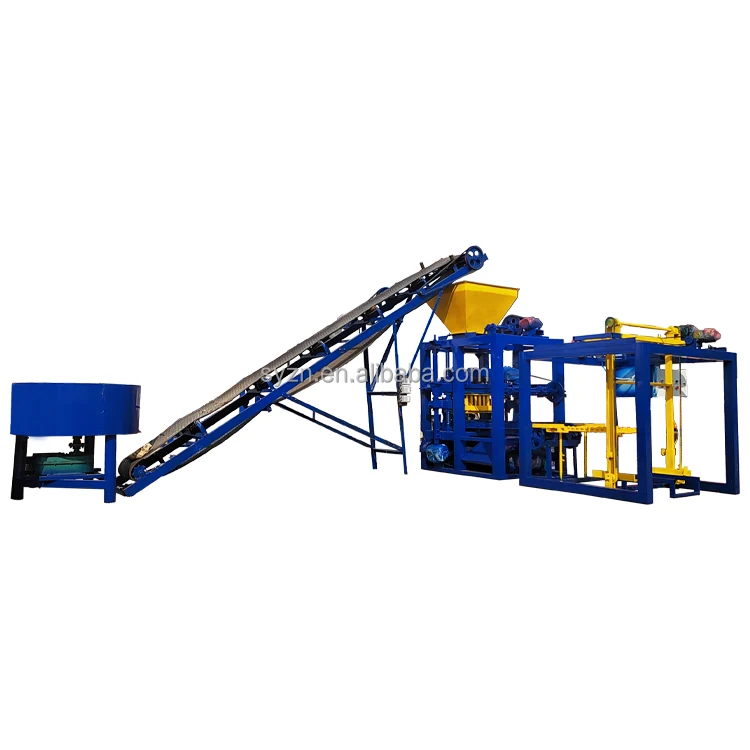
Matched Line Sizing — The QTJ4-26 press, JQ350 mixer, and 850×450×20 mm pallet are specified as one system so each station keeps pace with the 26-second molding cycle without idle time or material starvation.
Technical Specifications
| Parameter | Value |
|---|---|
| Product Type | Semi-Automatic Concrete Block Making Machine |
| Model | QTJ4-26 |
| Overall Dimensions (L×W×H) | 2060×1730×2580 mm |
| Molding Cycle | 26 s |
| Vibration Frequency | 4200 r/min |
| Exciting Force | 35.5 kN |
| Total Power | 14.25 kW |
| Mixer Model | JQ350 |
| Pallet Size | 850×450×20 mm |
| Net Weight | 1800 kg |
| Automation Level | Semi-automatic (four guide pillars, automatic mould movement) |
| Stacking Method | Manual pallet handling |
| Applied Products | Hollow block (8 inch, 6 inch), solid brick |
| Raw Materials | Crushed stone, sand, cement, dust, fly ash |
| Output — Hollow Block 390×190×190 mm | 480 pcs/h, 3800 pcs/8 hr (4 pcs/mould, 26 s cycle) |
| Output — Hollow Block 400×150×200 mm | 600 pcs/h, 4800 pcs/8 hr (5 pcs/mould, 26 s cycle) |
| Output — Solid Brick 240×115×53 mm | 2100 pcs/h, 17000 pcs/8 hr (18 pcs/mould, 26 s cycle) |
| Hydraulic Pressure | Basis to be confirmed |
| Control System | Basis to be confirmed |
| Voltage & Frequency | Basis to be confirmed |
Application Suitability
| Application | Material or Output |
|---|---|
| Small to medium block plants | Hollow blocks and solid bricks from crushed stone, sand, cement, and fly ash |
| On-site construction production | 8 inch and 6 inch hollow blocks for housing and development projects |
| First-time block plant setup | Standard hollow and solid formats with lower initial line investment |
| Existing product range expansion | Adding 390×190×190 mm and 400×150×200 mm hollow blocks to current catalogue |
What "Pieces per Hour" Leaves Out About Line Throughput
A press cycle only matters if every upstream and downstream station can keep up.
Quoted capacity figures for a semi-automatic block making machine production line often state the press cycle in isolation. The mixer batch time, pallet circulation speed, and manual stacking pace are left out entirely. I have visited sites where the press sat idle for eight seconds per cycle waiting for the next pallet because the return conveyor was never sized to match. The result is a line that produces well below its nameplate rating across a full shift [NEED_CITE: line balancing principles in concrete block production].
How Each Station Connects Around the QTJ4-26
The JQ350 mixer must discharge a fresh batch before the mould hopper runs empty. With a 26-second molding cycle and four to eighteen cavities depending on the block format, the mixer throughput has to sustain continuous pressing across an eight-hour shift. If the mixer undershoots, the press waits and the semi-automatic block making machine production line loses cycles that cannot be recovered later.
Pallet Circulation Defines Real Daily Output
The 850×450×20 mm pallet carries every wet block from the press to the curing area. In a semi-automatic configuration, operators manually transfer pallets, which sets a hard ceiling on how fast the line can run. The pallet quantity included in the shipment must cover the distance between press and curing rack plus the return loop [NEED_CITE: pallet logistics in semi-automatic block plants]. Underestimating pallet count means the press stops while operators walk pallets back.
Reading the Specs That Matter for Block Density
The 35.5 kN exciting force at 4200 r/min comes from dual vibrating motors mounted under the mould table. This vibration frequency compacts the concrete mix into the mould cavities, and its effectiveness depends directly on the aggregate gradation and moisture content of the local raw material. Fine desert sand, for instance, responds differently to this vibration profile than coarse crushed stone, which is why confirming your mix design before finalizing the line configuration is necessary.
The four guide pillars ensure the mould head descends evenly onto the mould box. Uneven pressure produces blocks with density variation across the same pallet. The total power draw of 14.25 kW covers the press and mixer together, which matters when sizing the dedicated circuit at your site — undersized wiring causes voltage drop that weakens vibration force at the mould.
The Hidden Cost of Skipping Line Integration
When the mixer, pallet supply, and stacking pace are not planned around the press cycle, the bottleneck simply moves rather than disappears. I have seen contractors lose an entire shift per week to pallet shortages because the quotation listed the press alone. Voltage mismatches discovered after arrival delay commissioning by weeks while transformers are sourced locally [NEED_CITE: voltage and frequency standards by export market]. These are not machine defects — they are line planning gaps that show up as lost production.
Why Sourcing the Full Line from One Supplier Matters
The QTJ4-26 is offered with its JQ350 mixer and pallet specification confirmed as a matched set, so throughput calculations hold across the full line rather than just the press station. Configuration is set against your actual raw material and target block format, not pulled from a catalogue default. Mould design covers the formats your market sells, and custom drawings are accepted when standard moulds do not fit. The automation level is selectable — you can start with manual pallet handling and add automatic stacking later without replacing the press. Installation includes operator training so your team understands how mixer batch timing and pallet return pace affect the 26-second cycle.
Documentation & Verification
- Line layout showing station spacing and pallet flow path for the QTJ4-26 configuration
- Capacity calculation sheet stating output per block format with cycle assumptions
- Pallet specification confirming 850×450×20 mm size, material, and included quantity
- Voltage and control language confirmation document signed before production
- Hydraulic and electrical schematic for independent local component sourcing
- Factory test record on your specified block format before dispatch
Installation, Commissioning & Support
- Foundation must support 1800 kg press weight plus dynamic vibration loads from the 35.5 kN exciting force
- Dedicated circuit required for 14.25 kW total draw — confirm voltage and frequency before wiring
- Press ships partially assembled; guide pillars and mould table aligned on-site during commissioning
- First production run includes cycle timing verification against your raw material and block format
- Operator training covers mixer batch scheduling to prevent press idle time between cycles
- Wear parts list identifies vibration motor and mould liner replacement intervals for local stocking
Before You Request a Quote
To size the semi-automatic block making machine production line correctly, share your target block formats, the local aggregate type and gradation you plan to use, and your available curing area dimensions. Confirm your site voltage and frequency, the control language your operators need, and whether your existing forklift can handle 850×450 mm pallets. If you have upstream or downstream equipment already in place, provide those specifications so the line layout accounts for existing station capacities.
Frequently Asked Questions
Q: How is daily output calculated when the line includes mixer, pallet feed, and stacking?
A: Daily output starts from the 26-second press cycle and the cavity count for your chosen block format. That figure is then adjusted for mixer batch discharge time, manual pallet transfer pace, and operator stacking speed. The capacity calculation sheet states the exact block format and line assumptions behind each output number so there is no gap between quoted and actual production.
Q: What supporting equipment is included in the quotation and what must I source locally?
A: The quotation covers the QTJ4-26 press, JQ350 mixer, and pallets in the confirmed quantity and specification. Raw material feeding conveyors, curing racks, and site electrical infrastructure are typically buyer-supplied. Every included and excluded item is listed in the line layout document so there are no surprise costs after order confirmation.
Q: How do I confirm pallet size matches my existing curing racks and forklift?
A: The pallet specification is locked at 850×450×20 mm before production begins. Share your curing rack dimensions and forklift fork width so we can verify compatibility. If your existing racks do not match, the line layout is adjusted or alternative pallet dimensions are evaluated before the order is finalized.
Q: Can the line be upgraded from semi-automatic to automatic stacking later?
A: Yes. The QTJ4-26 press accepts an automatic pallet feeder and stacker as an add-on without replacing the core machine. The upgrade path is planned during initial line layout so electrical conduits and floor space are reserved from the start, making the transition straightforward when your production volume justifies the investment.
Q: What voltage, frequency, and control language options are confirmed before production?
A: Your site voltage, frequency, and preferred control display language are documented and confirmed before the machine enters production. This prevents commissioning delays caused by incompatible electrical components or unreadable interface text when the line arrives at your facility [NEED_CITE: export machinery electrical configuration standards].