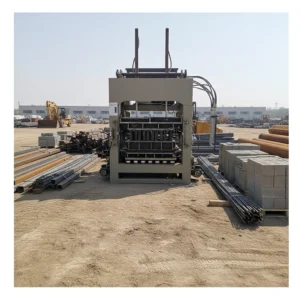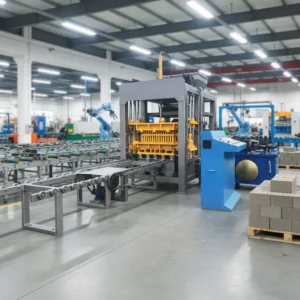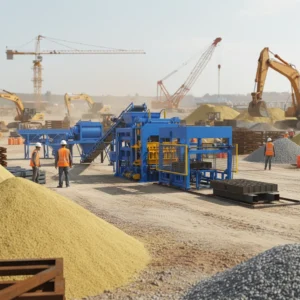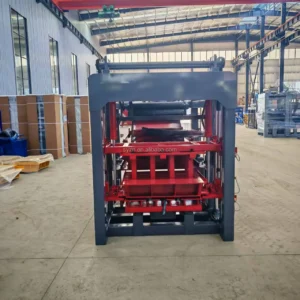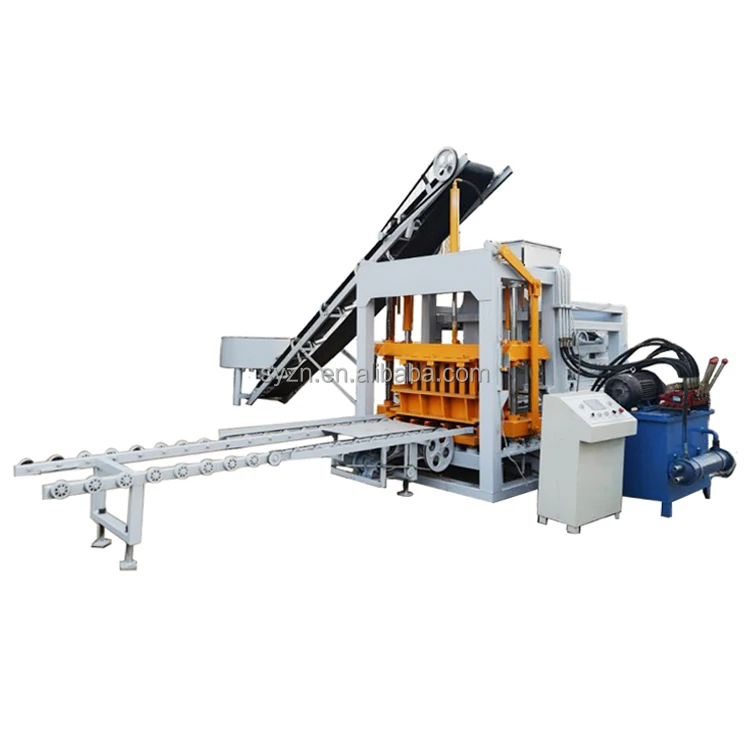
System Matched to Press — Every station in the QT4-20 block production line is specified against the press cycle so material flow never forces the host to wait.
Technical Specifications
| Parameter | Value |
|---|---|
| Model | QT4-20 |
| Product Type | Concrete Block Making Machine |
| Overall Dimensions (L×W×H) | 7100×1600×2610mm |
| Rated Pressure | 16-21MPa |
| Main Vibration Form | Platform Vibration |
| Vibration Frequency | 4600 r/min |
| Vibration Force | 45kN |
| Pallet Size | 1020×570mm |
| Molding Cycle | 20-30s (basis not stated in source — confirm block format / material / thickness) |
| Overall Power | 27.5kW |
| Total Mass | 6T |
| Demolding Method | Hydraulic |
| General Water Consumption | 12T/Day |
| Factory Area | 500m² |
| Raw Materials | Crushed stone, sand, cement, fly ash, gravel, slag, dust |
| Applied Products | Concrete blocks, hollow/solid blocks, pavers, interlocking blocks, curbstone, colored pavers |
Application Suitability
| Application | Material or Output |
|---|---|
| Hollow block production for building walls | Crushed stone, sand, cement, fly ash |
| Solid concrete block for load-bearing structures | Gravel, cement, sand |
| Paving block and colored paver manufacture | Fine aggregate, cement, pigment |
| Interlocking brick for retaining walls | Crushed stone, sand, cement |
| Curbstone and kerb production for road works | Coarse aggregate, cement, slag |
Why "Cycles per Hour" Misleads Every Block Plant Buyer
The molding cycle only matters when the surrounding line can feed and clear the press at the same pace.
I have watched a mid-tier block production line sit idle because the pan mixer discharged a batch every four minutes while the press demanded a fresh charge every ninety seconds. The operator stood next to the hopper, arms folded, waiting for material. On another site the pallet return conveyor ran slower than the ejection stroke, so wet blocks backed up on the press table and had to be lifted off by hand. Neither failure showed up on the quotation sheet [NEED_CITE: synchronization standards for block making line stations]. When the turnkey block making machine arrives with mismatched upstream or downstream equipment, the rated cycle becomes a theoretical number that no shift ever reaches.
Matching Mixer Discharge to Press Appetite
The QT4-20 completes a molding cycle in the 20-30 second window depending on block format and mix workability. A mixer that takes three minutes to discharge a single batch will starve the press for at least two of those minutes. Sizing the mixer to the press means calculating batch weight per cycle, multiplying by cycles per hour for the chosen format, and adding a buffer for pallet changeover pauses. When the turnkey block making machine runs hollow blocks that demand a drier, stiffer mix, the mixer must deliver that consistency at the same tempo the press consumes it.
Pallet Return and Stacking Rhythm
A 1020×570mm pallet loaded with wet blocks weighs well over what an operator should lift repeatedly. The pallet return loop must clear the ejection side before the next press stroke finishes, otherwise the table blocks and the cycle stalls. Block production line planning has to account for the travel distance from press exit to curing yard and back. If the curing racks sit fifty meters away, the conveyor speed and pallet magazine capacity must absorb that travel time without forcing the press to idle [NEED_CITE: pallet handling layout considerations in concrete product plants].
Reading the Numbers That Actually Matter
The 16-21MPa rated pressure and 45kN vibration force together determine how densely the concrete consolidates inside the mould. Higher vibration without sufficient hydraulic clamp pressure lets the mix separate; higher pressure without enough vibration leaves voids. The 4600 r/min platform vibration suits fine-aggregate paver mixes but may need adjustment when the buyer switches to a coarser hollow-block recipe. The 27.5kW overall power figure covers the host press motor and hydraulic pump; auxiliary stations like the mixer and stacker draw additional load, so the site transformer must be sized for the full line, not just the press nameplate.
The Cost of Skipping Line Synchronization
Buyers who select the press on cycle time alone and source the mixer, pallet feeder, and stacker from separate vendors often discover on day one that the stations speak different tempos. The mixer overproduces, the mix sits and loses slump. The pallet magazine jams because its sensor was never wired to the press PLC. The stacker accumulates blocks faster than the curing crew can move them, and cracked product piles up on the floor. Each of these mismatches costs daily output and forces overtime that was never in the project budget [NEED_CITE: common commissioning issues in multi-vendor block lines]. None of these problems appear in a single-vendor quotation that treats the press as one node inside a complete line.
Why This Line Configuration Works
The QT4-20 is specified here as the press node inside a coordinated block production line, not as a stand-alone catalogue item. The mixer is chosen to discharge at a rate the press can absorb, the pallet feeder is matched to the 1020×570mm pallet and the curing rack spacing the buyer already uses, and the electrical cabinet is wired for the site voltage before shipment. Mould options cover the hollow, solid, paver, and interlocking formats the buyer’s market actually sells, and each mould drawing is confirmed against the press vibration and pressure envelope. Operator training covers the full sequence from aggregate batching through curing rack loading so the crew understands where the bottlenecks can form.
Documentation & Verification
- Line layout drawing showing every station footprint and conveyor run for the QT4-20 configuration
- Capacity calculation sheet stating the block format and mix assumed for each output figure
- Hydraulic and electrical schematic with voltage, frequency, and PLC language confirmed pre-shipment
- Pallet specification matched to your existing curing rack dimensions and forklift rating
- Factory test record on your chosen block format before the line is crated
Installation, Commissioning & Support
- Foundation drawing sized for the 7100×1600mm press footprint and 6T operating mass
- Dedicated power circuit sized for the 27.5kW press load plus mixer and auxiliary motors
- Assembly sequence for the modular line stations delivered in container-load lots
- First-run parameter setting for vibration frequency and hydraulic pressure on your local aggregate
- Operator training covering mould change, pallet loading, and daily greasing points
- Wear parts list identifying mould liners, vibration springs, and hydraulic seals by part number
What We Need From You to Size the Line
Send us the block formats your market sells, the daily volume you need for each format, and the raw materials you can source locally. Tell us the voltage and frequency at your site, the PLC display language your operators read, and the curing yard dimensions you already have in place. If you run existing conveyors or mixers that must stay in the line, share their cycle times so the new stations match.
Frequently Asked Questions
Q: How is the daily output calculated, and which block format is assumed in the cycle time?
A: The 20-30 second molding cycle varies with block thickness, mix stiffness, and mould cavity count. We state output separately for each format you plan to run — hollow, solid, paver, or interlocking — so the daily figure reflects the actual product mix, not a generic best-case number pulled from a catalogue.
Q: What supporting equipment is included in the line quotation, and what is left to the buyer?
A: The quotation lists the mixer, pallet feeder, press, stacker, and curing rack handling as line items with their own cycle times. Items excluded — such as site civil works, water supply, and the curing yard cover — are marked clearly so you can budget them before the equipment ships.
Q: How do upstream and downstream station cycle times match the press to prevent idle time?
A: We calculate the mixer discharge interval, pallet feed stroke, and stacker lift cycle against the press molding rate for your chosen format. Every station is selected or adjusted so its tempo sits within the press cycle window, eliminating the wait periods that cut real output below quoted figures.
Q: Is the 1020×570mm pallet compatible with my existing curing area and forklift?
A: We check your curing rack slot width and forklift fork spread against the pallet dimensions before confirming the order. If your existing racks accept a different size, we adjust the pallet spec and mould layout to match rather than forcing you to rebuild the curing yard.
Q: What voltage, frequency, and PLC language will be configured before the line ships?
A: You confirm the site supply — for example 380V/50Hz/3-phase — and the operator language during the proposal stage. The electrical cabinet is wired and the PLC display is loaded with that language before factory testing, so the line runs on arrival without rewiring or translation delays.