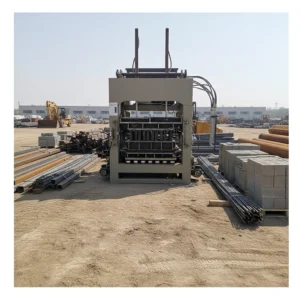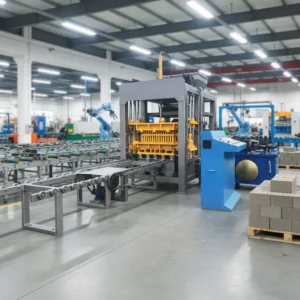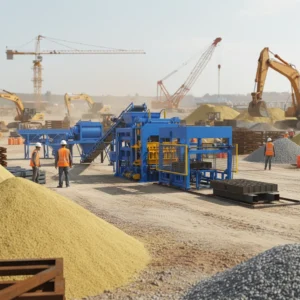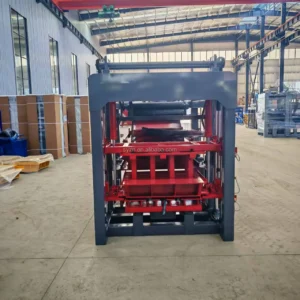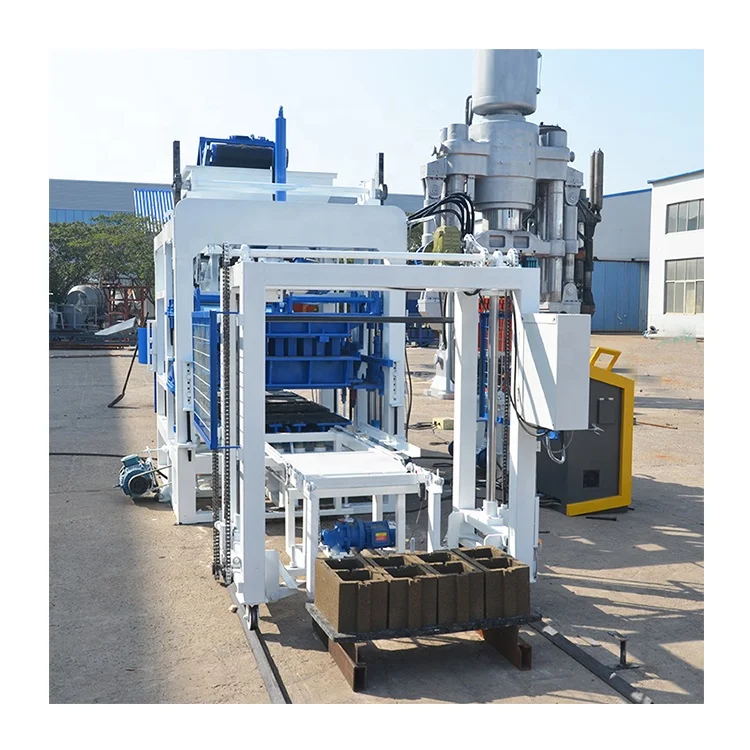
Matched Line Configuration — Every station from mixer to stacker is timed against the QT4-18 press cycle so the host never idles waiting for material or pallets.
Technical Specifications
| Parameter | Value |
|---|---|
| Product Type | Concrete Block Making Machine |
| Model | QT4-18 |
| Overall Dimensions (L×W×H) | 3900×1600×2300 mm |
| Total Weight | 3 T |
| Rated Power | 24 kW |
| Exciting Force (Vibration) | 40–50 kN |
| Molding Cycle | 15–25 s |
| Mixer Model | JQ350 |
| Pallet Size | 850×550×25 mm |
| Output Capacity (Hollow Block 400×200×200 mm, 4 pcs/mould) | 1200–1680 pcs/h |
| Output Capacity (Hollow Block 400×150×200 mm) | 1800–2400 pcs/h |
| Output Capacity (Solid Brick 240×115×53 mm) | 3240 pcs/h |
| Daily Output (8 hr, Hollow Block 400×200×200 mm) | 9600–13440 pcs |
| Daily Output (8 hr, Hollow Block 400×150×200 mm) | 14400–19200 pcs |
| Daily Output (8 hr, Solid Brick 240×115×53 mm) | 16200–19440 pcs |
| Automation Level | Semi-automatic |
| Hydraulic Station | Equipped, high pressure |
| Vibration System | Bed mould vertical vibration + upper mould compression vibration |
| Pallet Material Option | Fiber glass or wooden |
| Stacking Method | Automatic stacker |
| Applicable Products | Hollow block, solid brick, paver, curbstone |
| Raw Materials | Crushed stone, sand, cement, dust, fly ash |
Application Suitability
| Application | Material or Output |
|---|---|
| Medium-scale hollow block plant | Crushed stone, sand, cement, fly ash — producing 400×200×200 mm and 400×150×200 mm hollow blocks |
| Solid brick production for local masonry markets | Cement and fine aggregate — forming 240×115×53 mm solid bricks |
| Paver and curbstone manufacturing | Cement, crushed stone and dust — with format change via mould replacement |
| On-site block production for building contractors | Local aggregate and cement — semi-automatic operation with automatic stacking to curing area |
What "1200 Pieces per Hour" Actually Means on the Floor
Capacity figures only hold when every upstream and downstream station keeps pace with the press.
I spent years walking trade shows across Europe and North America, and the same question comes up every time: why does my line produce far less than the brochure says? The answer almost always sits between the stations, not inside the press itself. A QT4-18 block making machine production line rated at 1200–1680 pieces per hour assumes a specific block format — the 400×200×200 mm hollow block at four per mould — and it assumes the mixer has already delivered the batch, the pallet is already in position, and the stacker clears the finished product before the next cycle begins. When any one of those stations lags, the press sits idle and real daily throughput drops well below the calculation [NEED_CITE: common causes of block line idle time between stations].
How Each Station Feeds the Next
The QT4-18 block making machine production line starts with the JQ350 mixer, which prepares each batch in time to match the 15–25 second molding cycle. A conveyor carries the mixed material to the host press hopper, keeping the feed consistent so the mould fills evenly on every stroke. Once the press completes a cycle, the wet blocks on the pallet move to the automatic stacker, which lifts and transfers them toward the curing area without manual handling. This station-to-station rhythm is where most lines lose time — and where the QT4-18 block making machine production line is designed to hold its cycle.
Where Cycle-Time Mismatches Show Up First
The pallet circuit is the most common bottleneck on a semi-automatic line. If the curing area is too far from the press, or if the trolley fleet is too small, pallets do not return in time and the press waits. On the QT4-18 block making machine production line, the 850×550×25 mm pallet size is specified alongside the stacking and trolley arrangement so the return loop closes within the molding cycle. Fiber glass or wooden pallet options let the buyer match the pallet to local curing conditions and handling equipment [NEED_CITE: pallet return cycle impact on block press idle time].
Reading the Specs Against Your Actual Product
Vibration force and hydraulic pressure together determine block density and compressive strength. The QT4-18 delivers 40–50 kN of exciting force through bed mould vertical vibration, combined with upper mould compression vibration. This dual action compacts the concrete evenly from top and bottom, which matters when the local aggregate includes coarse crushed stone that resists settling. The hydraulic station maintains steady pressure throughout the compression stroke so block dimensions stay consistent across a full shift. Molding cycles range from 15 to 25 seconds depending on the format — solid bricks cycle faster than large hollow blocks because the mould cavity is smaller and the material consolidates more quickly.
The Cost of Skipping the Pallet Question
Buyers who focus only on the press often discover after delivery that pallets, stacking and trolley transport were not part of the quotation. The result is a line where wet blocks are moved by hand, pallets pile up at the press exit, and the next cycle cannot start until the operator clears the station. Over an eight-hour shift, those small delays accumulate into a significant gap between quoted and actual output. Specifying the pallet material, quantity and return path before the order goes to production prevents this entirely [NEED_CITE: hidden costs of incomplete block line quotations].
Why This Line Is Specified as a System
Block machinery is our single focus, which means the QT4-18 press, the JQ350 mixer, the automatic stacker and the pallet specification are selected together rather than sourced from separate suppliers and bolted on after the fact. The line layout and capacity calculation state which block format each output figure assumes, so the buyer can compare directly against their market demand. Mould design covers the formats the buyer actually sells, with custom drawings available when the local market requires a non-standard size. Automation starts at semi-automatic with the stacker handling the heaviest manual task, and the configuration allows a future upgrade path as the plant grows.
Documentation & Verification
- Line layout drawing showing station positions, conveyor routing and pallet return path for the QT4-18
- Capacity calculation sheet stating the block format and cycle time assumed for each output figure
- Mould drawing and format list covering hollow block, solid brick, paver and curbstone options
- Hydraulic and electrical schematic for on-site troubleshooting and spare part ordering
- Pallet specification sheet with material option, dimensions and recommended quantity for the curing area
- Factory test record run on the buyer’s target block format before dispatch
Installation, Commissioning & Support
- Foundation plan sized to the 3900×1600 mm press footprint with anchor bolt layout
- Electrical connection confirmed for the 24 kW total load, with voltage and frequency matched to site supply
- Machine arrives in dismantled shipping condition; reassembly and alignment completed on site
- First-run molding test on the buyer’s chosen block format with cycle time and pressure adjustment
- Operator training covering mould change procedure, pallet loading sequence and daily maintenance checkpoints
- Wear parts and mould list provided with recommended spare quantities for the first year of operation
What to Prepare Before Requesting a Quote
To size the QT4-18 line to your plant, share the block formats your market sells, the daily volume you need per format, and the local aggregate and cement you plan to use. Confirm your site voltage, frequency and preferred control language so the electrical system is built to match before production begins. If you already have curing racks, forklifts or trolleys on site, include their dimensions and capacity so the pallet specification and return loop align with your existing equipment.
Frequently Asked Questions
Q: How is the output capacity calculated and which block format does each figure assume?
A: Each output figure is tied to a specific block size and mould cavity count. For example, 1200–1680 pieces per hour is based on the 400×200×200 mm hollow block at four pieces per mould within a 15–25 second cycle. Switching to a smaller solid brick format changes the pieces-per-mould count and cycle time, producing a different hourly figure entirely.
Q: Which stations are included in the line and where can cycle-time mismatches cause the press to idle?
A: The line covers the JQ350 mixer, conveyor, QT4-18 host press, automatic stacker and pallet trolley system. The most common idle points are the mixer falling behind on batch delivery and the pallet return loop from the curing area. If pallets are not back in position before the next cycle, the press waits.
Q: What pallet material and quantity are needed, and how does pallet size relate to the curing area layout?
A: The pallet size is 850×550×25 mm, available in fiber glass or wood. Quantity depends on the curing area distance and trolley fleet size — enough pallets must be in circulation so the press never waits for a return. Three hundred to five hundred pieces is a common starting range.
Q: How do I confirm voltage, frequency and control language before shipment to avoid on-site delays?
A: Provide your site supply voltage, frequency and preferred PLC display language at the quotation stage. These parameters are confirmed before production so the electrical cabinet and control interface match your site conditions when the machine arrives.
Q: What is included in the line versus what the buyer needs to source locally?
A: The quoted line includes the mixer, press, stacker, pallets and trolley transport system. Items typically sourced locally are the curing area infrastructure, water supply, raw material stockpiles and the forklift used to move cured product. The line layout drawing clarifies the boundary between supplied and local-scope equipment.