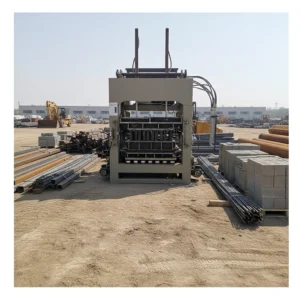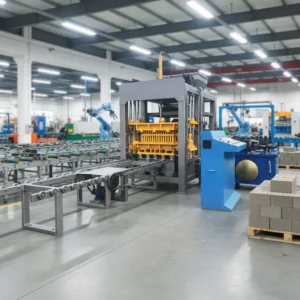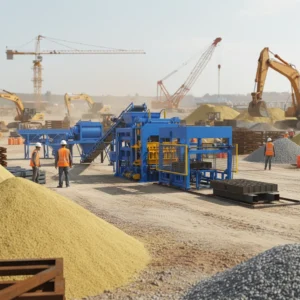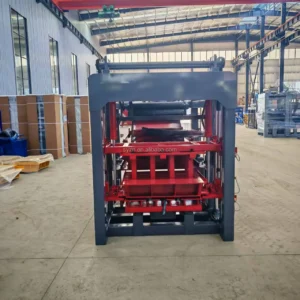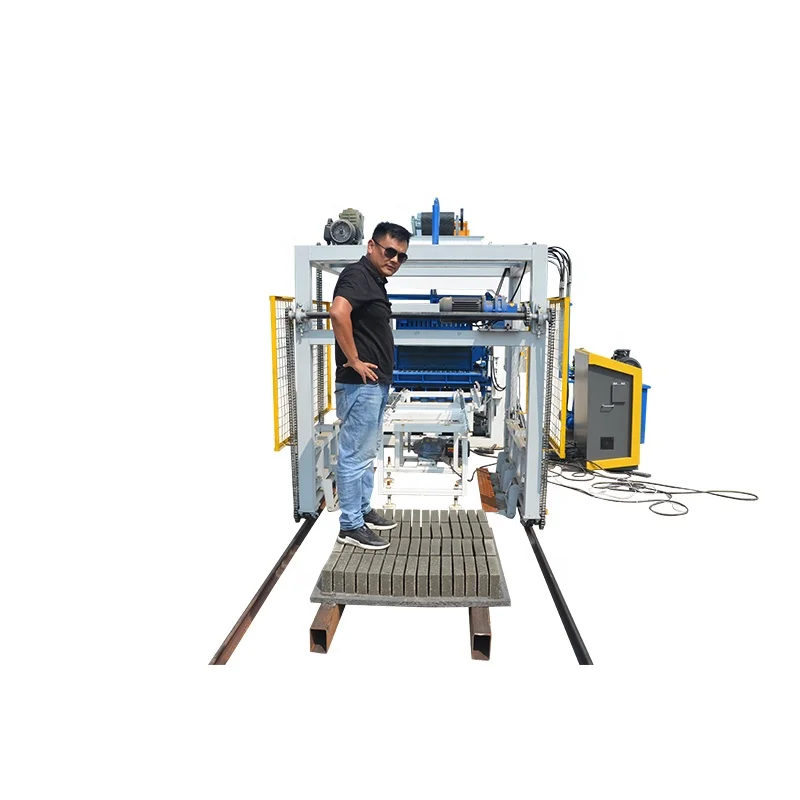
Matched system design — the QT4-15B press is specified together with its mixer, pallet feeder and stacker so that every station meets the 15–20 s cycle without forcing the press to idle.
Technical Specifications
| Parameter | Value |
|---|---|
| Product Type | Fully Automatic Concrete Block Making Machine |
| Model | QT4-15B |
| Control System | Computer controlled, fully automatic |
| Vibration Mode | Multiaxis synchronizer vibration (vertically downward) |
| Guide Bearing | Long-period over-length guide bearing for upper mould and mould box alignment |
| Mixer System | Multiaxis forced mixer |
| Hydraulic System | High thermal efficiency, low heat generation |
| Frame Construction | High-strength steel with special welding technique (vibration shock resistant) |
| Moulding Cycle | 15–20 s |
| Output Capacity (400×200×200 mm hollow block, 4 pcs/mould) | 900–1,200 pcs/h | 7,200–9,600 pcs per 8 hr shift |
| Output Capacity (400×150×200 mm block, 5 pcs/mould) | 1,080–1,440 pcs/h | 8,640–11,520 pcs per 8 hr shift |
| Output Capacity (400×100×200 mm block, 8 pcs/mould) | 1,440–1,920 pcs/h | 11,520–15,360 pcs per 8 hr shift |
| Output Capacity (200×100×60 mm paver, 16 pcs/mould) | 2,880–3,840 pcs/h | 23,040–30,720 pcs per 8 hr shift |
| Output Capacity (240×115×53 mm solid brick, 28 pcs/mould) | 5,930–6,720 pcs/h | 47,400–53,700 pcs per 8 hr shift |
| Automation Level | Fully automatic |
| Mould Format Compatibility | Hollow block, solid brick, paving brick, multicellular brick |
| Warranty | 1 year (excluding spare parts) |
| Rated Power (kW) | (basis to be confirmed) |
| Voltage & Frequency | (basis to be confirmed) |
| Overall Dimensions (L×W×H) | (basis to be confirmed) |
| Net Weight | (basis to be confirmed) |
| Hydraulic Pressure (MPa) | (basis to be confirmed) |
| Vibration Force (kN) | (basis to be confirmed) |
| Pallet Size | (basis to be confirmed) |
| Mould Change Time | (basis to be confirmed) |
| PLC Brand / Language Options | (basis to be confirmed) |
| Standards | CE (confirm applicability to this model) |
Application Suitability
| Application | Material or Output |
|---|---|
| Hollow block production for building walls | Crushed stone, sand, cement, fly ash blends |
| Solid brick production for masonry | Fine aggregate and cement mixes |
| Paving brick production for roads and walkways | High-density aggregate and cement blends |
| Multicellular brick production | Lightweight aggregate and cement combinations |
| Block production plants of small-to-medium output tier | Multiple format runs within a single shift |
| On-site or fixed-plant concrete product manufacturing | Local raw material sourcing with variable gradation |
Why the Pallet Feeder Decides Whether "9,600 Blocks per Shift" Is Real
A press that waits for a pallet is a press that is not making blocks.
Quoted cycle times for this concrete block making machine production line assume a pallet is already positioned when the mould lifts. In the field I have watched a QT4-15B sit idle for four or five seconds every cycle simply because the pallet feeder could not keep pace with the press. That gap compounds across an eight-hour shift and the daily count falls well short of what the capacity table promised. [NEED_CITE: typical pallet feeder cycle matching requirements for block presses]
The upstream mixer faces the same trap. If the multiaxis forced mixer cannot deliver a fresh batch to the hopper before the press finishes its 15–20 s moulding cycle, the hopper runs dry and the operator watches the press stall. Every station in the line — raw material feeding, mixing, pallet feeding, pressing, stacking — must be timed against the press cycle, not quoted in isolation.
Timing Every Station Around the 15–20 s Press Cycle
A concrete block making machine production line only reaches its rated output when each upstream and downstream station is specified against the press cycle. The QT4-15B completes a moulding cycle in 15–20 seconds, which sets the metronome for everything else. The pallet feeder must deliver, position and register a pallet within that window, the mixer must drop a full charge into the hopper, and the stacker must clear cured pallets before they back up into the press exit zone.
Where Block Plants Lose the Most Time
Most lost output in a block line does not come from the press itself. It accumulates in the gaps between stations — a mixer discharging too slowly, a stacker that cannot index fast enough, a curing rack handler that jams on uneven pallets. When I reconfigured a line in West Africa, the press was never the constraint; rebalancing the conveyor speeds and adding a buffer station between the stacker and curing racks pulled daily output back in line with the original calculation. [NEED_CITE: common bottleneck locations in automatic block production lines]
Reading the Specs That Actually Govern Line Balance
The multiaxis synchronizer vibration delivers vertically downward force, which compacts the mix evenly across the full pallet area and shortens the vibration phase within each cycle. The long-period over-length guide bearing keeps the upper mould aligned to the mould box over thousands of cycles, reducing the scrap caused by mis-pressed blocks that would otherwise need to be cleared manually and stop the line. The hydraulic system is designed for high thermal efficiency and low heat generation, meaning the press can sustain its cycle time through a full shift without thermal slowdown — a factor that matters in tropical climates where ambient temperatures already push fluid temperatures upward. The computer-controlled automation ties the pallet feeder, mixer discharge and stacker into a single sequence so that operator reaction time is removed from the critical path.
When Supporting Equipment Is Chosen Without the Line in Mind
A buyer who purchases the press from one supplier and the mixer, pallet feeder and stacker from three others often discovers that the conveyor heights do not match, the PLC signals are incompatible, or the pallet dimensions do not fit the stacker grippers. The result is weeks of on-site fabrication and rewiring before the line can run continuously. I have seen plants where the mixer output was rated for a larger press, so it overfed the hopper and caused spillage that required manual cleanup every few cycles. [NEED_CITE: integration risks when block line equipment is sourced from multiple suppliers]
Why Specifying the Line as One System Matters
Every component around the QT4-15B — raw material feeder, multiaxis forced mixer, pallet feeder, stacker, curing rack handler — is configured against the same cycle-time calculation. The pallet size is matched to the buyer’s existing curing area dimensions and forklift capacity rather than picked from a catalogue default. Voltage, frequency and PLC display language are confirmed before production starts so that commissioning is not delayed by a control panel the local electrician cannot read. The line layout drawing shows station positions, conveyor lengths and the total footprint, so the buyer knows the building requirements before the equipment ships. Moulds for the block formats the buyer’s market actually sells — hollow block, solid brick, paver, multicellular brick — are included in the same proposal, and custom mould designs can be built from buyer drawings.
Documentation & Verification
- Line layout drawing showing QT4-15B station positions, conveyor lengths and plant footprint
- Capacity calculation document stating the block format assumed for each output figure
- Voltage, frequency and PLC display language confirmation sheet signed before production
- Factory test record run on the buyer’s specified block format and pallet size
- Pallet specification sheet matched to the buyer’s curing area and forklift dimensions
- Operation and maintenance manual covering the full line, not the press alone
Installation, Commissioning & Support
- Foundation drawing provided for the QT4-15B frame, mixer and conveyor anchor points
- Power supply specifications confirmed for the plant’s local voltage and frequency before wiring begins
- Equipment arrives dismantled for container loading with a marked reassembly sequence
- First-run commissioning covers press cycle tuning, mixer discharge timing and stacker indexing
- Operator training addresses mould change, PLC navigation and daily greasing points on the press and line
- Wear parts list supplied for hydraulic seals, guide bearings and vibration components
What We Need to Size Your Line
Tell us which block formats your market moves and the daily output you need to hit. Share your local aggregate type and the cement ratio you plan to run, along with your curing area dimensions and the forklift you already have on site. Confirm your site voltage, frequency and the language your operators need on the PLC display.
Frequently Asked Questions
Q: How is the QT4-15B line capacity verified, and which block format does each figure assume?
A: Every output figure in the capacity table is tied to a specific block format and piece count per mould — for example, 7,200–9,600 pieces per eight-hour shift is based on 400×200×200 mm hollow blocks at four pieces per mould. We provide a written capacity calculation that states the assumed format so buyers can compare against their actual product mix.
Q: What supporting equipment is included and what is optional?
A: The standard line package covers the multia*k handler matched to the QT4-15B cycle. Raw material feeding systems, cubing stations and additional conveyors can be added or omitted depending on the buyer’s existing equipment and plant layout.
Q: How do upstream mixer output and downstream stacking speed match the 15–20 s press cycle?
A: We calculate the mixer discharge volume per batch against the hopper consumption rate at the press cycle time, and we set the stacker indexing speed to clear pallets before the next press cycle completes. Conveyor speeds between stations are tuned during commissioning to eliminate gaps.
Q: What voltage, frequency and PLC language must be confirmed before the line ships?
A: We require written confirmation of site voltage, phase configuration, frequency and the PLC display language before production begins. This prevents commissioning delays caused by mismatched electrical components or an interface the operators cannot read.
Q: What installation, commissioning and operator training support is provided for the full line?
A: Our team supervises reassembly, connects the stations and runs test cycles on the buyer’s chosen block format. Operator training covers PLC navigation, mould change procedure, daily maintenance checkpoints and troubleshooting common stoppages across every station in the line.