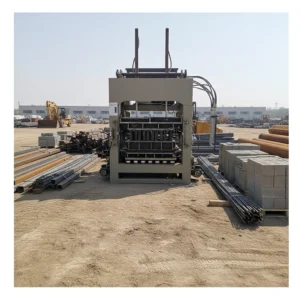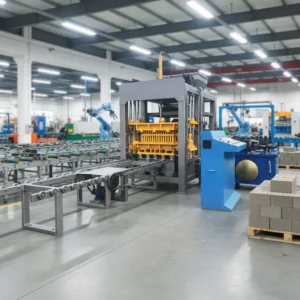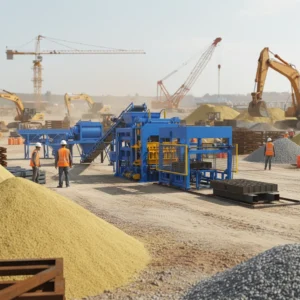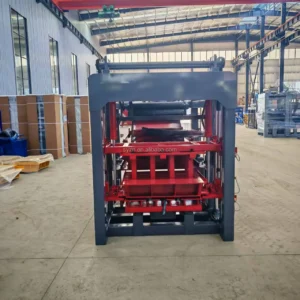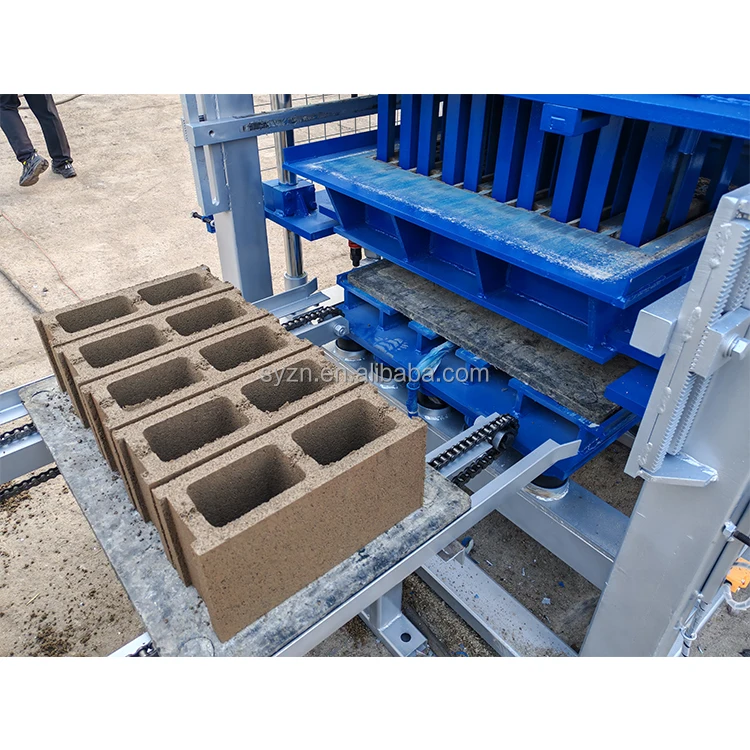
System-Level Integration — the QT4-15A block production line turnkey QT4-15A is specified as one matched chain of stations, so mixing, pressing, pallet circulation, and stacking all keep pace with the same 25-30 s molding cycle instead of leaving fresh blocks waiting at the press outlet.
Technical Specifications
| Parameter | Value |
|---|---|
| Model | QT4-15A |
| Product Type | Fully Automatic Concrete Block Making Machine |
| Overall Dimensions (L×W×H) | 4100×1600×2600 mm |
| Total Mass | 4 T |
| Rated Pressure | 16-21 MPa |
| Vibration Force | 55 kN |
| Vibration Frequency | 4200 r/min |
| Main Vibration Form | Platform Vibration |
| Pallet Size | 880×550 mm |
| Molding Cycle | 25-30 s (basis to be confirmed) |
| Overall Power | 18.45 kW |
| Demolding Method | Hydraulic |
| Control System | PLC |
| Automation Level | Fully Automatic |
| Applied Products | Concrete blocks, hollow/solid blocks, pavers, interlocking blocks, curbstone, colored pavers |
Application Suitability
| Application | Material or Output |
|---|---|
| Hollow block production for building envelopes | Crushed stone, sand, cement, fly ash |
| Solid block manufacturing for load-bearing walls | Gravel, slag, cement blends |
| Interlocking paver runs for municipal walkways | Colored aggregates with fine sand |
| Curbstone fabrication for road infrastructure | Coarse aggregate and high-cement mixes |
| Porous brick output for permeable paving | Graded stone dust and cement |
What the Molding Cycle Figure Actually Depends On
A quoted 25-30 s cycle only holds when block format, mix moisture, and aggregate grading stay within the range tested at the factory.
In the field, buyers who switch from a hollow block mould to an interlocking paver mould often find the cycle stretches because the new format needs a different vibration profile and longer hydraulic hold. The block production line turnkey QT4-15A must be set against the exact format you intend to run most days, not a generic average. [NEED_CITE: effect of aggregate grading on vibration compaction time] When the front-end mixer cannot deliver a fresh batch every half minute, the press sits idle and daily output falls well below the quoted figure.
Keeping Every Station Synchronized with the Press
The 25-30 s molding cycle sets the heartbeat of the entire block production line turnkey QT4-15A. Raw material batching, mixing, and delivery must drop a charged box into the press within that window, or the vibration table waits. Pallet return loops must clear the demolding station and deliver an empty pallet before the next cycle fires. Any bottleneck in these supporting stations turns a fully automatic label into a semi-manual reality.
How Pallet Circulation Dictates Real Output
With 880×550 mm pallets moving through press, curing racks, and stacker, the total pallet count decides how many cycles can run before the loop stalls. If curing racks are undersized, pallets jam at the transfer point and the operator ends up pulling blocks by hand. Specifying pallet quantity alongside rack capacity at the quotation stage prevents this cascade. [NEED_CITE: pallet loop sizing for block plants]
Reading the Numbers That Matter
Platform vibration at 4200 r/min combined with 55 kN force determines how tightly the aggregate particles pack during each cycle. Hydraulic pressure of 16-21 MPa then locks that packed shape before demolding. Together they set block density and compressive strength. If your local sand is fine and well-graded, lower vibration amplitude may suffice; coarse crushed stone demands the full force range. The 4 T machine mass anchors the vibration table so energy travels into the mix rather than shaking the floor slab.
The Cost of Leaving Line Stations to Chance
Buyers who quote the press alone discover on arrival that pallets must be fed manually and wet blocks stacked by hand, cutting practical output in half. Voltage mismatches surface only during commissioning, leaving the PLC screen dark until a local transformer arrives. Pallets sized for a different curing rack force the plant to rebuild the curing area or run with half-empty racks, wasting floor space. [NEED_CITE: common causes of delayed block plant commissioning]
Why the Line View Matters Here
Block machinery is the single focus of our supply chain, so every supporting station is chosen to match the QT4-15A’s cycle rather than assembled from unrelated vendors. Pallet specifications are locked against your existing curing racks and forklift capacity before production starts. Voltage, frequency, and PLC display language are confirmed on paper so the control cabinet arrives ready for your grid. Wear parts and mould lists ship with part numbers, cutting first reorder delays. Layout drawings show press footprint, curing zone, and finished-block staging as one continuous flow, not separate sketches.
Documentation & Verification
- Line layout drawing showing press, curing racks, and block staging as one plan
- Capacity sheet listing output per block format, not a generic cycles-per-hour claim
- Hydraulic and electrical schematics for local voltage and PLC language prep
- Pallet specification confirming size, material, and forklift compatibility
- Factory test record run on your target block format before dispatch
Installation, Commissioning & Support
- 300 m² floor plan allocation across press, curing, and stacking zones
- 18.45 kW total load verified against local supply and dedicated breaker sizing
- Pallet return loop leveled to match 880×550 mm pallet travel height
- PLC display language and voltage set before cabinet leaves the factory
- Operator training covering mould change sequence and hydraulic pressure checks
- Wear parts list with reorder codes for vibration springs and hydraulic seals
Before You Request a Quotation
Send the block formats you plan to produce, the daily volume you need for each, and the local aggregates available. Confirm your workshop dimensions, curing area layout, and existing forklift capacity. State the local voltage, frequency, and preferred PLC language so the control system ships pre-configured.
Frequently Asked Questions
Q: How do raw material feeding and mixing keep pace with the QT4-15A cycle?
A: The batch plant is sized to deliver one mixer charge within the 25-30 s window, and the hopper gate opens on a signal from the press PLC. If your mix design uses high-moisture sand, we extend mixing time slightly and adjust the feeder screw speed so the press never waits for material.
Q: Are pallet handling and stacking included in the line quotation?
A: Yes. The quotation covers pallet feeding, return conveyors, automatic stacking, and curing rack transfer as part of the block production line turnkey QT4-15A package. Each station is balanced to the press cycle so fresh blocks move off the press without manual intervention.
Q: What electrical details must be locked before dispatch?
A: We need your site voltage, frequency, and the language you want on the PLC screen. Confirming these points early avoids transformer delays and lets the electrician prepare dedicated circuits for the 18.45 kW total load before the containers arrive.
Q: How is the 300 m² floor area divided across the plant?
A: The layout drawing allocates space for raw material storage, the press footprint, pallet circulation, curing racks, and finished-block staging. We provide this plan at quotation stage so you can verify ceiling height and forklift travel paths before the line ships.
Q: Which spare parts ship with the line, and how fast can I reorder?
A: Vibration springs, hydraulic seals, and pallet guide rollers are included as first-assembly spares with part numbers listed. Reorders follow typical multi-week lead times, and we keep common items in stock for faster dispatch when you confirm the part code.