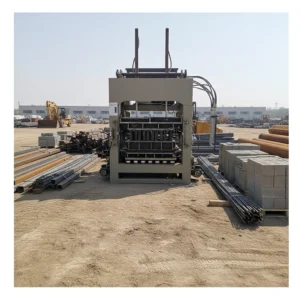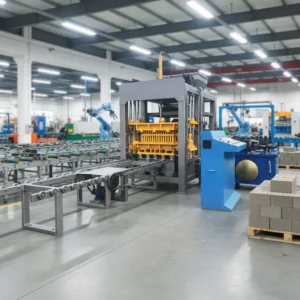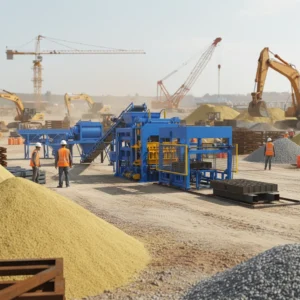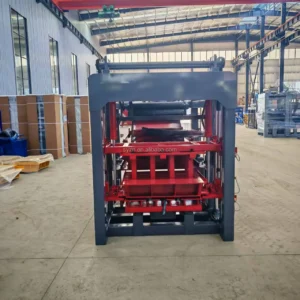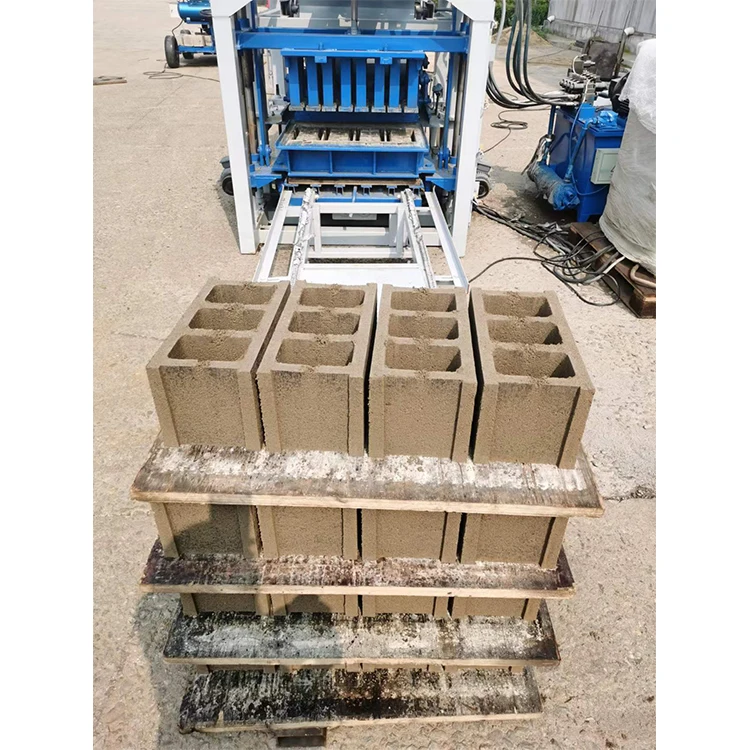
Matched station timing — the QT4-15A line is configured so the JQ350 mixer, pallet feeder, press and conveyor share a common cycle, preventing the press from standing idle while upstream or downstream stations catch up.
Technical Specifications
| Parameter | Value |
|---|---|
| Model | QT4-15A |
| Product Type | Fully Automatic Concrete Block Production Line |
| Overall Dimensions (L×W×H) | 7100×1600×2610 mm |
| Molding Cycle | 15–25 s (basis not stated in source) |
| Vibration Frequency | 4600 r/min |
| Exciting Power (Vibration Force) | 40–50 kN |
| Rated Power | 18.45 kW |
| Mixer Model | JQ350 |
| Pallet Size | 850×550×25 mm |
| Total Weight | 3 T (basis to be confirmed) |
| Control System | PLC control system |
| Hydraulic Station | High-pressure hydraulic system included |
| Line Equipment Included | Block making machine, hydraulic station, PLC control system, pallet feeder, brick conveyor, block sweeper |
| Applied Products | Hollow block, solid block, paver, kerbstone (via mould change) |
| Raw Materials | Crushed stone, sand, cement, dust, fly ash |
| Free Accessories | Manual hydraulic trolley, spare parts and tools |
| Output — Hollow Block 400×200×200 mm | 4 pcs/mould, 408 pcs/h, 3264 pcs/8 hr |
| Output — Hollow Block 400×150×200 mm | 5 pcs/mould, 510 pcs/h, 4080 pcs/8 hr |
| Output — Solid Brick 240×115×53 mm | 18 pcs/mould, 2100 pcs/h, 17000 pcs/8 hr |
| Automation Level | Fully automatic |
Application Suitability
| Application | Material or Output |
|---|---|
| Hollow block production for wall construction | Crushed stone, sand, cement, fly ash in 400×200×200 mm and 400×150×200 mm formats |
| Solid brick production for masonry and infill | Cement and aggregate blends in 240×115×53 mm format |
| Paver and kerbstone production for roads and landscaping | Dense aggregate mixes with mould change |
| On-site block production for housing and development projects | Locally sourced sand, crushed stone and cement |
| Concrete product manufacturers expanding format range | Multiple formats via mould change on a single press |
What "3264 Blocks per Day" Leaves Out About a Block Production Line Turnkey
A capacity number without the block format behind it is meaningless for line planning.
I once configured a QT4-15A line for a buyer who expected to run 400×200×200 hollow blocks all day. The press could keep up, but the JQ350 mixer could not deliver enough fresh material per cycle to sustain that rhythm. The block production line turnkey was rated at 3264 hollow blocks 400×200×200 mm per 8-hour shift, yet actual output settled around half of that because the mixer batch size and the press cycle were never matched on paper before shipping. The stations around the press determine whether the press runs or waits, and that matching must happen before the line is built, not after it arrives. [NEED_CITE: concrete block production line station synchronization principles]
How Each Station in the QT4-15A Line Connects to the Next
The QT4-15A block production line turnkey is specified as a sequence of stations: the JQ350 mixer feeds raw material into the press hopper, the pallet feeder delivers boards to the moulding position, the press cycles, and the brick conveyor carries finished blocks to the sweeper. Each station has a fixed time window. If the mixer takes longer to deliver a batch than the press takes to consume one, the press sits idle. If the pallet feeder cannot place a board fast enough, the press waits again. Configuring the line means calculating these intervals against the buyer’s target block format so no station becomes the bottleneck that governs the entire output.
Where Cycle Time Mismatches Surface After Commissioning
The moulding cycle is listed at 15–25 seconds, but that range covers different block formats and material consistencies. A thinner solid brick at 240×115×53 mm may cycle faster than a 400×200×200 mm hollow block because the vibration and compaction requirements differ. If the buyer plans to switch between formats during the same shift, the pallet feeder and conveyor must handle the fastest cycle the press can produce, not just the average. Overlooking this is a common reason lines underperform against the nameplate figure. [NEED_CITE: concrete block moulding cycle variation by format]
Reading the Specs That Matter for Line Output
The vibration force of 40–50 kN at 4600 r/min works together with the high-pressure hydraulic system to compact the mix into the mould. Higher vibration frequency densifies fine aggregate mixes, while hydraulic pressure holds the mould head down during compaction so blocks leave with uniform height. The pallet size of 850×550×25 mm defines how many blocks fit on each board and must match both the mould layout and the curing racks the buyer already has on site. A mismatch here means pallets cannot be stacked in the curing area or handled by the existing forklift, creating a secondary bottleneck downstream of the press. The rated power of 18.45 kW covers the press itself; the mixer, conveyor and hydraulic station draw additional power, and the total connected load must be calculated before the electrical supply is sized.
The Cost of Skipping Line-Level Configuration
When a buyer orders the press alone and sources the mixer, pallets and conveyor locally, the stations rarely share the same timing logic. The press may be ready for the next cycle while the locally sourced conveyor is still clearing the previous board. Over a full shift, these gaps of a few seconds per cycle accumulate into hundreds of lost blocks. Worse, pallets ordered without reference to the mould layout may not align with the block pattern, causing fresh blocks to chip during transfer. These issues are not visible in a single-machine quotation but appear the first week the line runs. [NEED_CITE: block production line integration risks when sourcing stations separately]
Why Buyers Plan the Full Line Before Ordering the Press
Every QT4-15A block production line turnkey leaves the factory as one matched system: the mixer capacity is checked against the press cycle, the pallet feeder timing is set to the moulding interval, and the conveyor speed matches the press output rate. The hydraulic and electrical schematics are drawn for the full set of stations, not the press alone. Pallet specifications — 850×550×25 mm — are confirmed against the buyer’s curing area dimensions and forklift capacity before production starts, so boards arrive ready to use on day one. The PLC control system governs the entire sequence from raw material feed through to block exit, and the display language is confirmed to match the operator team. Voltage and frequency are verified against the buyer’s site supply before the electrical cabinet is wired, preventing delays at commissioning.
Documentation & Verification
- Line layout drawing with capacity calculation per block format
- Machine specification sheet with station-by-station power and timing data
- Hydraulic and electrical schematic covering the full line
- Pallet specification matched to buyer’s curing area and forklift
- Factory test record on buyer’s target block format before dispatch
- Voltage, frequency and PLC display language confirmation document
Installation, Commissioning & Support
- Foundation plan sized to the 7100×1600 mm press footprint and dynamic vibration load
- Electrical supply sizing for the 18.45 kW press plus mixer, conveyor and hydraulic station
- Pallet feeder and conveyor alignment verified during on-site assembly
- PLC control system parameterized to buyer’s block format and cycle timing
- Operator training covering mould change sequence and daily maintenance checks
- Wear parts list with mould and hydraulic component reorder intervals
Before You Request a Quotation
To size the QT4-15A block production line turnkey to your project, the key inputs are the block formats you plan to sell, your target daily output per format, and the raw materials available locally. Share your site voltage, frequency and preferred PLC display language so the electrical cabinet can be built to match. If you already have curing racks and a forklift, provide the rack dimensions and forklift capacity so the pallet specification is set before the line ships.
Frequently Asked Questions
Q: How is line capacity verified, and which block format does each output figure assume?
A: Every capacity figure is tied to a specific block format. The QT4-15A produces 3264 pieces per 8-hour shift based on a 400×200×200 mm hollow block, and 17000 solid bricks 240×115×53 mm over the same period. The capacity calculation provided with the quotation states the format, mould cavity count and assumed cycle time so buyers can compare against their actual product mix.
Q: What stations are included, and where must cycle times match?
A: The line includes the JQ350 mixer, pallet feeder, press, brick conveyor and block sweeper. The mixer batch delivery time must not exceed the press cycle, and the pallet feeder must place a board before the press is ready for the next moulding. If any station is slower, the press idles and daily output drops below the rated figure.
Q: How is pallet size chosen to fit the existing curing area?
A: The standard pallet size is 850×550×25 mm, selected to match the QT4-15A mould layout. Before production, the buyer’s curing rack spacing and forklift fork width are confirmed so pallets fit the racks and can be moved without manual handling. If the existing curing area requires a different dimension, the pallet specification is adjusted accordingly.
Q: What voltage and control language are confirmed before shipment?
A: The buyer’s site voltage, frequency and preferred PLC display language are confirmed during the quotation stage. The electrical cabinet is then wired and labeled to that specification, and the PLC interface is set to the agreed language before the factory test, so no rework is needed on arrival.
Q: What supporting equipment is available beyond the standard line?
A: Beyond the mixer, pallet feeder, conveyor and sweeper included as standard, additional stations such as automatic stacking, curing rack handling systems and cubing equipment can be added. Each is specified to match the QT4-15A cycle time so the extended line runs without press idle gaps.