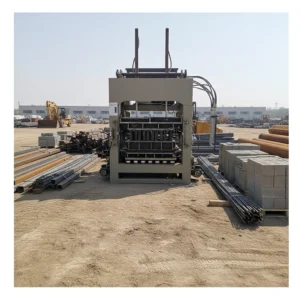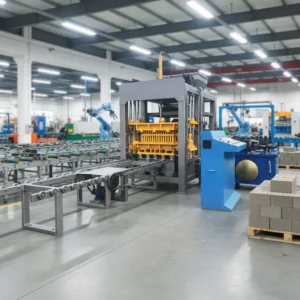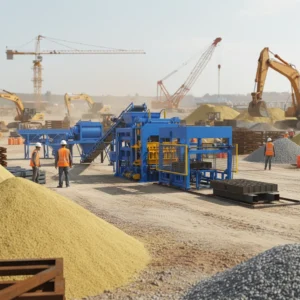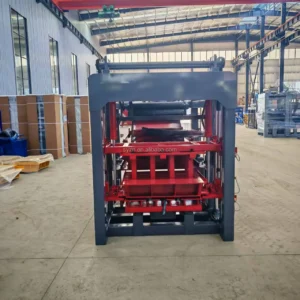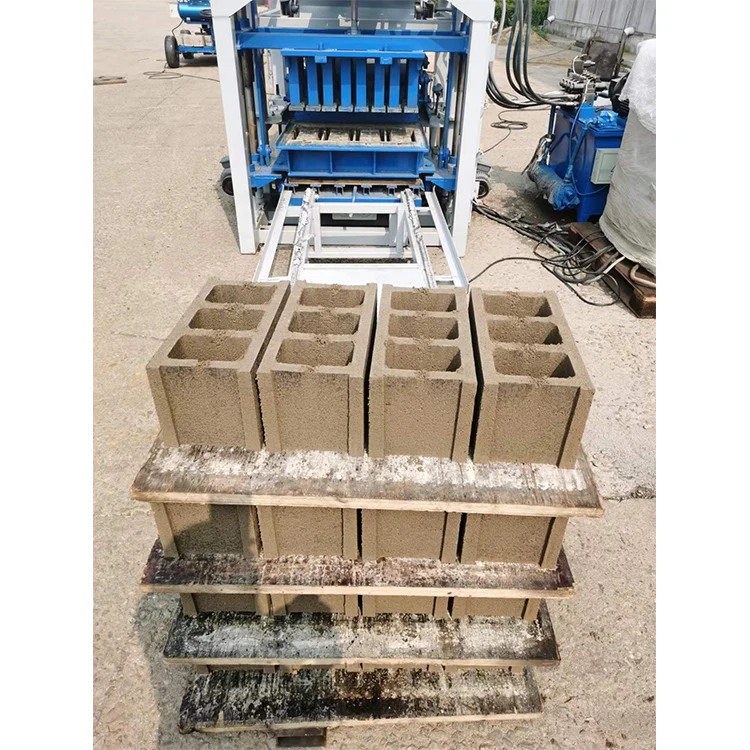
Integrated Block Line Coordination — Every station from the JQ350 mixer to the pallet feeder and block sweeper is timed to the QT4-15A press cycle so the hydraulic ram never waits for material or an empty pallet, keeping the 15–25 second molding window consistent across formats.
Technical Specifications
| Parameter | Value |
|---|---|
| Model | QT4-15A |
| Product Type | Automatic Hydraulic Block Making Machine |
| Overall Dimensions (L×W×H) | 7100×1600×2610 mm |
| Molding Cycle | 15–25 s (basis not stated in source — confirm block format / material / thickness) |
| Vibration Frequency | 4600 r/min |
| Vibration Force | 40–50 kN |
| Rated Power | 18.45 kW |
| Mixer Model | JQ350 |
| Pallet Size | 850×550×25 mm |
| Net Weight | 3 T |
| Applied Products | Paver, solid block, hollow block, curbstone |
| Raw Materials | Crushed stone, sand, cement, dust, fly ash |
| Control System | PLC |
| Hydraulic Station | Included |
| Pallet Feeder | Included |
| Brick Conveyor | Included |
| Block Sweeper | Included |
| Output — Hollow Block 400×200×200 mm | 408 pcs/h, 3264 pcs/8 hr |
| Output — Hollow Block 400×150×200 mm | 510 pcs/h, 4080 pcs/8 hr |
| Output — Solid Brick 240×115×53 mm | 2100 pcs/h, 17000 pcs/8 hr |
| Automation Level | Automatic with hydraulic station and PLC control |
| Voltage & Frequency | To be confirmed before commissioning |
Application Suitability
| Application | Material or Output |
|---|---|
| Hollow block production for wall construction | Crushed stone, sand, cement, fly ash in 400×200×200 mm and 400×150×200 mm formats |
| Solid brick manufacturing for load-bearing and partition walls | Cement, sand and stone dust in 240×115×53 mm format |
| Paver production for driveways, walkways and parking areas | Crushed stone and cement mixes in interlocking and rectangular formats |
| Curbstone and kerb production for road and site perimeter works | Dense aggregate and cement mixes in standard kerb profiles |
| On-site block production for housing and development projects | Locally sourced aggregate with fly ash or dust as supplementary binder |
Why the Voltage Question Must Come Before the Line Layout
An automatic hydraulic block making machine production line stops being automatic the moment the local grid cannot power it.
I once stood on a site in Kenya watching a fully crated block press sit idle for three weeks because the local supply was a different voltage and frequency from what the control panel expected. The transformer retrofit consumed the entire float in the project schedule. Since then, every automatic hydraulic block making machine production line I help configure starts with a voltage, frequency and PLC language confirmation before any steel is cut [NEED_CITE: voltage and frequency standards by export market]. A line that includes a mixer, pallet feeder, conveyor and sweeper has multiple motors and sensors that must all agree on the same electrical supply, and getting that wrong does not just delay commissioning — it forces rewiring inside sealed hydraulic and PLC cabinets.
How Station Cycle Times Must Align Across the Line
The QT4-15A press completes a molding cycle in 15 to 25 seconds, which means the pallet feeder must deliver a clean pallet, the mixer must discharge a measured batch into the feed hopper, and the brick conveyor must clear the finished block before the next cycle begins. If any one of these stations runs slower than the press, the hydraulic ram sits idle and the quoted output drops accordingly.
An automatic hydraulic block making machine production line only reaches its stated capacity when every peripheral station is specified to match or slightly exceed the press cycle rate. The JQ350 mixer, the pallet feeder, the brick conveyor and the block sweeper shipped with the QT4-15A are selected so their individual cycle times sit inside the press window rather than outside it.
Where Pallet Handling Meets the Curing Yard
The 850×550×25 mm pallet size on the QT4-15A is not an arbitrary dimension — it determines how many blocks sit on each pallet, how many pallets fit on a curing rack, and what forklift capacity the yard requires. A buyer who specifies pallets without checking curing rack spacing ends up with pallets that cannot be stacked two-high, forcing single-layer curing that doubles the yard footprint [NEED_CITE: typical curing rack configurations for small to medium block plants].
When the pallet feeder, the conveyor and the sweeper are included in the same quotation as the press, the line hands off wet blocks to the curing rack in a predictable rhythm. Leaving pallet handling out of the scope means workers carry pallets by hand from the press to the yard, and the bottleneck simply moves downstream.
Reading the Core Numbers on the QT4-15A
Vibration force and hydraulic pressure work together during compaction: the 40–50 kN vibration force re-arranges aggregate particles while hydraulic pressure squeezes out air voids. If vibration is high but pressure is low, blocks leave the mould with a smooth face but low internal density. If pressure is high but vibration is weak, the mix does not flow into mould corners and edges chip during de-moulding. The QT4-15A pairs both systems so the operator can tune pressure and vibration together for the local aggregate.
The 4600 r/min vibration frequency is chosen for the mid-range pallet size. Higher frequencies suit smaller pallets with thin pavers; lower frequencies suit larger pallets with tall hollow blocks. Running the vibration at the correct frequency keeps motor current within the 18.45 kW rated power envelope and avoids thermal trips during continuous shifts.
The JQ350 pan mixer discharges into the feed hopper at a rate timed to the press cycle. A mixer that is too small forces the press to wait for the next batch; a mixer that is too large delivers more material than the hopper can hold, causing spillage and inconsistent feed weight.
The Hidden Cost of Leaving Stations Off the Quotation
A quotation that lists only the press and omits the pallet feeder, conveyor and sweeper looks cheaper until the machine arrives and the buyer discovers that wet blocks must be lifted from the press table by hand. The labour required to move, sweep and stack pallets manually can consume an entire shift, and the physical handling introduces cracks and edge damage that raise scrap rates [NEED_CITE: common causes of block breakage before curing]. Specifying the automatic hydraulic block making machine production line as a complete set of matched stations removes that surprise and keeps the output quality consistent from the first pallet to the last.
Why Buyers Source the Full Line Here
Block machinery is the single focus of the workshop, so the QT4-15A press, its moulds, pallets and handling equipment are specified as one system rather than assembled from separate suppliers who do not talk to each other.
Configuration is set against the buyer’s actual mix design and local aggregate, not a catalogue default, which means vibration force and hydraulic pressure are adjusted before the machine leaves the factory.
Mould design covers every format the buyer’s market sells — hollow block, solid brick, paver and curbstone — and custom mould drawings are accepted when a non-standard profile is needed.
The automation level is selectable, allowing a buyer to start with semi-automatic pallet handling and add automatic stacking later without replacing the press.
Installation support includes on-site commissioning and operator training so the crew knows how to read the PLC alarms and change moulds before the first production run.
Documentation & Verification
- Line layout drawing showing station spacing and pallet flow direction for the QT4-15A footprint
- Capacity calculation sheet stating the block format assumed for each output figure
- Hydraulic and electrical schematic matching the confirmed voltage and frequency
- Pallet specification sheet with dimensions, material and load rating for curing rack planning
- Factory test record run on the buyer’s target block format before dispatch
Installation, Commissioning & Support
- Foundation plan sized to the 7100×1600 mm machine footprint with anchor bolt positions
- Dedicated electrical circuit rated for the 18.45 kW total load at the confirmed voltage and frequency
- PLC display language set to the operator’s preference before the control cabinet is sealed
- Mould change procedure trained on-site so format switches fit within a single shift window
- Wear parts list for hydraulic seals and vibration motor bearings with recommended stock quantities
- Daily greasing schedule for the pallet feeder guides and press column slides
Before You Send the Inquiry
To size an automatic hydraulic block making machine production line that actually fits your site, share the block formats you sell most, your target daily output per format, and the aggregate you can source locally. Include your workshop dimensions, the voltage and frequency at the meter, and whether you already have curing racks and forklifts so the pallet size can be matched. If you plan to integrate the QT4-15A into an existing line with upstream mixers or downstream stackers, list those units by model so the station cycle times can be checked for alignment.
Frequently Asked Questions
Q: How is output capacity calculated and which block format does each figure assume?
A: Each capacity figure is tied to a specific block size. The QT4-15A is rated at 408 pieces per hour based on a 400×200×200 mm hollow block, 510 pieces per hour based on a 400×150×200 mm hollow block, and 2100 pieces per hour based on a 240×115×53 mm solid brick. Changing format, mix design or mould thickness alters the molding cycle and therefore the hourly output.
Q: How do the mixer feed rate, pallet feeder cycle and press cycle align so the press is never starved?
A: The JQ350 mixer discharge rate, pallet feeder stroke time and brick conveyor speed are each specified to complete within the QT4-15A molding cycle window. If any station runs longer than the press cycle, the hydraulic ram waits and actual output drops below the stated capacity.
Q: What supporting equipment is included in the line scope and what must the buyer supply separately?
A: The standard scope covers the hydraulic press, JQ350 mixer, pallet feeder, brick conveyor, block sweeper and PLC control cabinet. The buyer typically supplies the curing rack structure, yard forklift, water connection and primary power feed to the control panel.
Q: How are pallet size, curing rack layout and forklift specification coordinated before shipment?
A: The 850×550×25 mm pallet dimension is checked against the buyer’s curing rack bay width and forklift tine spacing. If the existing rack cannot accept this pallet size, the rack spacing or pallet material is adjusted during the configuration stage to avoid rework after delivery.
Q: What voltage, frequency and PLC language options are confirmed before production begins?
A: The buyer’s site voltage and frequency are recorded on the order sheet along with the preferred PLC display language. The electrical schematic and control cabinet wiring are then built to match those values, and the settings are verified during the factory test before the cabinet is sealed for shipment.