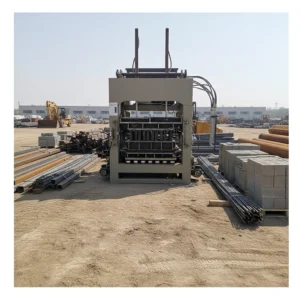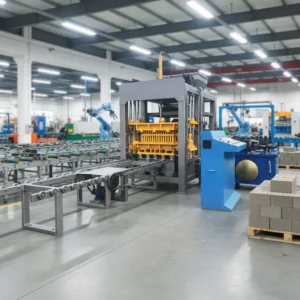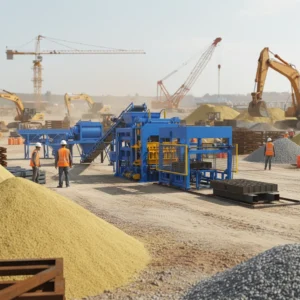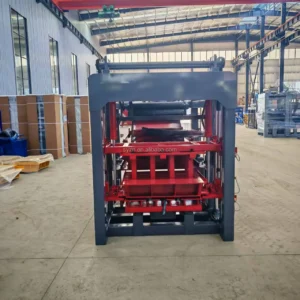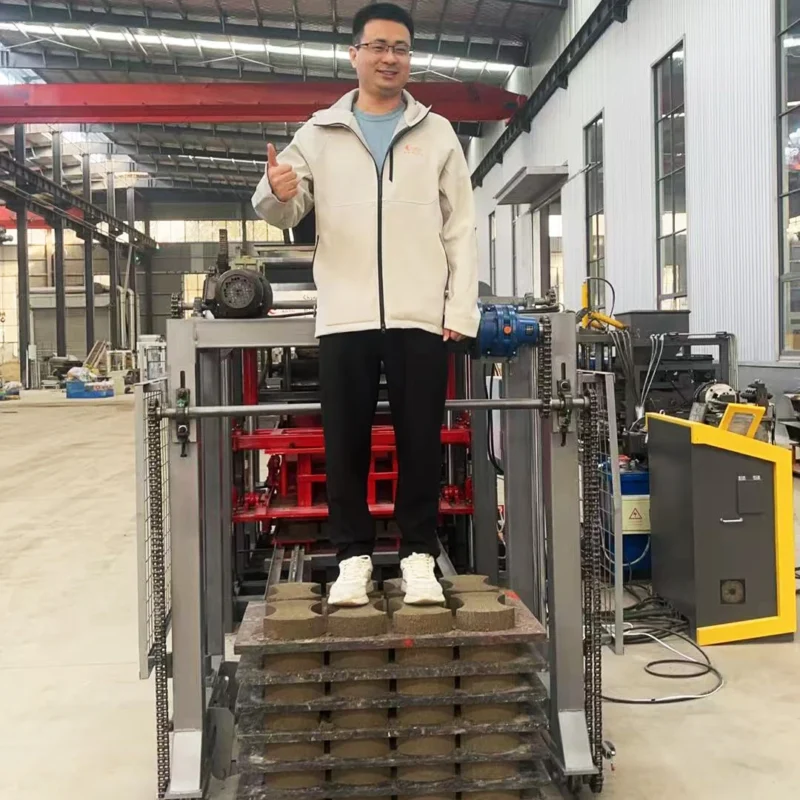
Matched Line Configuration — The QT4-15A is specified so mixer discharge, pallet feed, and stacking stations align with its 25–30 s press cycle, preventing upstream or downstream bottlenecks that cut real output.
Technical Specifications
| Parameter | Value |
|---|---|
| Product Type | Fully Automatic Concrete Block Making Machine |
| Model | QT4-15A |
| Overall Dimensions (L×W×H) | 4100 × 1600 × 2600 mm |
| Total Mass | 4 T |
| Overall Power | 18.45 kW (source value — verify against manufacturer catalog) |
| Rated Pressure | 16–21 MPa |
| Main Vibration Form | Platform Vibration |
| Vibration Frequency | 4200 r/min |
| Vibration Force | 55 kN |
| Pallet Size | 880 × 550 mm |
| Molding Cycle | 25–30 s (basis to be confirmed per block format and material) |
| Demolding Method | Hydraulic |
| Factory Area Required | 300 m² |
| Automation Level | Fully Automatic |
| Control System | PLC (basis not stated in source) |
| Output Capacity | (basis not stated in source) |
| Applied Products | Hollow blocks, solid blocks, pavers, interlocking blocks, curbstone |
| Raw Material | Crushed stone, sand, cement, fly ash, gravel, slag |
Application Suitability
| Application | Material or Output |
|---|---|
| Block and paver production plants | Hollow and solid blocks from crushed stone, sand, and cement |
| Building material manufacturers expanding formats | Interlocking blocks and curbstones from fly ash and slag blends |
| On-site construction block production | Concrete masonry units from locally sourced aggregate and cement |
Why the Mixer and Pallet Feeder Decide Your Real Daily Output
A fully automatic concrete block making machine production line only meets its quoted capacity when every station around the press keeps pace.
I have watched plants install a high-cycle press and then lose hours waiting for a slow mixer to finish a batch or for a pallet return conveyor to clear the press table. The bottleneck is rarely the press itself — it sits upstream where batching falls behind, or downstream where stacking cannot clear cured pallets fast enough [NEED_CITE: block plant bottleneck analysis in small-scale masonry production].
When the QT4-15A runs a 25–30 s molding cycle, the batching station must deliver a fresh mix within that window, the pallet feeder must place an empty board before the press opens, and the wet stacker must remove the loaded pallet without delaying the next press stroke. Miss any one of those handoffs and the press idles.
How the QT4-15A Line Stations Connect
The raw material batcher feeds weighed aggregate and cement into the mixer, which must discharge a homogeneous blend before the press completes its current cycle. A 25–30 s press cycle leaves a narrow window — the mixer and conveyor must be sized so fresh material arrives without forcing the press operator to hold the next stroke.
Downstream, the pallet circulation system returns empty boards from the curing rack area to the feed station. If the return path is too long or the pallet stacker at the wet end cannot index a loaded pallet clear of the press table in time, the fully automatic concrete block making machine production line stalls at its most expensive station.
Matching the Pallet to Your Existing Curing Area and Forklift
The 880 × 550 mm pallet is not an arbitrary dimension. It must fit the racking pitch of the curing area the buyer already operates or plans to build, and it must sit within the fork envelope of the site forklift [NEED_CITE: pallet and curing rack dimensional standards for concrete block plants]. Specifying a pallet size without checking the curing layout means either rebuilding the racks or manually re-stacking every board before it enters the rack — both outcomes erase the automation advantage.
Hydraulic Pressure and Vibration Force at the Press
Rated pressure between 16 and 21 MPa pushes the mould head down while the platform delivers 55 kN of vibration at 4200 r/min. The two forces must work together: vibration consolidates the mix around the aggregate particles, and hydraulic pressure locks that dense arrangement in place before demolding. If pressure is too low for the vibration force, blocks crack on release; if vibration is too weak for the pressure, the mix never reaches full density.
The 4 T machine mass anchors the press against vibration transmission to the foundation, keeping energy directed into the mould cavity rather than dissipated into the floor slab. Buyers should confirm the foundation specification matches this mass and vibration profile before the line arrives on site.
The Hidden Cost of Quoting the Press Alone
Leaving pallet handling, stacking, and curing rack equipment out of the quotation means the buyer arrives on site to find finished blocks piled by hand beside the press. A fully automatic line that ends with manual stacking is not automatic — it is a semi-automatic press with extra automation bolted on [NEED_CITE: hidden costs of incomplete block line quotations].
Voltage and PLC display language often go unconfirmed until the container arrives. If the destination market runs on a frequency or phase the motor was not wound for, commissioning stops until a replacement drive is shipped.
Why Source the Full Line from One Configuration Point
Block machinery as a single focus means the press, mould, pallet, and handling equipment are specified as one matched system rather than assembled from separate suppliers who do not share cycle time data.
Configuration is set against the buyer’s actual mix design and local aggregate, not a catalogue default — so the mixer, batcher, and press are all tuned for the same material profile.
Mould design covers the formats the buyer’s market actually sells, with changeover procedures that preserve daily output rather than consuming a full shift.
Automation level is selectable, allowing a buyer to start with semi-automatic pallet handling and upgrade to full stacking and cubing later without replacing the press.
Installation support includes operator training on the complete line, not just the press, so every station is understood by the crew running it.
Documentation & Verification
- Line layout drawing showing station spacing and pallet circulation path for the QT4-15A
- Capacity calculation sheet stating the block format assumed for the quoted cycle time
- Pallet specification matched to buyer’s curing rack dimensions and forklift envelope
- Voltage, frequency, and PLC display language confirmation form signed before production
- Factory test record covering mixer discharge timing against press cycle on actual mix
Installation, Commissioning & Support
- 300 m² plant area verified for pallet circulation path and curing rack placement around the QT4-15A
- 18.45 kW total power supply confirmed with dedicated circuit breaker and correct phase sequence
- Machine dismantled for container loading and reassembled on site with foundation bolt alignment
- PLC control system commissioned with display language and cycle parameters set to buyer specification
- Operator training covers mixer, pallet feeder, and stacker, not only the press station
Before You Request a Quote
Share the block formats your market sells, the daily volume you need per format, and the raw materials available locally so the batcher and mixer can be sized correctly. Confirm your site voltage, frequency, and the PLC display language your operators require. Let us know what pallet handling and curing equipment you already have on site so the line connects to it without redundant investment.
Frequently Asked Questions
Q: How is daily output calculated, and which block format is the capacity figure based on?
A: Daily output depends on the block format, mix design, and pallet size in use. The quoted molding cycle of 25–30 s applies to a specific block profile that must be stated in the capacity calculation. We provide a format-by-format output sheet so you can compare realistic figures against your production target before committing.
Q: Which supporting stations are included in the line quotation?
A: The line covers raw material batching, mixing, pallet feeding, press operation, wet stacking, and curing rack handling. Each station is specified so its cycle time matches the QT4-15A press. Stations you already own can be excluded if they meet the required interface dimensions and timing.
Q: How do upstream and downstream cycle times match the press cycle?
A: The mixer discharge rate, pallet feed speed, and stacker index time are all calculated against the 25–30 s molding cycle. If any station runs slower, the press idles and real output drops. We provide a station timing chart in the line layout so every handoff is visible before installation.
Q: What voltage, frequency, and PLC language are configured for my market?
A: Voltage and frequency must be confirmed before production so motors and the PLC are wound and programmed correctly for the destination site. The PLC display language is set to your operator preference. These details are captured on a signed confirmation form before manufacturing begins.