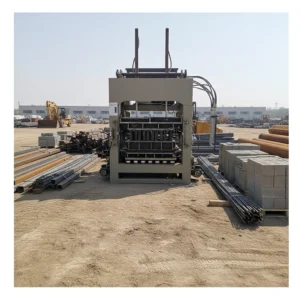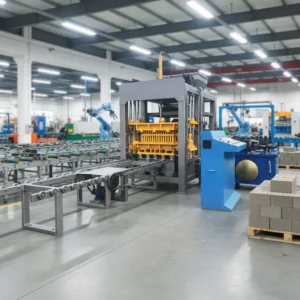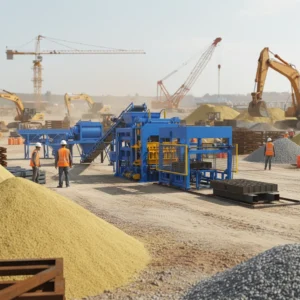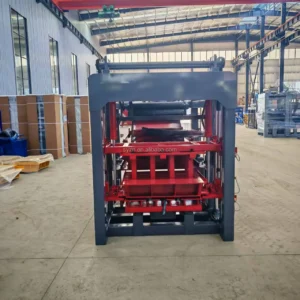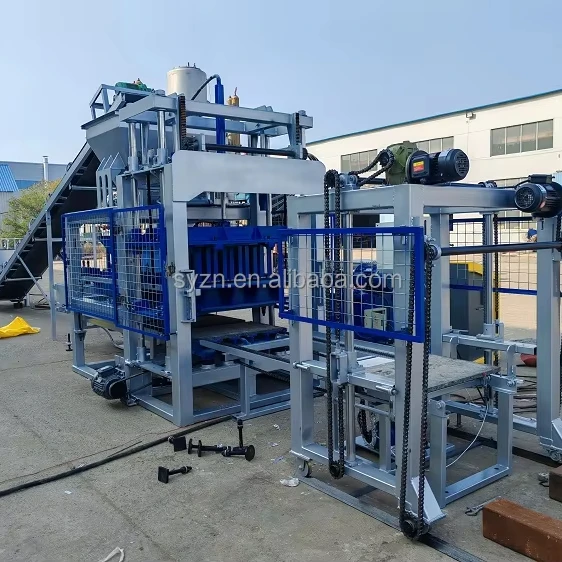
Line Balance — Every station in the QT4-15 block production line is timed against the 15–25 second press cycle so no upstream mixer or downstream stacker becomes the bottleneck.
Technical Specifications
| Parameter | Value |
|---|---|
| Model | QT4-15 |
| Product Type | Fully Automatic Concrete Block Making Machine |
| Overall Dimensions (L×W×H) | 3900×1600×2300 mm |
| Molding Cycle | 15–25 s |
| Vibration Force (Exciting Power) | 40–50 kN |
| Total Power | 24 kW |
| Mixer Model | JQ350 |
| Pallet Size | 850×550×25 mm |
| Total Weight | 3 T |
| Applied Products | Paver, solid block, hollow block, curbstone |
| Raw Materials | Crushed stone, sand, cement, dust, fly ash |
| Control System | PLC (brand and language options to be confirmed) |
| Automation Level | Full automatic (verify actual automation level with manufacturer) |
| Output: Hollow Block 400×200×200 mm | 1200–1680 pcs/h (basis to be confirmed) |
| Output: Hollow Block 400×150×200 mm | 1800–2400 pcs/h (basis to be confirmed) |
| Output: Solid Brick 240×115×53 mm | 3240 pcs/h (basis to be confirmed) |
| Standards | CE declaration referenced in company profile, per-model confirmation required |
Application Suitability
| Application | Material or Output |
|---|---|
| Hollow block production plants | Crushed stone, sand, and cement mixed for 400×200×200 mm and 400×150×200 mm cavity formats |
| Solid brick manufacturing | Fine aggregate and cement blends pressed into 240×115×53 mm dense units |
| Paver and interlock production | Pigmented face-mix and base-mix aggregates for pedestrian and driveway paving blocks |
| Curbstone and kerbstone forming | Coarse aggregate and high-cement mixes shaped into roadside and drainage channel profiles |
| On-site housing project production | Locally sourced sand, fly ash, and cement formed into structural walling blocks near the build zone |
Why the Pallet Question Must Be Settled Before You Sign
A block production line quotation that omits pallet specification leaves your freshly pressed blocks stacked by hand before the shift ends.
I have watched crews in Latin America unload wet blocks onto mismatched timber because the pallet dimensions were never checked against the curing racks already on site. The press keeps cycling, but the output end collapses into manual labor [NEED_CITE: manual pallet handling impact on block line throughput]. When the block production line is specified as a collection of separate parts rather than a matched system, the press sits idle while workers scramble for space. The pallet size, material, and quantity must be confirmed against your curing area layout and the forklift you already operate, not chosen from a catalogue default.
How Each Station Feeds the Next
The JQ350 mixer prepares each batch and discharges it onto the conveyor belt that feeds the QT4-15 host press. The mixer discharge rate, conveyor speed, and press cycle of 15–25 seconds are balanced during line configuration so that the hopper never runs dry mid-cycle. A block production line only delivers its rated output when every upstream station finishes its task before the press completes its current mold closure.
What Happens After the Press Opens
Formed blocks on their pallets travel from the press table to the automatic stacker, which lifts and indexes them into layers ready for the curing trolley. The stacker speed must match the press cycle — if it lags, the press waits and your hourly count drops [NEED_CITE: stacker cycle synchronization in automatic block lines]. From the stacker, trolleys carry the racks into the curing area. This is why pallet quantity matters: with 300 to 500 pallets in rotation, blocks can cure undisturbed while empty pallets return to the press for the next cycle.
Reading the Numbers That Matter
The vibration force of 40–50 kN works together with hydraulic pressure to compact the raw material inside the mold cavity. Higher vibration amplitude densifies the mix more thoroughly, which directly influences the compressive strength of the finished hollow block or paver. The total power draw of 24 kW across the press, mixer, and conveyors determines the transformer and dedicated circuit you need on site before the line arrives. Pallet dimensions of 850×550×25 mm define the mold area footprint — any curing rack, forklift tine spacing, and storage yard must accommodate this size. The molding cycle range of 15–25 seconds reflects variation across block formats: a thin solid brick releases faster than a deep-cavity hollow block, and the cycle time you budget for daily output must match the specific format your market demands.
What Unmatched Stations Cost You on Day One
When the mixer output exceeds what the press can consume, material sits in the hopper losing workability. When the stacker runs slower than the press cycle, operators pull pallets off the line by hand and stack them on the floor — the exact scenario the automatic stacker was meant to eliminate [NEED_CITE: block plant downtime from unbalanced line speeds]. I have seen plants where the curing trolley track was too narrow for the pallet width, forcing a complete re-lay of steel rail after installation. These are not engineering failures; they are specification failures that surface only when the line is already bolted to the floor.
Why Buyers Source the Full Line Here
Block machinery is the single focus of the manufacturer behind the QT4-15, which means the press, mold, pallet, and handling equipment are specified as one matched system rather than assembled from separate suppliers. The line configuration is set against your actual mix design, local aggregate gradation, and target block format — not a catalogue default. Molds are designed and supplied for the specific formats your market sells, including custom drawings when standard cavity profiles do not apply. The automation level is selectable, so a buyer can start with semi-automatic pallet handling and add automatic stacking later without replacing the host machine. Installation and commissioning support includes operator training on the specific PLC interface and hydraulic controls of the line delivered to your site.
Documentation & Verification
- Line layout drawing showing every station position and pallet flow path for the QT4-15 configuration
- Capacity calculation sheet stating the exact block format assumed for each hourly and daily output figure
- Pallet specification document confirming 850×550×25 mm dimensions, material grade, and recommended rotation quantity
- Voltage and PLC display language confirmation record signed before production begins
- Factory test record capturing actual cycle times run on the buyer’s specified block format before dispatch
- Hydraulic and electrical schematic package for on-site maintenance team reference
Installation, Commissioning & Support
- Foundation plan sized for the 3900×1600 mm press footprint and 3-tonne operating weight
- Electrical supply confirmed for 24 kW total line draw with dedicated circuit breaker and earth bonding
- Machine arrives dismantled for container loading; on-site reassembly covers press frame, hopper, and stacker alignment
- First-run commissioning includes cycle time verification on the buyer’s actual block format and raw material
- Operator training covers PLC menu navigation, mold changeover sequence, and hydraulic pressure adjustment
- Wear parts list and mold inventory provided at delivery so first replacements are on hand before production starts
Before You Request a Quote
To size the QT4-15 line correctly, share the block format your market buys most — dimensions, wall thickness, and target daily volume. Confirm your local aggregate type and whether fly ash or stone dust is available, because the mix design shapes the vibration and pressure settings. Specify the voltage, frequency, and PLC display language at your site so the control panel is built to match before the line leaves the factory.
Frequently Asked Questions
Q: How is daily output calculated, and which block format does each number assume?
A: Every capacity figure is tied to a specific block dimension and a molding cycle within the 15–25 second range. For example, the hollow block output assumes a 400×200×200 mm format at four pieces per mold. Daily output multiplies the hourly rate by an eight-hour shift, minus pallet return time and mold changeover pauses. Always ask which format underpins the quoted number.
Q: Which stations come standard, and which are optional in the line quotation?
A: The host press, JQ350 mixer, conveyor, and automatic stacker form the standard block production line. Pallets are quoted separately because the rotation quantity depends on your curing area size. If you already own a mixer or stacker, the line can be configured around your existing equipment to avoid duplication.
Q: How do the mixer, conveyor, and stacker cycle times stay aligned with the press?
A: During line configuration, each station’s throughput is calculated against the QT4-15 press cycle of 15–25 seconds. The mixer batch size and discharge interval, conveyor belt speed, and stacker indexing rate are all tuned so the press hopper never starves and the stacker never queues pallets [NEED_CITE: line balancing methodology for block production].
Q: What pallet materials are available, and how does the choice affect the curing area?
A: Fiberglass pallets offer longer service life and consistent flatness, while timber pallets cost less upfront but require more frequent replacement. The 850×550 mm pallet size dictates curing rack spacing and forklift tine width. Your curing area layout should be drawn around the chosen pallet dimension before racks are fabricated.
Q: Can the automation level be increased after initial installation?
A: The QT4-15 platform allows a buyer to begin with semi-automatic pallet handling and add an automatic stacker and trolley system later. The PLC control architecture supports additional I/O modules, so upgrading the output end does not require replacing the host press or its hydraulic system.